



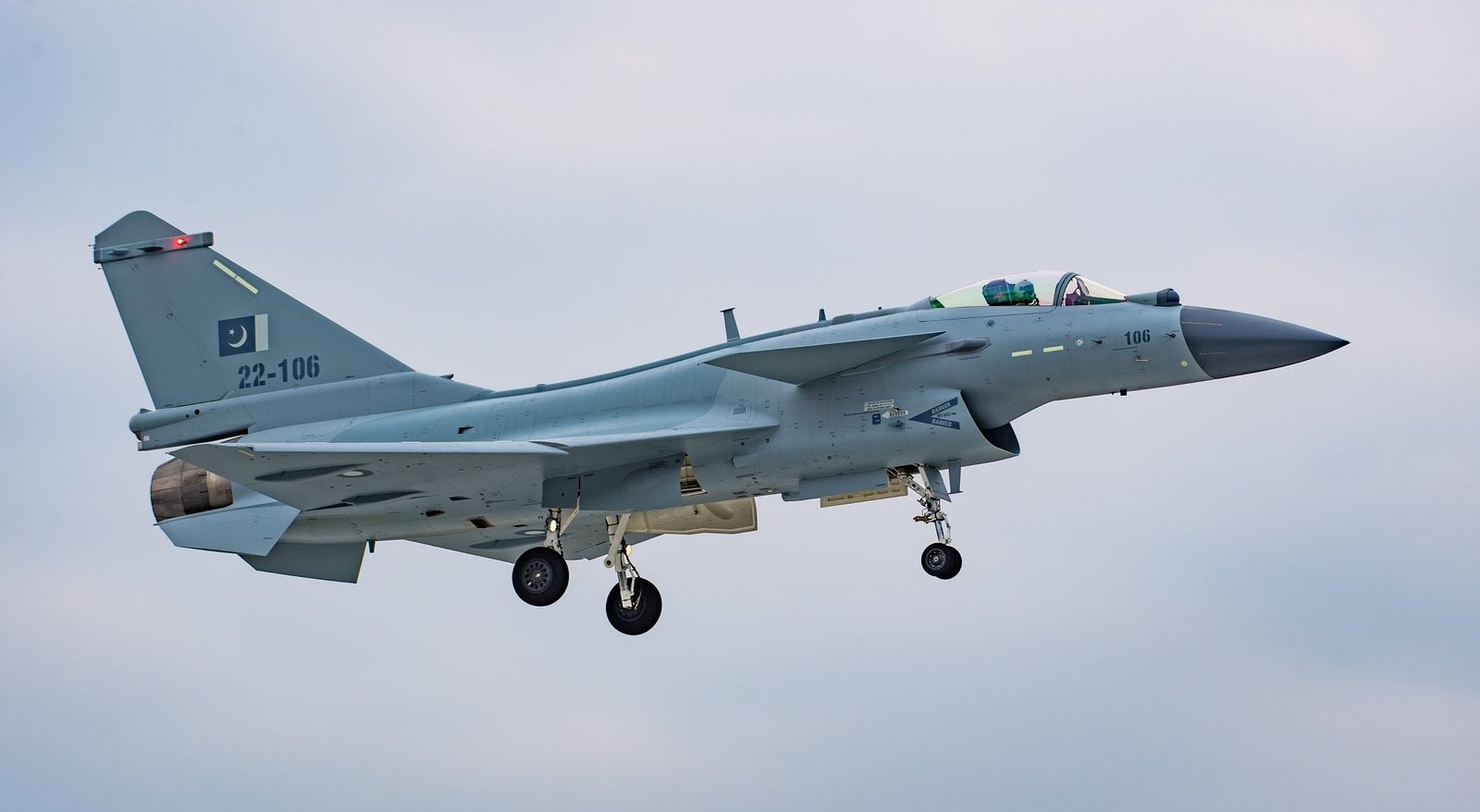
- Indonesia signs historic $5 billion deal to buy China’s J-10C fighter jets, marking a major shift in Asian defense alliances.
- Pakistan’s stunning May victory, where its pilots downed six Indian jets using J-10Cs, turned global attention toward the Chinese aircraft.
- Jakarta abandoned plans to buy U.S. F-16s and France’s Rafales after witnessing the J-10C’s superior dogfight performance and cost-efficiency.
- China’s aviation industry surges, with J-10C’s manufacturer shares soaring and new orders reportedly coming from Egypt, Sudan, and Bangladesh.
Pakistan Air Forces dominace over India Air Force compelled Indonesia to bet on China’s Wings. In a historic defense breakthrough, Indonesia has finalized a massive $5 billion deal with Beijing to procure J-10C multirole fighter jets, marking China’s largest-ever arms export and a defining moment in Asian airpower politics. The deal, confirmed by senior Indonesian defense officials, includes 48 J-10C fighters, along with comprehensive training, missile packages, and maintenance infrastructure.
For years, Jakarta had balanced its options between France’s Rafale, America’s F-16V, and Russia’s Su-35, weighing cost, capability, and political strings. But in the end, it was neither Paris nor Washington that won Indonesia’s trust—it was Beijing, backed by the stunning performance of the Pakistan Air Force (PAF) earlier this year.
That single event changed everything.
The Turning Point: Pakistan’s Air Triumph
The world had doubted Chinese combat aircraft. Critics called them “cheap imitations.” But that narrative collapsed in May, when the Pakistan Air Force unleashed its Chinese-built J-10Cs during a tense border standoff with India.
In what aviation analysts now describe as one of the most decisive dogfights of the decade, Pakistan’s elite pilots flying the J-10C shot down six top-of-the-line Indian Air Force jets, including two Rafales, three Su-30MKIs, and a Mirage 2000—all within a span of minutes.
The victory was surgical, precise, and electrifying.
As the Indian formation crossed into Pakistani airspace over the Line of Control, radar screens in Rawalpindi lit up. The PAF’s new J-10Cs, equipped with AESA radars and long-range PL-15 air-to-air missiles, locked onto targets far before the Indian pilots could even detect them.
“Target locked… Fox Three!” crackled a calm Pakistani voice over the radio. Seconds later, an Indian Rafale disappeared from the radar—followed by another, then a Sukhoi.
When the smoke cleared, six Indian fighters were gone, and Pakistan’s airspace remained untouched.
READ MORE: Pakistan Air Force shot down six Indian fighter jets, says PM Sharif
It was the first-ever real combat test between China’s J-10C and Western and Russian aircraft—and the results sent shockwaves across the defense world. The jet once dismissed as “unproven” had just outgunned and outrun the Rafale, the pride of France’s aviation industry.
A Legend Born in Pakistani Hands
For the Pakistan Air Force, the battle wasn’t just about technology—it was about precision, discipline, and pride.
ALSO READ: Ceasefire in Doha: How Pakistan’s Stunning Response Forced Kabul to the Table
Trained relentlessly on Chinese systems, Pakistani pilots had mastered the art of digital warfare, using the J-10C’s superior radar and electronic countermeasures to blind and outmaneuver Indian aircraft. With high-altitude agility, advanced data links, and unmatched missile range, the Chinese jet proved lethal in Pakistani hands.
International observers were stunned. Western analysts grudgingly admitted that “the J-10C’s performance has changed the global perception of Chinese combat aviation.”
For Chengdu Aircraft Corporation, the jet’s manufacturer, it was a marketing miracle. The company’s stock surged overnight, and inquiries began pouring in from across Asia, Africa, and the Middle East. The jet that won the skies over Kashmir had become the most talked-about fighter aircraft in the world.
Indonesia Takes Notice
Thousands of miles away, Indonesia’s defense circles were watching closely.
Jakarta had long sought a new-generation fighter fleet to modernize its air force. It had initially eyed Russia’s Su-35, even signing a contract in 2018, but Washington’s threat of CAATSA sanctions forced a pause. The U.S. then pitched the F-15EX, a powerful but astronomically expensive option—nearly $580 million per aircraft. France offered the Rafale, but at a steep cost and limited weapons export clearance.
Then came Pakistan’s dogfight victory.
For Indonesia, it was proof—real, tangible proof—that Chinese fighters were not only reliable but superior in real-world combat. The J-10C offered cutting-edge avionics, stealth design, and PL-15 missiles at a fraction of Western prices—and without political restrictions on deployment or upgrades.
Jakarta’s decision was swift and strategic. By October 16, Indonesia had formally confirmed its purchase of 48 J-10C fighters, with the first batch expected to arrive in 2026.
“The performance of the J-10C in recent combat operations demonstrated its reliability and power,” said a senior Indonesian defense official. “We are confident this aircraft will secure our skies for decades.”
A New Dawn for Asian Airpower
For China, the Indonesia deal is more than a commercial success—it’s a geopolitical statement. The J-10C’s rise reflects Beijing’s evolution from a defense imitator to an innovator, capable of challenging Western hegemony in high-end aerospace technology.
For Pakistan, it is validation of its operational excellence. By proving the J-10C in battle, the PAF not only secured its own deterrence but opened doors for China in global markets.
And for Indonesia, the deal represents independence—freedom from the political dictates of Western suppliers and a chance to modernize rapidly at scale.
As global defense experts note, the J-10C’s export success may well mark the start of a new Asian century in airpower—one where the roar over the skies is no longer American or European, but unmistakably Chinese.
The Sky Belongs to the Brave
That day in May, when Pakistan’s pilots soared through the clouds, they did more than defend their borders—they rewrote the rules of global aviation. Their courage and precision turned a Chinese jet into a global icon, and their victory has now reshaped defense strategies from Islamabad to Jakarta.
From the mountains of Kashmir to the islands of Indonesia, the legend of the J-10C is not just flying—it’s soaring.
The dragon’s wings, once doubted, now cast a shadow across the world’s skies.