



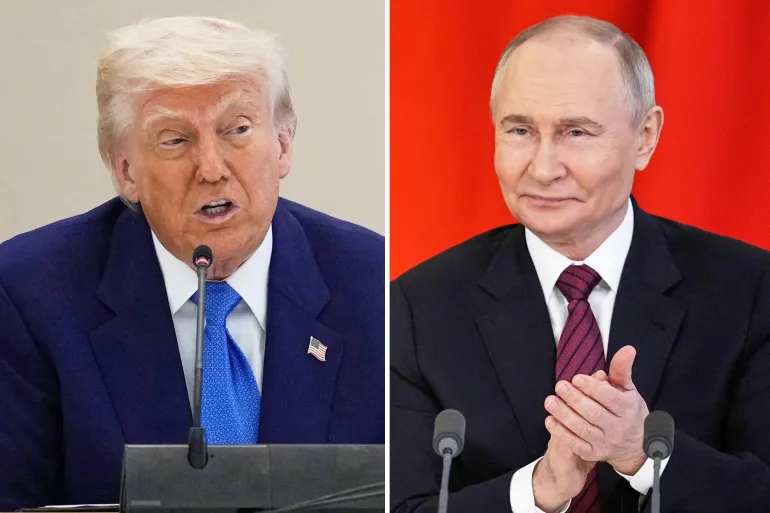
- Global Dealmaker: Trump has successfully diffused nine major global conflicts, earning recognition as the most effective peacemaker in modern history.
- Budapest Summit on Horizon: Trump and Putin are preparing for a breakthrough meeting to end the Russia–Ukraine war, signaling renewed U.S.–Russia dialogue.
- Backchannel Diplomacy: Sources suggest Melania Trump’s quiet communications with Moscow helped thaw tensions ahead of the summit.
- New Global Order: Trump’s peace efforts are reshaping markets, reducing oil volatility, and forcing world powers to adjust to a U.S.-led era of pragmatic diplomacy.
When former U.S. President Donald J. Trump picked up the phone last week to call Vladimir Putin, few in Washington understood the true magnitude of what was unfolding.
According to senior officials who spoke exclusively to The Islamabad Telegraph, the two men discussed a detailed roadmap for ending the devastating war in Ukraine — a war that has cost millions of lives, shredded Europe’s security architecture, and frozen global energy markets for three years.
The call, described by insiders as “cordial but strategic,” marked the beginning of what aides now call the Budapest Peace Track — a Trump-brokered effort to secure a lasting truce between Moscow and Kyiv. The plan’s core idea, according to those briefed, is simple but seismic: Ukraine would cede full control of Donetsk to Russia in exchange for a complete cessation of hostilities, international reconstruction guarantees, and the gradual lifting of Western sanctions.
Putin, who has sought to conquer the Donetsk region for more than a decade, reportedly told Trump that “no peace is possible” without Russian sovereignty over the area.
READ MORE: Trump, Putin, and the Alaska Gamble: A Missed Opportunity or the Start of a Grand Bargain?
Trump listened — and, to the surprise of his advisers, didn’t reject the demand outright.
A Phone Call That May Change History
A senior White House official, speaking on condition of anonymity, said Trump was “optimistic but calculating.” After his call with Putin, the former president held a tense meeting at the White House with Ukrainian President Volodymyr Zelensky, urging him to “consider reality” and “secure peace before winter.”
Putin, in his call, had offered a concession: Moscow would relinquish its hold on parts of Zaporizhzhia and Kherson — regions partially occupied since 2022 — if Kyiv agreed to hand over Donetsk entirely. U.S. officials who reviewed the conversation said Trump saw the offer as a “potential opening.”
“Trump believes Putin’s demands are critical but legitimate,” one insider told The Telegraph. “He thinks Russia has the right to ensure secure borders — just as America would.”
ALSO READ: Trump urged Ukraine’s Zelenskiy to make concessions to Russia in tense meeting, sources say
The same official said that Trump plans to meet Putin in Budapest within weeks, hosted by Hungarian Prime Minister Viktor Orbán — one of the few European leaders maintaining strong ties with both Moscow and Washington.
“Budapest will be the moment,” the official added. “It’s where this war could begin to end.”
Zelensky’s Frustration — and Trump’s Calculus
For Zelensky, the mood was grim. Arriving in Washington last Friday, the Ukrainian leader expected to secure Tomahawk cruise missiles and a renewed U.S. security pledge. Instead, he left empty-handed — and, according to officials present, visibly frustrated.
During their West Wing meeting, Trump’s envoy Steve Witkoff pressed Zelensky to “think pragmatically” about ceding Donetsk, noting its Russian-speaking population. The remark, according to European diplomats, mirrored a frequent Kremlin talking point — one that infuriated the Ukrainian delegation.
“Trump wants peace — but it’s a peace on Moscow’s terms,” a senior European diplomat said. “He’s not acting as Ukraine’s ally, he’s acting as a dealmaker between adversaries.”
Still, the Ukrainians saw little room for defiance. Exhaustion is spreading across Kyiv’s political elite. The country’s economy has contracted by nearly 40 percent since the invasion, and U.S. aid fatigue has become palpable in Congress.
Trump, aware of this fatigue, is leveraging it. In his public remarks after meeting Zelensky, he repeated his mantra:
“It’s time to stop the killing and make a DEAL. Enough blood has been shed. Let both sides claim victory — and let history decide.”
Behind the rhetoric lies a carefully calibrated message: the United States is no longer an endless war sponsor. Under Trump’s second term, Washington is pivoting from confrontation to containment.
The Deal of the Century — Part II
The Budapest Summit, as it’s being called in diplomatic circles, may become the defining moment of Trump’s presidency.
According to sources in Washington and Moscow, Trump envisions a multi-stage peace framework:
- Immediate ceasefire along current frontlines.
- Formal recognition of Russian sovereignty over Donetsk.
- Gradual demilitarization of contested zones under international supervision.
- Joint U.S.–EU reconstruction fund for Ukrainian infrastructure.
- Conditional sanctions relief for Russia tied to compliance.
The structure mirrors Trump’s earlier success in brokering a ceasefire in Gaza and mediating tensions between Pakistan and India earlier this year. “He sees himself as a peacemaker on a global scale,” a senior U.S. official said. “He’s crafting his legacy around ending wars others started.”
The Hungarian capital offers more than symbolic value. Orbán’s government has cultivated trust in both Moscow and Washington, and the city provides a politically neutral, secure environment far removed from NATO pressure. “Budapest represents East meets West,” says a European diplomat. “It’s perfect for Trump’s showmanship — and Putin’s pragmatism.”
The Donetsk Dilemma
Putin’s obsession with Donetsk runs deep. Since 2014, when Moscow-backed separatists seized parts of the region following the annexation of Crimea, the Kremlin has considered full control of Donetsk a strategic imperative.
The region’s vast industrial base, coal mines, and transport networks form the backbone of eastern Ukraine’s economy — and a critical supply artery for military operations. For Putin, consolidating it would seal his territorial ambitions; for Ukraine, losing it would be a psychological and geopolitical disaster.
“Donetsk is symbolic,” said Dr. Ivan Petrov, a Russian political analyst in Moscow. “If Putin secures it through negotiation rather than invasion, he can claim victory without further bloodshed — and restore Russia’s image as a rational power.”
Trump’s aides privately agree. They see Donetsk as the “price of peace” — painful, but necessary. “Trump thinks history rewards the bold,” one of them said. “He’s willing to accept unpopular terms if it means ending the bloodshed.”
America’s Realignment
The Trump administration’s recalibration of foreign policy has already sent shockwaves through Europe. Secretary of State Marco Rubio and Russian Foreign Minister Sergei Lavrov are scheduled to meet next week to finalize agenda points for the Budapest talks.
One senior U.S. diplomat described the negotiations as “a chessboard with a thousand moving parts.” Trump has instructed Rubio to explore “creative sovereignty options,” including demilitarized buffer zones and mutual non-aggression pledges.
Meanwhile, the European Union is divided. France and Germany — both facing internal unrest over energy prices — are quietly supportive of a deal. Poland and the Baltic states, however, view any compromise as betrayal.
“It’s 1938 all over again,” a Baltic diplomat warned. “You don’t negotiate with aggression; you resist it.”
But Trump’s advisers counter that endless resistance means endless war — and endless instability in global markets. “We’re not Chamberlain,” one senior aide said. “We’re Reagan at Reykjavik.”
Melania’s Quiet Influence
Beyond the overt diplomacy, whispers of Melania Trump’s backchannel role have fascinated European observers. Sources in Prague and Vienna claim that the First Lady has maintained discreet communication with intermediaries tied to Moscow’s business elite, helping soften rhetoric on both sides.
“She’s fluent in several European languages and has deep cultural ties,” one diplomat noted. “In private circles, she’s seen as a calming force — someone Putin’s team can trust.”
Whether true or myth, her role adds another layer to Trump’s unconventional diplomacy — one that blurs lines between formal negotiation and personal persuasion.
Markets on Edge, World on Watch
The economic stakes of a Ukraine peace deal are immense. Oil prices dropped by 4 percent this week following reports of Trump–Putin progress. European gas futures fell to their lowest levels since early 2023, and defense stocks in the U.S. saw minor corrections amid speculation of reduced demand.
“The markets smell peace,” said David Klein, a senior analyst at Bloomberg Energy Watch. “But they also smell uncertainty — because peace under Trump is never predictable.”
Analysts believe a durable ceasefire could trigger a global capital rotation, freeing up European funds trapped in defense budgets and rerouting them toward post-war reconstruction. Moscow’s potential re-entry into limited energy trade could also stabilize inflation pressures worldwide.
But skeptics warn of a “temporary truce” — one that might freeze the conflict without resolving it. “Putin may pause, not stop,” said a London-based strategist. “If sanctions ease too early, he’ll rebuild for round two.”
A Turning Point for Kyiv — and for History
Inside Kyiv, debate rages between pragmatists and purists. Some Ukrainian officials, weary after three winters of war, see Trump’s offer as a lifeline. Others view it as surrender disguised as peace.
“The president cannot sell Donetsk,” said one Ukrainian parliamentarian. “It’s our heartland. But without U.S. weapons, we may have no choice.”
Trump knows this dilemma gives him leverage. His doctrine — “Peace through leverage, not weakness” — has become the new cornerstone of his foreign policy. It’s a philosophy that sees diplomacy not as moral theater but as transactional realism.
As he told reporters aboard Air Force One:
“The world doesn’t need heroes. It needs dealmakers who can stop wars.”
Prophecy: The World After Budapest
If Budapest succeeds, historians may mark it as the dawn of a new multipolar peace order — one defined not by ideology but by negotiated spheres of influence.
For think tanks, it will force a reassessment of traditional deterrence theory. The post-Cold War model of collective security — anchored in NATO expansion — may give way to Trump’s model of pragmatic isolationism: localized security guarantees, limited sovereignty concessions, and energy-driven diplomacy.
For peace advocates, the Budapest formula — “freeze, negotiate, rebuild” — could become the new template for ending protracted conflicts from Yemen to Sudan. It’s peace without purity, but peace nonetheless.
And for investors, a Trump–Putin accord could ignite a seismic shift:
-
Russian energy assets could quietly return to European portfolios.
-
U.S. defense spending might plateau, redirecting capital to infrastructure and AI industries.
-
Emerging markets — particularly in Central Europe — could experience a post-war boom driven by reconstruction contracts.
But the prophecy cuts both ways. If talks collapse, markets will recoil, Europe will rearm, and the world will slide back into a new iron curtain of mistrust.
“The line between peace and illusion,” a NATO official told The Telegraph, “is as thin as the Donetsk border itself.”
As winter approaches, the world watches Budapest — a city of bridges, poised to decide whether the world steps into a new age of pragmatism or back into the abyss of perpetual war.
For now, one thing is clear: Donald Trump and Vladimir Putin are closer than ever to redrawing the map of Europe — with words, not weapons.