



- Ukraine War: Trump sends high-level Pentagon officials to Ukraine to revive stalled peace talks with Russia.
- Ukraine strikes Russian territory with U.S.-supplied ATACMS, raising fears of dangerous escalation.
- Moscow signals conditional openness to negotiations amid intensifying drone and missile exchanges.
- The world faces a critical question: can it afford another major war if diplomacy fails now?
When Ukraine confirmed for the first time that it had fired U.S.-supplied long-range ATACMS missiles deep into Russian territory this week, the world braced for the familiar chill that precedes catastrophe. For months, Washington had vetoed such actions, fearing they would cross a red line and provoke a dangerous escalation.
But this time was different. The missiles streaked toward their targets at the exact moment President Donald Trump dispatched one of the most powerful Pentagon delegations yet to Kyiv—a paradoxical move that reveals both the urgency of the moment and the fragility of global peace.
Ukraine France Rafale Deal Shows a War Now Set to Define Europe’s Next Decade
Trump, despite his often unconventional approach to foreign policy, has returned once again to a role he knows well: the reluctant peacemaker, the dealmaker hovering at the edge of chaos, insisting he can pull the world back from the brink. With war in Ukraine grinding through its fourth year—and with Russia intensifying attacks on Ukraine’s infrastructure—Trump appears convinced that if he does not push for negotiations now, the next phase of the conflict could be devastating, unpredictable, and impossible to control.
The White House’s decision to lift restrictions on Ukraine’s use of certain long-range missiles is an admission of strategic frustration. For nearly a year, American officials discouraged Kyiv from hitting Russian soil with Western weapons, fearing exactly what happened this week—retaliation, escalation, or a diplomatic collapse. Yet Trump’s policymakers now find themselves walking an impossibly thin line: applying military pressure on Moscow while simultaneously sending envoys to both Kyiv and, eventually, Russia to restart peace talks.
READ MORE: Trump Sends Pentagon Officials to Ukraine in Effort to Restart Peace Talks
The delegation is led by Army Secretary Dan Driscoll, flanked by Gen. Chris Donahue—the top U.S. Army commander in Europe—and Gen. Randy George, the Army chief of staff. It is one of the most military-heavy diplomatic missions Washington has launched since the war began. The reasoning is both simple and unconventional: Trump believes Moscow may trust military negotiators more than civilian diplomats. Whether this proves to be a stroke of strategic brilliance or reckless improvisation will only be known in hindsight.
Yet the timing could not be more precarious.
Ukraine’s ATACMS strikes on Russia came just hours before Driscoll arrived in the region. Moscow claims four missiles were shot down over Voronezh; Ukraine insists it hit legitimate military targets. Falling debris damaged a clinic and an orphanage. No casualties were reported—but the message was unmistakable. Kyiv wanted to demonstrate resolve, capability, and the willingness to strike if cornered.
ALSO READ: Trump Halts Tomahawk Deliveries to Ukraine in Shock Decision That Stuns Europe and Delights Moscow
Russia, too, delivered its own message. As the U.S. delegation traveled through Germany and Poland on its way to Kyiv, Moscow unleashed a fresh wave of missile and drone attacks, killing at least 10 civilians in western Ukraine. Both sides are escalating in parallel—sometimes deliberately, sometimes reflexively. And both insist they are responding to the other.
This is precisely the type of spiraling tension that Trump now wants to interrupt.
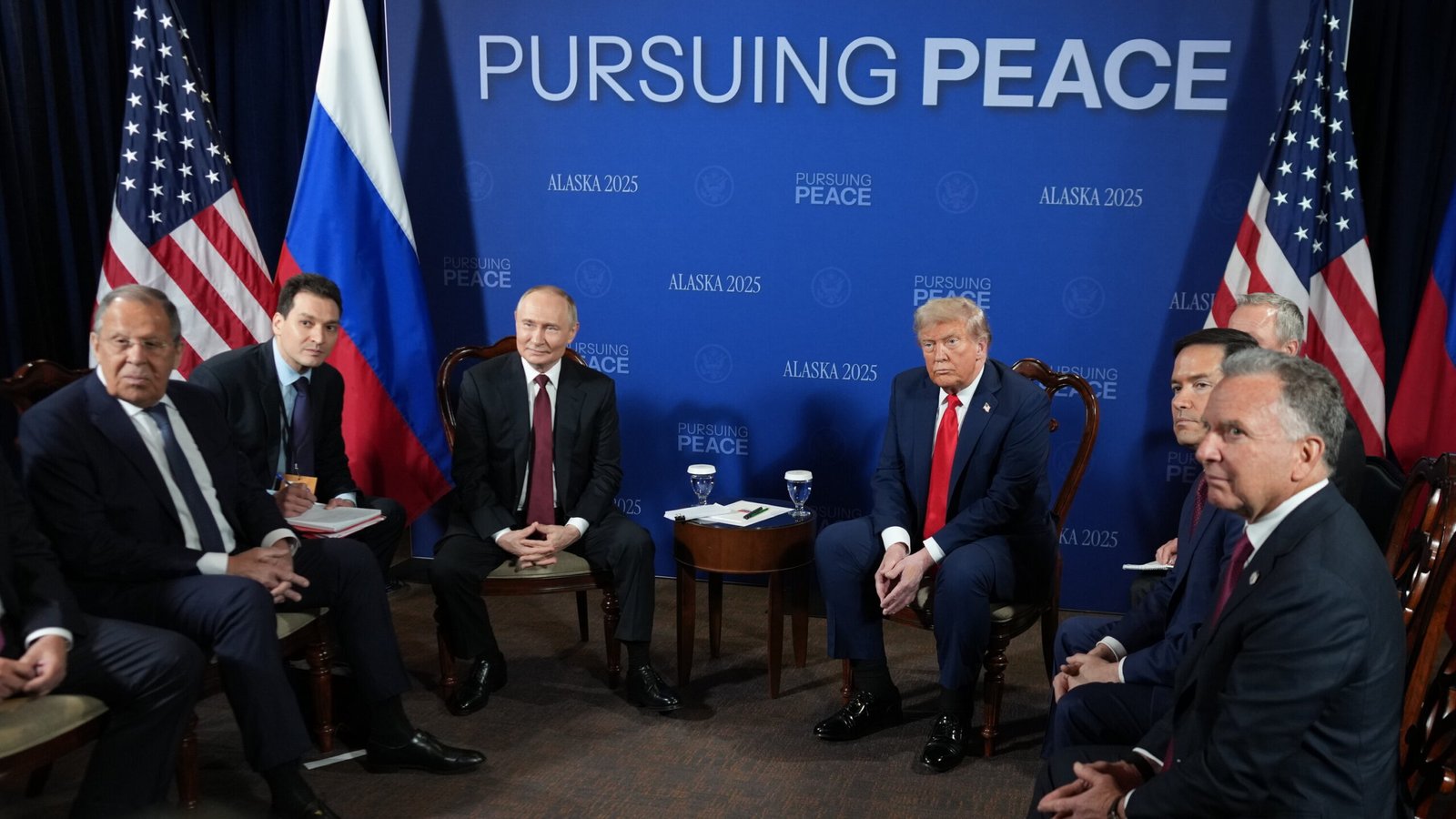
Inside the Oval Office, Trump has expressed frustration that his earlier attempts to negotiate with Vladimir Putin yielded little. The Alaska summit ended in a polite stalemate; a planned follow-up meeting in Budapest collapsed when Moscow refused to soften its positions. Since then, Trump has tried sanctions, diplomatic pressure, and back-channel envoys—yet the war continues.
Now he is trying something different: a military-brokered push for peace.
It is worth noting that Driscoll is not a conventional diplomat. His background—revamping the Army’s acquisitions system, overseeing drone expansion programs, managing National Guard deployments—makes him an unusual choice for delicate peace talks. But Trump has always gravitated toward unconventional emissaries, from real-estate developers to billionaires. In Driscoll, he sees someone who understands power, logistics, intelligence, and battlefield realities—not merely protocol.
Trump’s calculation is simple: if battlefield commanders can freeze frontlines, diplomats can freeze politics.
But the larger question is one haunting every capital across Europe, Asia, and the Middle East:
Ukrain War: Can the world afford another war?
Europe is already buckling under defense spending hikes, inflation pressures, and energy disruptions. The Middle East is consumed by its own crises. Asia is balancing on a knife-edge with tensions around Taiwan and the South China Sea. Africa is witnessing a cascade of coups and proxy conflicts.
Another major escalation in Ukraine—especially one involving long-range strikes deep into Russia—could shake global markets, energy flows, supply chains, and political alliances. The world has not forgotten what a single miscalculation can ignite.
And that is the essence of Trump’s renewed push for diplomacy. It is not idealism. It is not softness. It is strategic realism.
Trump has long boasted that he “stopped eight wars.” His critics scoff, but the sentiment reveals his worldview: he sees peace not as sentimental virtue but as transactional necessity. Wars are expensive, destabilizing, politically dangerous—and most importantly, unpredictable.
The unpredictability is now the problem. Ukraine is accelerating long-range drone production, expanding its missile program, and experimenting with Western-backed technology. Russia is experimenting with hypersonic strikes, electronic warfare, and infrastructure sabotage. Both sides are innovating faster than diplomats can negotiate.
Without external intervention, escalation becomes the default.
That is why Trump sent Driscoll to Kyiv.
And why Driscoll will soon visit Moscow.
And why this particular window of diplomacy may be the last before the conflict transforms into something far more lethal and far less containable.
Europe, for its part, is watching anxiously. France, Poland, and the Baltic states quietly support Ukraine’s expanding strike capabilities. Germany remains cautious. Britain is oscillating. Meanwhile, Asian powers like China and India prefer a negotiated end, fearing that long-range Western weapons hitting Russia could trigger a destabilizing chain reaction.
The Kremlin, ever calculating, noted on Wednesday that Putin is open to meeting U.S. officials “after the latest round of diplomatic talks in Ankara.” That is diplomatic language for: We’re willing to talk, but only if the terms shift in our favor.
To some degree, Trump’s military-pressure-plus-diplomacy strategy is an attempt to shift Moscow’s calculus.
But it is a dangerous gambit.
If Kyiv continues using American intelligence to target Russian assets, Putin may interpret it as direct U.S. involvement. And if Moscow retaliates more forcefully, Kyiv may demand even more Western assistance. This cycle of dependency and retaliation is exactly what Trump wants to break.
The central question is whether he still can.
Driscoll’s mission is not to dictate surrender or redraw borders. It is to freeze the battlefield, open channels, and establish the foundations of a political settlement that—no matter how imperfect—halts the killing. The alternative is a catastrophic extension of the war, with longer-range missiles, more civilian casualties, more drones, and more unpredictable Russian retaliation.
And so the world waits—nervously, skeptically, hopefully—to see if Trump’s latest gamble can succeed where previous efforts failed.
For now, there is only one certainty:
Peace is still possible. But time is running out. And another war—bigger, darker, more ferocious—may be closer than anyone wishes to admit.
Trump has decided to give peace another chance. The world must hope he isn’t already too late.