


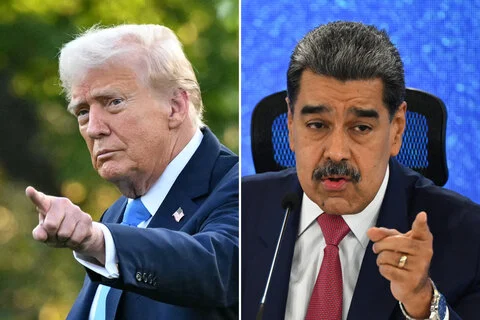
On Saturday, Trump jolted Washington, Caracas, and the entire region by declaring the airspace “above and surrounding Venezuela” to be “closed in its entirety.” The blunt announcement — issued not through the Pentagon or State Department, but through a Truth Social post — offered no operational details, no legal explanation, and no diplomatic context.
Trump Venezuela Patience: Why the U.S. President Is Holding Fire on Maduro
But it delivered what many analysts described as Trump’s most direct message yet: the Caribbean is entering a danger zone, and American patience with Nicolás Maduro’s government is reaching a breaking point.
“To all Airlines, Pilots, Drug Dealers, and Human Traffickers,” Trump wrote, “please consider THE AIRSPACE ABOVE AND SURROUNDING VENEZUELA TO BE CLOSED IN ITS ENTIRETY.”
READ MORE: Trump’s Caribbean Strategy: A Hemisphere on Edge as Latin America Braces for a New U.S. Order
The sentence landed like a bombshell. Aviation authorities scrambled for clarification. Diplomats attempted to verify whether the United States was enforcing a no-fly zone, preparing for naval interdictions, or signaling a new round of airstrikes. But U.S. officials contacted privately said they had “no knowledge” of any active operation, and the Pentagon declined all comment.
Still, intentions aside, the effect was unmistakable: Trump has taken the pressure campaign to a new height, locking the Caribbean Sea into a state of strategic tension that regional governments fear could ignite a conflict with catastrophic consequences.
Venezuela Condemns “Colonialist Threat”
Caracas reacted within hours. Maduro’s government called the declaration an “imperialist and colonialist threat” inconsistent with international law. Foreign Ministry officials described it as a unilateral attempt to intimidate a sovereign nation and warned the international community that Washington was crossing dangerous lines.
“It is a hostile, arbitrary act,” Venezuela said, framing the move as an assault on Latin American sovereignty itself.
ALSO READ: Explainer: How could Venezuela’s military respond to a US attack?
Yet beneath the condemnation lies a quieter truth: the Maduro government, battered by years of sanctions, internal dissent, and economic collapse, is already feeling the weight of months of intense U.S. pressure.
Venezuelan Airspace Closed: A Massive U.S. Military Footprint in the Caribbean
For nearly three months, the United States has conducted repeated strikes on vessels it labels “drug-trafficking boats” linked to Venezuelan gangs and state-aligned networks. The operations have killed dozens and triggered accusations of extrajudicial killings from human rights watchdogs.
Meanwhile, a massive U.S. military buildup surrounds Venezuela:
- Navy destroyers and Coast Guard cutters patrol the Caribbean basin.
- Surveillance aircraft sweep the skies.
- Special operations units have increased rotations in Puerto Rico.
- Intelligence assets monitor Venezuela’s coast and interior in unprecedented detail.
Trump has also reportedly authorized covert CIA operations focused on destabilizing narcotics networks the U.S. says are tied to Maduro’s government. Though publicly framed as anti-drug missions, officials privately acknowledge that regime-change options remain “on the table.”
This combination — public denials of war coupled with unmistakable signs of preparation — is precisely what alarms regional analysts. The Trump administration may not want a war, but its actions risk making one increasingly unavoidable.
Shock and Confusion Among Venezuelans
On the streets of Caracas, the announcement deepened anxiety. Many residents fear isolation during the holiday season, as airlines scramble to interpret the warning and Venezuela revokes the operating rights of major carriers.
“We’re essentially trapped,” said Carmen Castillo, a lawyer. “This affects work, travel, everything. It feels like we’re being suffocated.”
Others say the closure is punitive and unjust, punishing ordinary Venezuelans rather than elites. “We are not responsible for politics,” said Manuel Romero, a cooking assistant. “Why must the people pay the price?”
A Region on Edge
Latin American governments are watching the situation nervously. Many fear that Washington’s increasingly aggressive posture is creating a scenario where a single miscalculation — a misidentified aircraft, a naval encounter, a radar alert — could become the spark for a regional conflict.
Already, GPS disruptions have been reported across Venezuela. Surveillance has intensified in northeastern states. Security forces and ruling-party loyalists patrol coastlines where U.S. strikes have targeted suspected drug boats. People are frightened, officials are tense, and the margin for error is shrinking.
The Shadow of a New War
This is the reality: Trump does not want war — but he is creating conditions in which war becomes more likely by the day.
By declaring Venezuelan airspace effectively closed, Trump has sent a message not just to Maduro but to the entire region: the United States is prepared to escalate, and Venezuela stands one step away from the kind of confrontation that could engulf the Caribbean.
For a region already struggling with economic fragility, migration flows, and political instability, the prospect of another conflict — this time at the doorstep of South America — is a nightmare scenario.
Whether Trump intends it or not, the fuse has been lit. The question now is whether anyone can extinguish it before the Caribbean enters a war from which there may be no easy exit.