



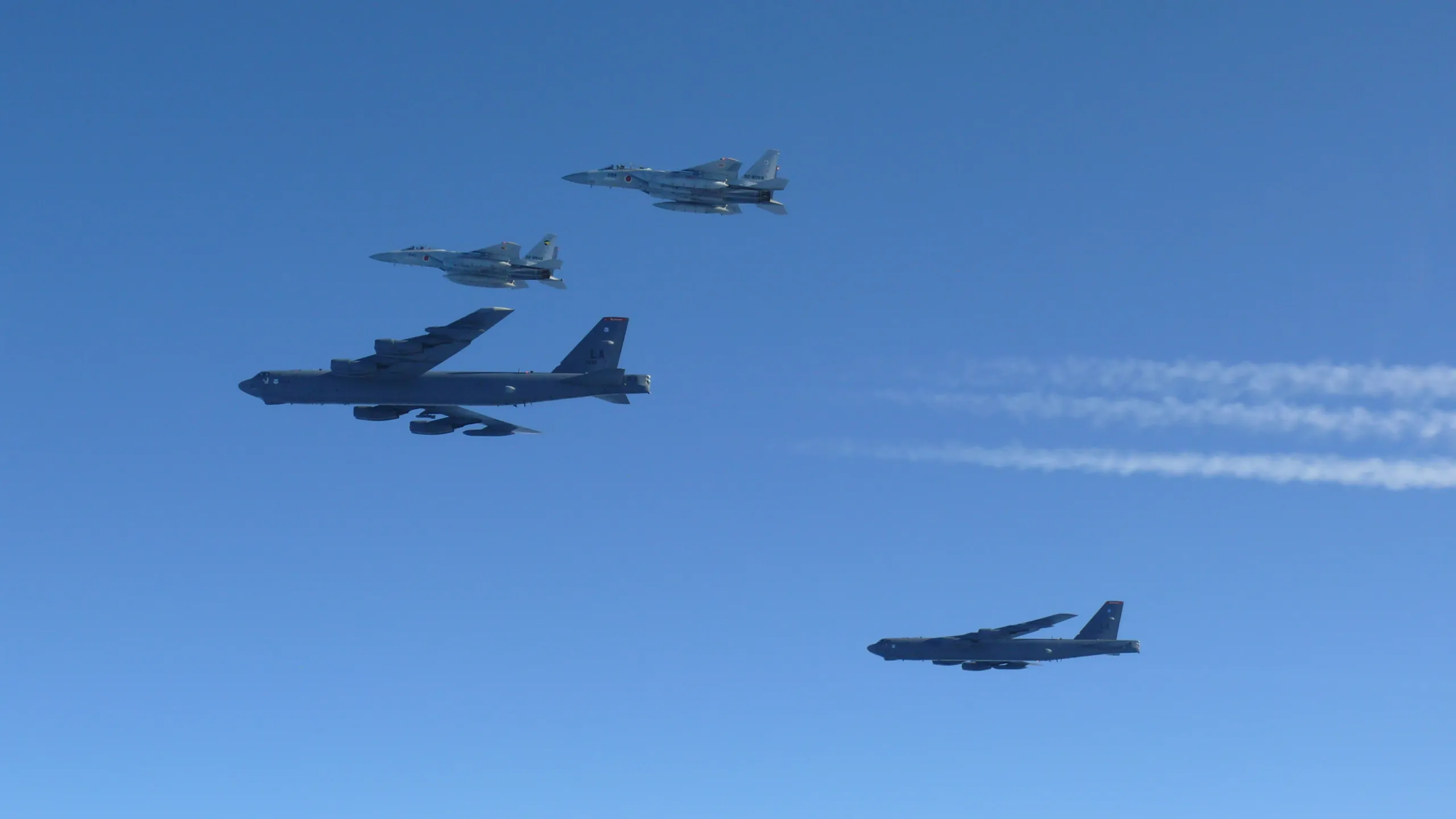
- US Bombers Japan Sea of Japan: U.S. B-52 bombers conducted a joint flight with Japanese F-35s and F-15s over the Sea of Japan amid rising China-Russia drills.
- China dismisses Japan’s alarm as exaggeration, while Taiwan reports intensified Chinese military patrols.
- Analysts warn that three nuclear powers flexing military muscle in one region increases the risk of accidental conflict.
- Growing Japan-China tensions, radar lock incidents, and rapid deployments create a volatile environment in East Asia.
U.S. nuclear-capable B-52 bombers flying alongside Japanese F-35 and F-15 fighters over the Sea of Japan on Wednesday marked one of the most striking military displays in the region this year. The coordinated flight — which Tokyo called a reaffirmation of U.S.–Japan resolve — came just 48 hours after Chinese and Russian bombers conducted a joint sweep across the East China Sea and western Pacific, triggering jet scrambles in both Japan and South Korea.
In a region already on edge, this sudden surge in air activity felt like a geopolitical 津波注意報 — a tsunami warning — signalling that East Asia’s strategic climate is shifting fast and dangerously.
China-Japan Tensions Heat Up: A Real-Life Wolves vs Man United Showdown in East Asia
Japan’s Ministry of Defense said the joint U.S.–Japan drill demonstrated readiness to deter any “unilateral attempt to change the status quo by force.” Washington downplayed the event as pre-planned, but the timing was deliberate. After a week of radar locks, aggressive maneuvers, and Chinese carrier drills, the visual of American bombers escorted by Japan’s most advanced fighters carried the unmistakable weight of deterrence.
Meanwhile, Taiwan reported its second consecutive day of stepped-up Chinese military activity — 27 aircraft, including nuclear-capable H-6K bombers, and several warships conducting “joint combat readiness patrols.” Beijing claims its operations are routine. Taipei calls them intimidation. Tokyo sees them as an escalation creeping closer to its sovereign space.
READ MORE: U.S. Strategic Bombers, Japanese Anti-Ship Fighters Take Flight Amid Japan-China Tensions
China’s response to regional alarm was dismissive. Foreign Ministry spokesperson Guo Jiakun accused Japan of “making a fuss about nothing,” insisting the Sino-Russian drills form part of an annual plan designed to “safeguard regional peace.” Yet Japan’s Chief of Staff, General Hiroaki Uchikura, labelled the flights a “grave concern,” revealing how sharply the threat perception differs across the Yellow Sea.
The billion-dollar question dominating strategic circles is now blunt: Is East Asia sliding toward the next global conflict? Could the Sea of Japan or the South China Sea become the next flashpoint?
Three nuclear-armed countries — the United States, China, and Russia — are flexing muscle on overlapping timelines. This level of simultaneous signalling is highly unusual and deeply destabilizing. Analysts argue there is no imminent threat of war, but the frequency, sophistication, and proximity of these operations mean that a single miscalculation — a radar lock, a collision, a warning shot — could spiral out of control.
ALSO READ: China’s Military Expansion: China’s Massive South China Sea Drill Sends Shockwaves Through Australia and the Quad
Japan’s political climate is sharpening the edges further. Prime Minister Sanae Takaichi’s recent warning that an attack on Taiwan could trigger Japanese military involvement infuriated Beijing. Former Chinese foreign minister Wang Yi fired back, chastising Japan — pointedly calling it a “defeated nation” — and declaring its new military posture “completely unacceptable.”
This rhetorical escalation mirrors the military one. The standoff now resembles a high-stakes strategy match — a total war warhammer 40k-style contest of scale and dominance, or even a Star Wars Fate of the Old Republic scenario, with rival powers manoeuvring for future control of the region. Each side is testing boundaries, gathering intelligence, and making sure the other knows: we are ready.
For global audiences, the tension carries the unpredictability of a Street Fighter movie 2026 battle — fast, theatrical, but with very real consequences. And unlike cinematic conflict, this theatre involves nuclear powers, crucial sea lanes, and economies that shape the planet.
The world already struggles with the Ukraine war and Middle East instability. The Pacific cannot afford another spark. Yet all signs point to a region where nerves are fraying, red lines are shrinking, and the margin for error is disappearing.
East Asia remains a loaded powder keg. One wrong move — intentional or accidental — could turn this tense standoff into the crisis the world fears most.