



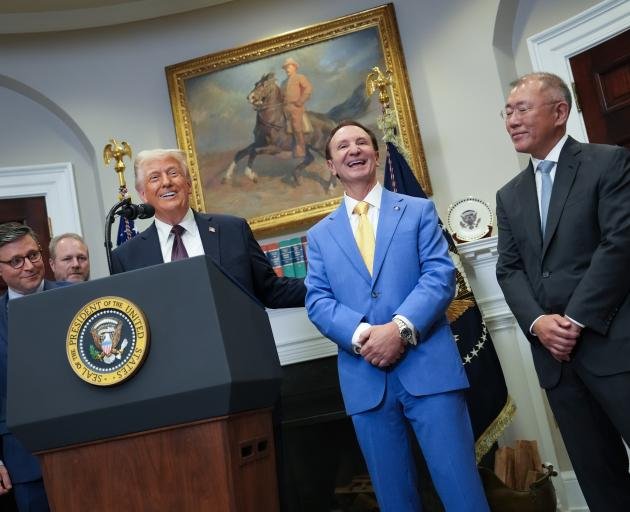
- Greenland National Security is cited by President Trump as the primary reason for appointing Governor Jeff Landry as a special envoy to the region.
- The appointment aims to counter the increasing presence of Russian and Chinese naval vessels in Arctic waters.
- A recent poll indicates that 68% of Greenlanders now favor independence, potentially facilitating a shift toward U.S. cooperation.
- International leaders, including Denmark’s Foreign Minister, have condemned the move as a threat to territorial sovereignty.
On December 22, 2025, President Donald Trump fundamentally shifted the geopolitical landscape of the Arctic. In a high-stakes announcement from Palm Beach, the President reiterated the United States’ “strategic necessity” to acquire or control Greenland, appointing Louisiana Governor Jeff Landry as a special envoy to lead the charge. This move has not merely reopened a diplomatic wound from his first term; it has ignited a firestorm that threatens to reshape NATO alliances and the very concept of territorial sovereignty in the 21st century.
Trump’s rationale is centered squarely on the shifting icy waters of the North. “We need Greenland for national security, not for minerals,” Trump declared, dismissing critics who suggest the move is a resource grab. “If you take a look at Greenland, you look up and down the coast, you have Russian and Chinese ships all over the place.”
By framing Greenland as a front-line defense against Eastern encroachment, Trump has moved the conversation from a “real estate deal” to a matter of existential survival.
Greenland National Security: A History of Friction
The roots of this controversy trace back to 2019, when Trump first floated the idea of purchasing Greenland. At the time, the proposal was met with a mixture of mockery and outrage. Danish Prime Minister Mette Frederiksen famously labeled the idea “absurd,” a comment that led Trump to cancel a planned state visit and brand her response as “nasty.”
READ MORE: Trump says US ‘has to have’ Greenland after naming special envoy
While the world laughed off the 2019 episode as an eccentricity, the 2025 iteration is markedly more aggressive. The diplomatic “simmer” has reached a boiling point as Trump refuses to rule out more assertive measures—including the suggestion of force—to secure the island. What was once dismissed as an unconventional whim is now being treated by Copenhagen as a credible threat of annexation.
The Melting Chessboard
Why Greenland, and why now? The urgency is driven by a literal meltdown. As Arctic ice thins due to climate change, the Northern Sea Route is becoming a viable commercial reality. This passage could slash transit times between Europe and Asia by up to 40%, potentially bypassing traditional chokepoints.
Sensing a vacuum, Russia has militarized the region with a fleet of nuclear-powered icebreakers and refurbished Soviet-era bases. Simultaneously, China has declared itself a “Near-Arctic State,” seeking to integrate Greenland into its “Polar Silk Road” through infrastructure investments.
ALSO READ: News Analysis: Court of International Trade Halts Trump’s ‘Liberation Day’ Tariffs in Stinging Legal Defeat
Trump’s supporters, including figures like Rod D. Martin, argue that Greenland is the “Louisiana Purchase of the 21st century”—an indispensable landmass for missile defense and Arctic dominance. Furthermore, internal dynamics are shifting; a recent University of Copenhagen poll shows that 68% of Greenlanders now favor independence from Denmark, a drastic rise from 32% just a year ago. Washington sees this desire for autonomy as a golden door for American influence.
Minerals and Manpower
Despite the President’s public focus on security, the subtext remains crystalline: rare earth minerals. Greenland sits atop some of the world’s largest deposits of elements essential for electric vehicles, advanced weaponry, and high-tech manufacturing—sectors currently dominated by China.
To manage this complex integration of security and industry, Trump chose Jeff Landry. As the 57th Governor of Louisiana, Landry is an unconventional choice for a diplomatic envoy. He has no formal foreign policy background, yet he possesses something Trump values more: unwavering loyalty and a “foreman” mentality. Landry has already overseen deals that funnel Greenland’s raw materials to processing plants in Louisiana, positioning his home state as a critical hub in the “America First” supply chain. Landry’s mission is to bypass traditional Danish channels and negotiate directly with Greenlandic leaders, offering investment and security in exchange for a permanent American alignment.
A Fractured Alliance
The international response has been swift. Danish Foreign Minister Lars Løkke Rasmussen has called the appointment of a “special envoy” for Danish territory “unacceptable” and a “violation of territorial integrity.” The sentiment is echoed in Brussels, where EU leaders have signaled total solidarity with Copenhagen, insisting that any change in status is for the Danish and Greenlandic people alone to decide.
Within the U.S., the move has polarized leadership. Supporters like JD Vance argue that U.S. leadership is the only way to prevent the Arctic from becoming a Russian lake. Critics, however, warn that bullying a NATO ally like Denmark plays directly into the hands of adversaries by fracturing the Western coalition.
As Jeff Landry prepares his first official maneuvers, the world watches with bated breath. This isn’t just a dispute over a map; it is a test of the modern international order. With the Arctic opening up and superpowers jockeying for position, Greenland has become the most valuable piece on the global chessboard. Whether this leads to a historic expansion of American influence or a catastrophic diplomatic divorce remains the defining question of 2026.