



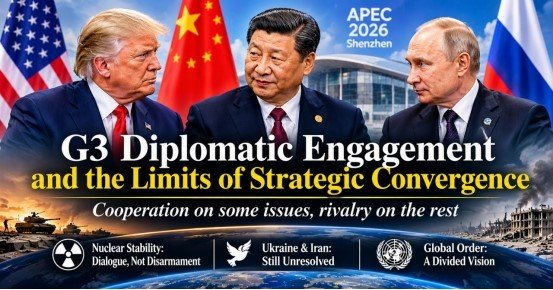
- The Shenzhen declaration established limited common ground on nuclear risks, energy security and international institutional reform.
- Ukraine and Iran were omitted from the declaration, exposing the gap between diplomatic engagement and conflict resolution.
- The three powers’ position on official immunity and ICC jurisdiction raises questions about great-power influence over international accountability.
The November 19 meeting in Shenzhen between US President Donald Trump, Chinese President Xi Jinping and Russian President Vladimir Putin produced the first formal trilateral heads-of-state declaration among the three powers.
The four-point China-Russia-U.S. Heads of State Declaration toward Peace addressed United Nations reform, refined petroleum supplies, official immunities and nuclear risk reduction. However, its omission of the wars in Ukraine and Iran reveals the central limitation of the meeting: great-power coordination can manage selected risks without resolving competing security interests.
The three leaders presented the meeting as a step toward international stability. Trump emphasized the importance of dialogue, Putin described the discussions as open and productive, and Xi advocated coexistence among major powers.
Shenzhen Trilateral Summit: Optimism Meets High-Stakes Diplomacy as Trump, Putin, and Xi Gather
Their engagement, however, did not produce a common position on the conflicts affecting their respective regional interests. The format allowed them to maintain diplomatic contact while leaving difficult disagreements outside the joint declaration.
The Shenzhen declaration: Nuclear Stability Without Binding Restraint
Nuclear stability illustrates the preference for risk management over enforceable commitments. The New START treaty expired in February 2026, ending the last legally binding bilateral limits on US and Russian strategic nuclear forces. Its expiry removed an important framework for transparency, verification and restraint between the world’s two largest nuclear powers.
Washington has sought a broader arms-control arrangement involving Beijing. China, however, has resisted numerical limits that would institutionalize the disparity between its arsenal and those of the two larger nuclear powers.
READ MORE: Shenzhen Trilateral Summit: Optimism Meets High-Stakes Diplomacy as Trump, Putin, and Xi Gather
The Shenzhen declaration commits all three governments to dialogue on reducing nuclear risks and preventing proliferation. It establishes no numerical ceilings, verification procedures or negotiating timetable. The commitment opens a channel for diplomacy but does not provide a new arms-control framework.
Energy Security and the Hormuz Constraint
Energy security offered a more immediate area of common interest. The second clause commits the three countries to increasing the production and supply of refined petroleum products and reaffirms the importance of stable energy flows. This commitment carries particular significance amid the Iran conflict and risks to shipping through the Strait of Hormuz, which normally handles more than 20 percent of global petroleum cargo.
READ MORE: Apec summit: Trump, Xi and Putin make ‘peace declaration’ but talks end without clear breakthrough – as it happened
However, increased refinery output cannot resolve a maritime supply disruption on its own. The declaration sets no production targets, export quotas or implementation timetable. Its practical impact will depend on subsequent government decisions and the restoration of reliable shipping. Reuters reported Brent crude at $92.19 per barrel on November 19, with shipping risks continuing to support prices despite expectations of a wider supply surplus. The energy commitment therefore does not establish that the underlying physical supply constraints have been resolved.
International Law and Great-Power Privilege
The declaration’s third clause reveals another area of institutional alignment. The three leaders emphasized state consent and immunity for state officials, warning the International Criminal Court and similar bodies against jurisdictional abuse. None of the three countries is party to the Rome Statute. This position, alongside their commitment to United Nations reform, raises broader questions about the distribution of authority and accountability within international institutions.
As permanent members of the UN Security Council, all three countries have a shared interest in retaining influence over international crisis management. However, strengthening the principles of state consent and official immunity without adequate safeguards could weaken international accountability mechanisms, on which smaller states also depend. The issue therefore extends beyond the jurisdiction of international courts to the balance between state sovereignty, institutional authority and equal application of international law.
The Limits of a Three-Power Understanding
The omission of Ukraine and Iran is central to assessing the declaration’s significance. Putin indicated that Ukraine was discussed, but the joint document contains no ceasefire proposal, territorial settlement or security guarantees. Ukraine and European governments were not represented in the trilateral negotiations, despite their direct interests in the conflict’s outcome.
Iran presents a different but equally consequential challenge. Washington remains militarily involved in the conflict, while Beijing maintains energy ties with Tehran and Moscow has established defense and diplomatic relations with Iran. The declaration offers no common approach to ending the conflict or securing the Strait of Hormuz.
For Europe, the meeting raises questions about its participation in decisions affecting continental security. For Gulf states, energy cooperation offers no substitute for maritime security arrangements. For Pakistan, the continuing conflict underscores the importance of regional diplomacy and engagement with Gulf partners rather than reliance on great-power understandings alone.
Shenzhen demonstrates that Washington, Beijing and Moscow can coordinate on selected interests, including nuclear risk reduction, energy flows and institutional reform. Whether these commitments acquire practical substance will depend on subsequent negotiations, implementation and the willingness of the three governments to accommodate competing interests.
Diplomatic coordination can reduce immediate risks without resolving strategic rivalry. Agreement among powerful states also does not automatically confer legitimacy on decisions affecting countries excluded from their deliberations. The durability of international stability will depend on whether great-power engagement respects the sovereignty, security and participation of the states whose futures are at stake.