



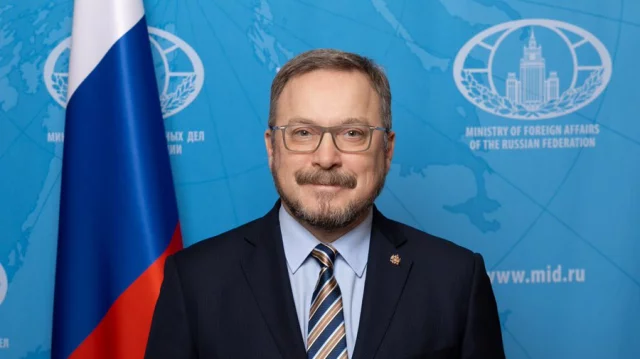
- Russian Ambassador Urges De-escalation: Alexander Khozin urged Dhaka to reduce Bangladesh India tensions before the February 2026 elections.
- The envoy reminded Bangladesh of the critical support provided by India and the USSR during the 1971 Liberation War.
- Pakistan has officially ignored the statements, maintaining a neutral stance on the Russian envoy’s historical references.
- Russia has deferred Rooppur Nuclear Power Plant loan repayments to 2028, underscoring its deep economic stakes in the region.
In a significant intervention into South Asian regional dynamics, the Russian Ambassador to Bangladesh, Alexander Grigoryevich Khozin, has urged Dhaka to actively de-escalate burgeoning tensions with New Delhi.
During a high-stakes press conference at the Russian Embassy in Dhaka on Monday, December 22, 2025, Ambassador Khozin delivered a pointed “reality check,” reminding the interim Bangladeshi administration of the historical role played by both Russia and India in securing the nation’s independence during the 1971 Liberation War.
Iran ballistic missile program expansion sparks new Israeli strike plans
The Ghost of 1971: Diplomacy via Historical Prisms
Ambassador Khozin’s remarks come at a time when relations between Bangladesh and India are at their lowest ebb in decades. Following the political upheavals of 2024 and the shift in the domestic power structure, anti-India sentiment has found new resonance in Dhaka’s streets. However, the Russian envoy was clear: “The sooner you reduce tensions with India, the better.”
Read More: Global Perspective With Kaswar Klasra
By explicitly invoking the 1971 conflict, Moscow is deploying “memory diplomacy.” Khozin underscored that Bangladesh gained its sovereignty “shoulder to shoulder” with Indian assistance and Soviet diplomatic backing. For the CEOs of think tanks and foreign ministers analyzing this move, the message is twofold: Russia is signaling that it views India as its primary strategic partner in South Asia and that any radical “strategic realignment” by Bangladesh away from New Delhi would be viewed with concern in the Kremlin.
The Nixon Doctrine and the “Genocide of Silence”
To understand the current friction, one must revisit the geopolitical architecture described by expert Robert S. Litwak in Détente and The Nixon Doctrine. In 1971, the world witnessed a stark divide. The United States, under Richard Nixon and Henry Kissinger, utilized the Guam Doctrine to maintain a “tilt” toward West Pakistan. Despite reports of systemic atrocities in East Pakistan, the White House remained largely silent, prioritizing the use of Islamabad as a diplomatic bridge to Beijing.
ALSO READ: Russia calls for reduced Bangladesh-India tensions, recalls 1971 war
In contrast, the Soviet Union and India formed an unbreakable axis that eventually facilitated the birth of Bangladesh. Today, the Russian Ambassador’s reminder of this “friendly role” serves as a counter-narrative to Western-leaning shifts in Dhaka. It suggests that while the names of the doctrines have changed, the fundamental contest for influence in the Bay of Bengal remains a zero-sum game between major powers.
Pakistan’s Strategic Silence
While the Russian Ambassador’s comments were clearly aimed at stabilizing the Dhaka-Delhi axis, they also touched upon the sensitive history of the 1971 war—a chapter that remains a point of deep institutional memory in Islamabad. Interestingly, Pakistan has maintained a policy of strategic silence regarding Khozin’s alleged statements.
Foreign policy analysts suggest that Islamabad’s refusal to comment is a calculated move. By ignoring the Russian envoy’s “1971 reminder,” Pakistan avoids a public spat with a key defense and energy partner (Russia) while simultaneously allowing the current tensions between Dhaka and New Delhi to play out without being seen as an agitator. For heads of state, this silence is a masterclass in “gray zone” diplomacy—choosing not to validate a narrative that highlights historical defeat, even when it is used as a tool by a common ally.
Election 2026: The Stakes for Regional Stability
Ambassador Khozin also touched upon the domestic political climate, welcoming the announcement of the national election scheduled for February 12, 2026. Russia has signaled its readiness to send election observers, contingent upon a formal invitation. The Kremlin’s interest is clear: it wants a “conducive, nonviolent environment” that ensures the continuity of flagship projects like the Rooppur Nuclear Power Plant, where Russia recently deferred debt repayments to 2028 to ease Bangladesh’s economic strain.
For the global policy community, the Russian intervention marks a pivot. Moscow is no longer content to be a silent financier of infrastructure; it is now positioning itself as a regional mediator, urging “mutual trust and confidence” to prevent a strategic nightmare that could destabilize the entire South Asian theater.