


- Civilian killed in Abu Dhabi after Iranian missile debris hits residential area.
- UAE air defenses intercepted multiple missiles, minimizing further casualties and damage.
- US Fifth Fleet headquarters in Bahrain struck, emergency alerts activated.
- Qatar intercepts missiles targeting Al Udeid Air Base; no casualties reported.
- Israel conducts broad strikes on western Iran in retaliation for Iranian attacks.
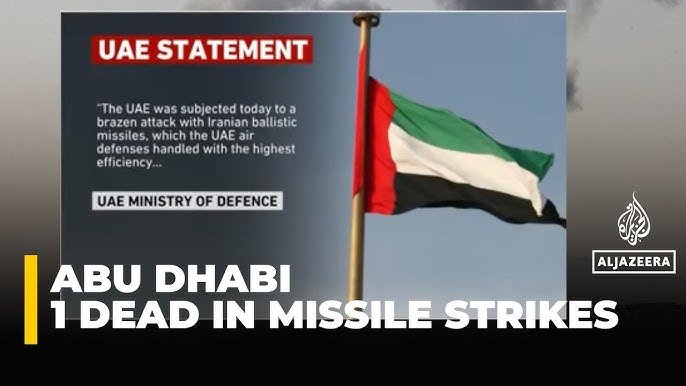
Abu Dhabi, UAE — A civilian has been killed in Abu Dhabi after debris from an Iranian ballistic missile struck a residential area, the United Arab Emirates Ministry of Defence confirmed Saturday, marking the first confirmed civilian casualty in the rapidly escalating Gulf conflict. The ministry described the attack as a “blatant attack involving Iranian ballistic missiles,” condemning it as a “dangerous escalation” and a “cowardly act,” and emphasized that the UAE “reserves its full right to respond.”
The victim, an individual of Asian nationality, has not been publicly identified. According to officials, the UAE’s advanced air defence systems intercepted multiple incoming missiles, minimizing casualties and destruction.
Nevertheless, falling debris caused material damage in nearby residential areas. The U.S. Air Force operates from Al Dhafra Air Base, south of Abu Dhabi, alongside the UAE Air Force, making the region a strategic military target.
Trump Confirms Full Scale U.S.-Israel Strikes on Iran, Warns of Possible American Casualties
Regional Missile Strikes Escalate
The deadly attack in Abu Dhabi comes amid a wider Iranian campaign across the Gulf. Qatar’s Defence Ministry reported intercepting multiple missiles targeting Al Udeid Air Base, the largest U.S. military facility in the region. Residents in Doha reported explosions, while emergency alerts advised citizens to stay indoors. Authorities stated that the attacks caused no damage to infrastructure or personnel.
Trump warns some Americans may die amid US strikes in Iran
Similar missile alerts and explosions were reported in Bahrain, Kuwait, and the UAE, raising concerns of a broader regional escalation. Bahrain confirmed that missiles struck the U.S. Navy Fifth Fleet headquarters, though the extent of damage has not been disclosed. Iranian officials had vowed retaliation against U.S. bases following prior U.S.-Israeli strikes on Iranian targets.
Israel Strikes Western Iran
In retaliation, the Israel Defense Forces (IDF) announced a “broad strike” on multiple Iranian military targets in western Iran. Explosions were reported in several Iranian cities, including Tehran, while Iranian air defence systems attempted to counter the strikes. Iran has confirmed that its Revolutionary Guards launched the first large-scale wave of retaliatory missile and drone strikes toward Israel, signaling a significant escalation of hostilities.
BREAKING NEWS — Explosions Rock Iranian Capital as Israel Confirms Missile Strik
Airspace Closures and Regional Precautions
As tensions soar, Qatar, Kuwait, Bahrain, and the UAE have closed their airspace temporarily. Residents across the Gulf reported hearing sirens and observing emergency measures near military installations. Traffic and public movement have been disrupted in major cities, though authorities report that essential services continue to operate.
U.S. Military Response
Amid the threats, the United States has reportedly redeployed and reduced troop numbers at key bases in Qatar and Bahrain as a force-protection measure. President Donald Trump confirmed that major combat operations against Iran have begun, underscoring the gravity of the current confrontation. Independent sources indicate that the U.S. is closely coordinating with Israel in ongoing operations against Iranian military infrastructure.
France, NATO, and Regional Alliances
Earlier this week, France and Bahrain finalized a defence cooperation agreement involving strategic information sharing and industrial collaboration. Analysts say the pact implicitly draws NATO-aligned powers into the ongoing conflict, raising the stakes for Western involvement in the region.
Outlook
The death of a civilian in Abu Dhabi highlights the human cost of the escalating Gulf war, even as military targets are the primary focus. Analysts warn that continued missile exchanges could draw additional regional actors into the conflict, disrupt civilian infrastructure, and heighten diplomatic tensions among Gulf states, the U.S., Israel, and European allies.