



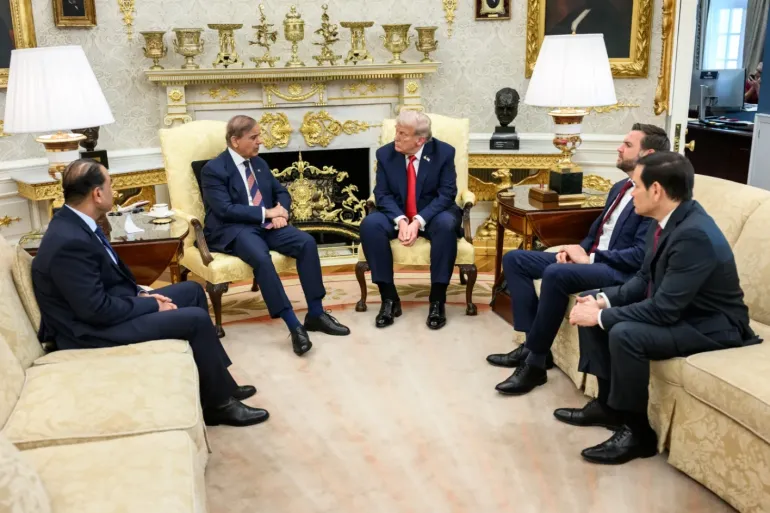
- Pakistan-mediated talks force U.S. to delay strikes on Iran’s energy grid
- Donald Trump confirms negotiations are “making headway”
- Iran signals cooperation through Strait of Hormuz shipping access
- Pakistan emerges as central diplomatic bridge in global conflict resolution
In a major diplomatic breakthrough reshaping the trajectory of the Gulf conflict, Pakistan-mediated talks have successfully compelled the United States to pause planned strikes on Iran’s critical energy infrastructure, signaling that negotiations are not only underway but yielding tangible results.
Senior officials and diplomatic sources confirm that Pakistan-mediated talks between Washington and Tehran are progressing “remarkably well,” with both sides inching closer to a framework that could bring an end to the month-long war.
Pakistan Digital Diplomacy: The Silent Channel Preventing a U.S.-Iran War Escalation
The breakthrough came after U.S. President Donald Trump publicly acknowledged the effectiveness of the mediation effort, crediting it for his decision to delay military escalation.
Pakistan-Mediated Talks Drive Diplomatic Momentum
The first clear sign of progress in Pakistan-mediated talks emerged when Trump postponed a planned strike on Iran’s power and energy grid. In a statement, he confirmed that discussions were “going very well” and making “strong headway,” marking a rare public endorsement of a third-party diplomatic channel.
This pause, now extended to April 6, underscores how Pakistan-mediated talks have altered Washington’s immediate military calculus. Initially, Trump had threatened to target Iran’s largest energy facilities if the Strait of Hormuz was not reopened within 48 hours. However, continued engagement through Islamabad prompted a shift toward diplomacy.
Trump says U.S. to hold off for 10 days on hitting Iran energy sites
According to officials, this is the first time in modern geopolitical history that the United States is negotiating an active conflict through structured messaging facilitated by a third-party mediator like Pakistan—an indicator of Islamabad’s rising diplomatic clout.
Pakistan-Mediated Talks Gain Global Recognition
The credibility of Pakistan-mediated talks was further reinforced when U.S. Special Envoy Steve Witkoff confirmed that Washington had delivered a comprehensive 15-point peace framework to Iran via Pakistani channels. The proposal reportedly includes conditions such as curbs on Iran’s nuclear program, limits on ballistic missile development, and guarantees for maritime security.
Trump himself highlighted a key confidence-building measure: Iran’s decision to allow oil tankers safe passage through the Strait of Hormuz. The development, he suggested, reflected that “the right people” were engaged through Pakistan-mediated talks, offering early signs of de-escalation.
Simultaneously, observers noted that multiple Pakistan-flagged oil tankers transited the strait without disruption—an operational signal that diplomatic efforts were stabilizing one of the world’s most critical energy corridors.
Despite the diplomatic progress, Pakistan-mediated talks are unfolding alongside intense military posturing. The Pentagon continues to prepare contingency plans, including potential operations targeting strategic locations such as Abu Musa Island, a key نقطة overlooking shipping lanes.
The deployment of U.S. forces, including elements of the 82nd Airborne Division and naval assets like the USS Tripoli, reflects Washington’s dual-track strategy: maintaining pressure while negotiating through Pakistan-mediated talks. Meanwhile, Iran has responded with its own show of strength, mobilizing forces and warning of “unprecedented” retaliation if provoked further.
Israel, under Prime Minister Benjamin Netanyahu, has also intensified strikes on Iranian-linked infrastructure, concerned that a diplomatic resolution could leave key security objectives unmet.
Pakistan’s Strategic Role in Conflict Resolution
At the center of this evolving landscape is Pakistan’s increasingly influential role. Led by Prime Minister Shehbaz Sharif, Islamabad has positioned itself as a trusted intermediary capable of engaging both Washington and Tehran without alienating either side.
Analysts argue that Pakistan-mediated talks are succeeding because they provide a neutral platform for communication at a time when direct engagement remains politically sensitive. Iran, while publicly rejecting U.S. proposals, has quietly indicated willingness to continue discussions through this channel—highlighting the effectiveness of Pakistan’s diplomatic balancing.
Moreover, coordination with regional actors, including Gulf partners, has strengthened the legitimacy of Pakistan-mediated talks, transforming them into a broader multilateral effort to stabilize the region.
The stakes, however, remain high. The conflict has already disrupted global energy markets, with volatility in oil prices and supply chains linked to tensions in the Strait of Hormuz. Any breakdown in Pakistan-mediated talks could rapidly escalate into a wider confrontation with global economic consequences.
Yet for now, cautious optimism prevails. The repeated postponement of U.S. strikes, combined with positive signals from both sides, suggests that Pakistan-mediated talks are not merely symbolic but actively shaping outcomes on the ground.
As the next 48 hours unfold, the world is watching closely. Whether this diplomatic momentum can translate into a lasting agreement remains uncertain, but one fact is increasingly clear: Pakistan-mediated talks have emerged as the most viable pathway to de-escalation in one of the most dangerous conflicts of recent times.