



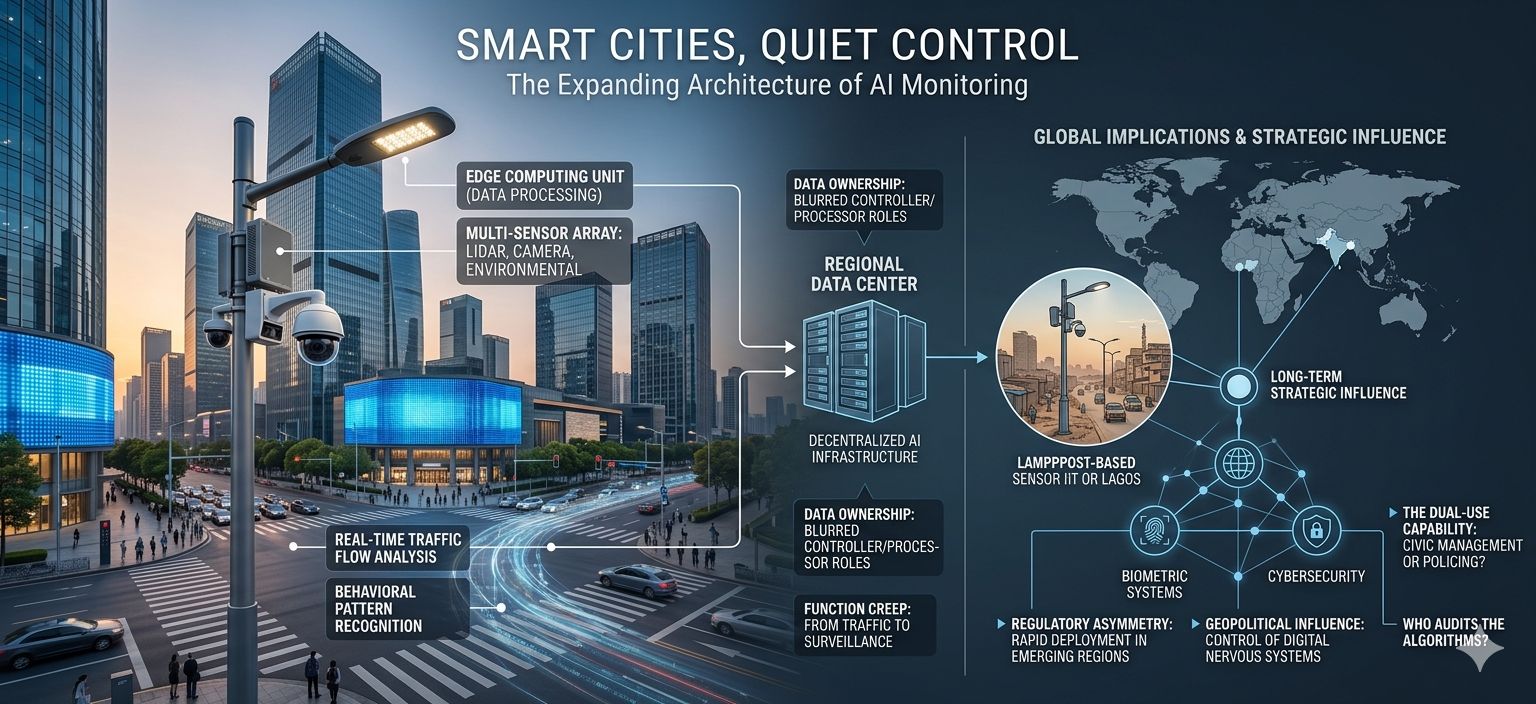
- AI infrastructure And The Illusion of Banality: The deployment of edge-computing frameworks through everyday items like lampposts shifts public perception from high-tech surveillance to routine urban improvement.
- Regulatory Asymmetry: Emerging markets often prioritize rapid infrastructure and modernization, creating environments where technologies facing strict scrutiny in Europe can be tested and deployed with fewer regulatory hurdles.
- The Controller vs. Processor Dilemma: Multi-jurisdictional and public-private partnerships blur legal accountability, leaving questions of data ownership, algorithmic audits, and liability for automated errors unanswered.
- Function Creep & Dual-Use Risks: Systems introduced for energy efficiency or basic traffic management possess the inherent capability to scale into real-time surveillance, turning civic amenities into instruments of strategic control.
In the first part of this analysis, I argued that the United Kingdom may be entering a new phase in which AI infrastructure expands not through dramatic announcements, but through apparently harmless urban improvements. The BBC article on lamppost-based data centres is significant precisely because of its banality. A streetlight is one of the least questioned objects in public space. Yet embedded inside that ordinary structure now appears the possibility of edge computing, behavioural analysis, traffic monitoring, sensor integration, and eventually real-time AI-supported urban management. What emerges is not merely a technological development, but the early outline of what could become a permanently networked civic environment.
Alongside its emphasis on innovation, the BBC article also raised concerns regarding facial recognition, behavioural monitoring, physical security, monetisation through traffic fines, and even the company chairman’s observation that Africa represented an attractive environment partly because there are “more relaxed rules and regulations.” That statement deserves calm reflection.
Iran War Peace Deal Near as Pakistan’s Asim Munir Leads Breakthrough Diplomacy
A review of Nigerian coverage appears, at least initially, to place greater emphasis on development, innovation, connectivity, security enhancement, and economic opportunity. That is understandable. For many rapidly developing societies, infrastructure itself remains a strategic necessity, and technologies promising improved public lighting, internet access, traffic management, and crime reduction naturally attract political and media interest.
That contrast does not necessarily imply negligence or concealment. It may simply reflect different national priorities and developmental perspectives. This can be observed, for example, in reporting by The Guardian Nigeria, Punch Newspapers, and IoT Insider, which appears comparatively less focused on several of those governance-related questions.
Singapore and Dubai as smart city case studies
The issue is not whether laws are being bypassed illegally. At present, there is no evidence for such a claim. The more important question is whether emerging technologies that might encounter stronger regulatory resistance or broader public scrutiny in Europe can be deployed more rapidly in developing regions eager for investment, infrastructure, and technological modernisation. Here, one begins to notice a deeper asymmetry in how emerging technologies are regulated, scrutinised, and socially negotiated across different parts of the world.
Who owns the data generated by the system? Who stores it? Who audits the algorithms behind behavioural enforcement? Who determines future upgrades? Who becomes legally responsible if automated systems produce false identifications or wrongful penalties? And perhaps most importantly: who ultimately controls the long-term informational architecture created by such infrastructures?
Britain’s Private School Tax Shock: Inside the Controversial VAT That Could Reshape Education Forever
Under modern data-protection law, an important distinction exists between the entity determining why and how personal data is collected — the “data controller” — and the entity merely processing that data on behalf of others — the “data processor.” In complex infrastructures involving governments, AI systems, private vendors, and potentially cross-border data processing, those distinctions can become blurred remarkably quickly.
The monetisation dimension outlined in the original BBC reporting also remains important, particularly because behavioural enforcement and technological infrastructure may eventually become financially interconnected.
Once AI systems become integrated into behavioural enforcement, the incentives surrounding enforcement itself inevitably become more complex. This is also where the concept of “dual-use capability” becomes relevant. In cybersecurity and geopolitical analysis, dual-use technologies are systems developed for legitimate civilian purposes that may also support surveillance, intelligence, policing, or strategic-control functions. The proposed iLamp network appears to fit that definition almost perfectly.
None of this necessarily implies malign intent. The project may genuinely improve lighting infrastructure, public connectivity, traffic enforcement, and crime prevention capabilities. But modern technological systems are rarely static. Once embedded into the ordinary fabric of urban life, they tend to accumulate additional functions over time — a phenomenon privacy scholars frequently describe as “function creep.”
The relevance extends beyond Nigeria. Pakistan itself continues to debate questions surrounding biometric systems, digital governance, cybersecurity regulation, and personal-data protection, particularly in relation to the country’s proposed Personal Data Protection Bill and broader concerns regarding state access to digital information (see: “Unravelling Pakistan’s Data Protection Framework” – Modern Diplomacy. Similar tensions increasingly appear worldwide: how should societies balance technological modernisation, public security, economic development, and the preservation of privacy once AI systems become embedded into ordinary civic infrastructure?
Ultimately, the deeper geopolitical issue may not concern lampposts at all, but who will design, own, update, and govern the digital nervous systems of emerging societies during the coming decades. Roads, telecommunications networks, AI platforms, cloud systems, smart-city infrastructures, and urban data architectures are no longer merely technical assets. Rather, they are increasingly becoming instruments of long-term strategic influence. And that is precisely why apparently ordinary streetlights now deserve rather extraordinary scrutiny.
Readers wishing to see and hear Edward Fitzpatrick, chairman and principal spokesperson for the company, directly may find one interview particularly illuminating. Speaking in the context of global energy insecurity and the Strait of Hormuz crisis, Fitzpatrick outlines his vision of decentralised AI-powered infrastructure as an alternative to increasingly fragile and resource-intensive economic models (watch here). A separate visual demonstration of how the iLamp infrastructure operates can also be consulted here.