


- US Iran Israel Lebanon war intensifies with a deadly drone strike on Kuwait International Airport
- Ceasefire between Israel and Hezbollah shows early signs of collapse amid renewed clashes
- US-Iran tensions rise as attacks target Gulf bases and shipping routes in the Strait of Hormuz
- Gulf states express frustration as regional security risks and economic disruptions grow
The fragile calm that followed weeks of intense confrontation between the United States and Iran is rapidly unraveling, as a series of escalating attacks across the Gulf and the Levant underscore how close the region remains to a wider war. The latest flashpoint came in Kuwait, where a drone strike on the country’s recently reopened international airport has injected fresh urgency into an already volatile geopolitical equation involving Washington, Tehran, Israel, and Hezbollah in Lebanon.
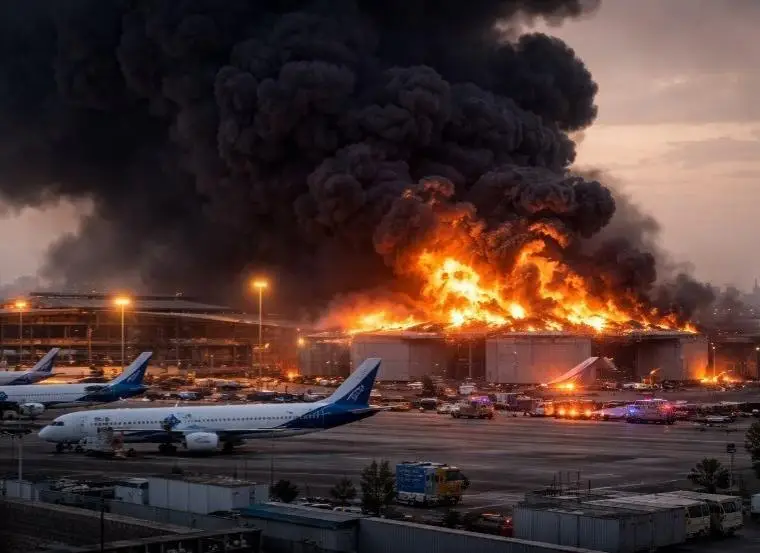
The attack on Kuwait International Airport, which killed at least one person and injured dozens, marks a significant shift in the conflict’s trajectory. Unlike earlier strikes that largely targeted military assets or energy infrastructure, this incident struck a civilian aviation hub—symbolizing both vulnerability and intent. Kuwaiti authorities released footage showing what appeared to be a Shahed-type drone slamming into Terminal 1, igniting a fireball that tore through the structure and sent passengers scrambling for safety. The strike forced another suspension of operations at an airport that had only resumed full service days earlier after earlier war-related disruptions.
Although Iran has denied responsibility, the nature of the attack aligns with its broader regional strategy: applying calibrated pressure without crossing thresholds that would trigger full-scale retaliation. Analysts suggest Kuwait presents a relatively softer target compared to regional heavyweights like Saudi Arabia or the United Arab Emirates, both of which possess stronger deterrent capabilities and have previously responded forcefully to Iranian provocations.
The Kuwait strike is not an isolated incident. It is part of a broader pattern of tit-for-tat escalation tied directly to the ongoing standoff in the Strait of Hormuz, where Iran has intermittently restricted maritime traffic while the United States enforces a tightening blockade on Iranian ports. In recent days, U.S. forces reportedly intercepted and disabled vessels suspected of transporting goods to Iran, prompting retaliatory drone and missile activity targeting U.S. military installations across the Gulf, including bases in Bahrain and Kuwait.
Despite a nominal ceasefire declared earlier this year, the conflict has entered what officials describe as a “controlled escalation” phase. U.S. Secretary of State Marco Rubio has characterized the ongoing exchanges as defensive responses rather than a return to full-scale war. However, the frequency and geographic spread of attacks suggest that the ceasefire exists more in rhetoric than reality.
Complicating matters further is the parallel conflict unfolding along the Israel-Lebanon border, where a newly brokered ceasefire between Israel and Hezbollah is already under severe strain. Within hours of its announcement, both sides accused each other of violations. Israeli airstrikes targeted what it described as militant infrastructure in southern Lebanon, while Hezbollah responded with rocket and drone attacks against Israeli positions.
The ceasefire agreement, negotiated with U.S. involvement, hinges on Hezbollah withdrawing from contested areas and halting attacks. Yet Hezbollah leadership has rejected key provisions, insisting that Israeli forces must first withdraw completely from southern Lebanon. This deadlock underscores the limitations of diplomatic efforts that exclude or marginalize powerful non-state actors with independent military capabilities.
For Washington, the simultaneous crises present a complex strategic dilemma. President Donald Trump has signaled reluctance to reignite full-scale hostilities, even as pressure mounts from repeated Iranian-linked attacks. His administration continues to pursue a framework agreement with Tehran that would reopen the Strait of Hormuz and place limits on Iran’s nuclear program. However, negotiations remain stalled over sequencing—specifically whether sanctions relief should precede Iranian concessions on uranium enrichment.
Iran, for its part, appears to be leveraging its regional network of allies and proxies to strengthen its negotiating position. By sustaining low-level but persistent pressure across multiple fronts—from Gulf shipping lanes to Lebanese battlefields—Tehran is demonstrating both resilience and reach. The strategy is designed to raise the costs of prolonged confrontation for the United States and its allies, while avoiding a decisive military clash that could prove catastrophic.
Meanwhile, Gulf states are growing increasingly uneasy. Privately, officials in Kuwait and elsewhere have expressed frustration that they are bearing the brunt of a conflict they neither initiated nor fully control. Public sentiment reflects a similar unease, with growing skepticism about Washington’s commitment to regional security beyond its core ally, Israel.
The broader implications are already reshaping the Middle East’s strategic landscape. Energy producers are accelerating investments in alternative export routes to bypass the Strait of Hormuz, long considered one of the world’s most critical chokepoints. Pipelines, rail networks, and new port infrastructure are being fast-tracked, signaling a long-term shift in how global energy flows are managed.
For now, the region remains suspended in a precarious balance—neither at war nor at peace. Each drone strike, missile launch, or air raid chips away at the already thin veneer of stability. As diplomacy struggles to keep pace with events on the ground, the risk is not just escalation, but miscalculation—one that could transform a series of contained conflicts into a full-scale regional war with global consequences.