



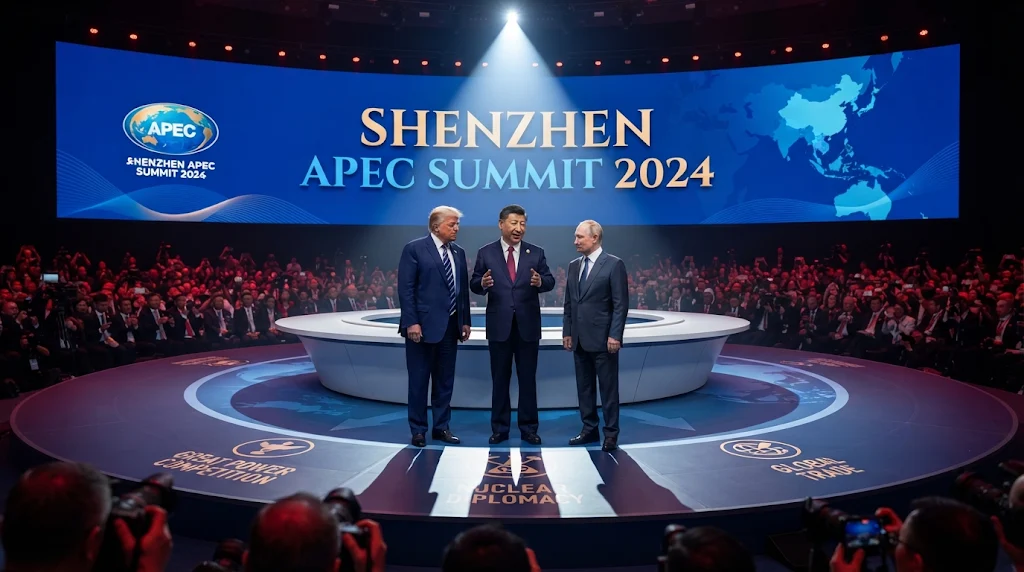
- Shenzhen APEC summit optics delivered high-profile symbolism and a rare trilateral meeting, while deferring core disputes over tariffs and semiconductor rules to the December G20 summit.
- Trilateral nuclear dialogues emerged as a notable diplomatic opening in Shenzhen, pairing risk-reduction talks with persistent limits on formal arms control and regional security disputes.
- Indo-Pacific alliance dynamics in Manila showed transactional diplomacy over concrete commitments, leaving questions around maritime disputes, regional deployments, and economic engagement in sharper focus.
The diplomatic choreography in Shenzhen last week offered a powerful visual narrative for the global stage: Chinese President Xi Jinping standing center stage, flanked by U.S. President Donald Trump and Russian President Vladimir Putin.
For observers in Beijing, Guangzhou, and Shenzhen, the symbolism was unmistakable. Hosting the Asia-Pacific Economic Cooperation (APEC) Summit and chairing a rare trilateral meeting in Shenzhen—a city that embodies China’s rapid technological rise—projected an image of undeniable geopolitical stature.
Yet beneath the carefully staged optics, a sober assessment of U.S. President Donald Trump’s Asia tour reveals a widening gap between diplomatic theater and substantive strategic shifts.
Not “Yalta 2.0”: What the Xi–Trump–Putin Summit Means for Asia and the Global South
The centerpiece of the tour, the Shenzhen trilateral summit, was widely billed as a potential “Yalta 2.0″—a grand bargain among great powers to divide spheres of influence. In reality, none of the three leaders arrived from a position of unassailable strength.
Beijing is navigating domestic economic headwinds; Moscow has severely depleted its conventional military and economic reserves in Ukraine; and Washington is grappling with domestic political fallout following steep midterm election losses and an ongoing entanglement in Iran. Consequently, the summit produced far more symbolism than concrete policy.
READ NEXT: Shenzhen Trilateral Summit: Optimism Meets High-Stakes Diplomacy as Trump, Putin, and Xi Gather
For China, the immediate dividend was prestige rather than policy concessions. By rolling out an elaborate welcome for Trump—even shortly after Washington introduced new rules restricting remote Chinese access to U.S. semiconductors—Beijing demonstrated a pragmatic desire to stabilize bilateral ties and project leadership across the Global South.
However, major structural friction points, particularly trade tariffs and technology export controls, were merely deferred to the upcoming G20 summit in Miami.
The most notable diplomatic breakthrough in Shenzhen was a subtle shift in nuclear diplomacy. In the Kylin Villa joint statement, the three powers reaffirmed that a nuclear war cannot be won and agreed to initiate trilateral dialogues on nuclear risk reduction and nonproliferation.
READ MORE: Trump, Xi, and Putin in Shenzhen: A Conversation with Andrea Kendall-Taylor
While formal arms control treaties remain off the table as China continues to modernize its nuclear deterrent, Beijing’s willingness to engage in risk-reduction talks—potentially covering artificial intelligence in weapons systems and crisis escalation—marks a meaningful, pragmatic step toward managing strategic stability.
Conversely, Moscow’s inclusion in the trilateral format highlighted Russia’s growing asymmetry within the relationship. While sitting as an equal alongside Washington and Beijing offered Putin a domestic propaganda victory, a joint pledge to boost global supplies of refined petroleum rang hollow given that Ukrainian drone strikes and Western sanctions have severely crippled Russia’s domestic refining capacity.
Frost and Fire in Northeast Asia: China–Japan Tensions Under Sanae Takaichi
Prior to arriving in Guangdong, Trump’s stop in Manila underscored a broader strategic drift in Washington’s approach to the Indo-Pacific. Arriving late to the Association of Southeast Asian Nations (ASEAN) meetings and holding the first in-person Quad leaders’ summit since 2024, the U.S. administration prioritized transactional optics over alliance reassurance.
Trade deals announced with Thailand and the Philippines lacked concrete frameworks, while Trump’s dismissive remarks regarding South China Sea disputes—paired with his silence during a major surge in People’s Liberation Army naval and coast guard deployments around Taiwan and the Philippine Sea—left regional allies questioning the durability of U.S. security commitments.
Ultimately, the tour illustrates an evolving geopolitical landscape where traditional alliance structures are being tested by transactional diplomacy. Where Washington has leaned heavily on defensive economic “sticks” like tariffs, it has struggled to offer positive economic “carrots” such as infrastructure investment or supply chain integration.
Meanwhile, quiet, functional cooperation continues in targeted areas like counternarcotics—where U.S.-China coordination has contributed to a sharp drop in fentanyl overdoses—and global public health.
As the diplomatic spotlight shifts toward Miami next month, the true legacy of the Shenzhen summit will depend on whether high-level personal rapport can translate into durable frameworks for managing competition—or whether the pageantry merely delayed an inevitable reckoning over trade, technology, and regional security.