



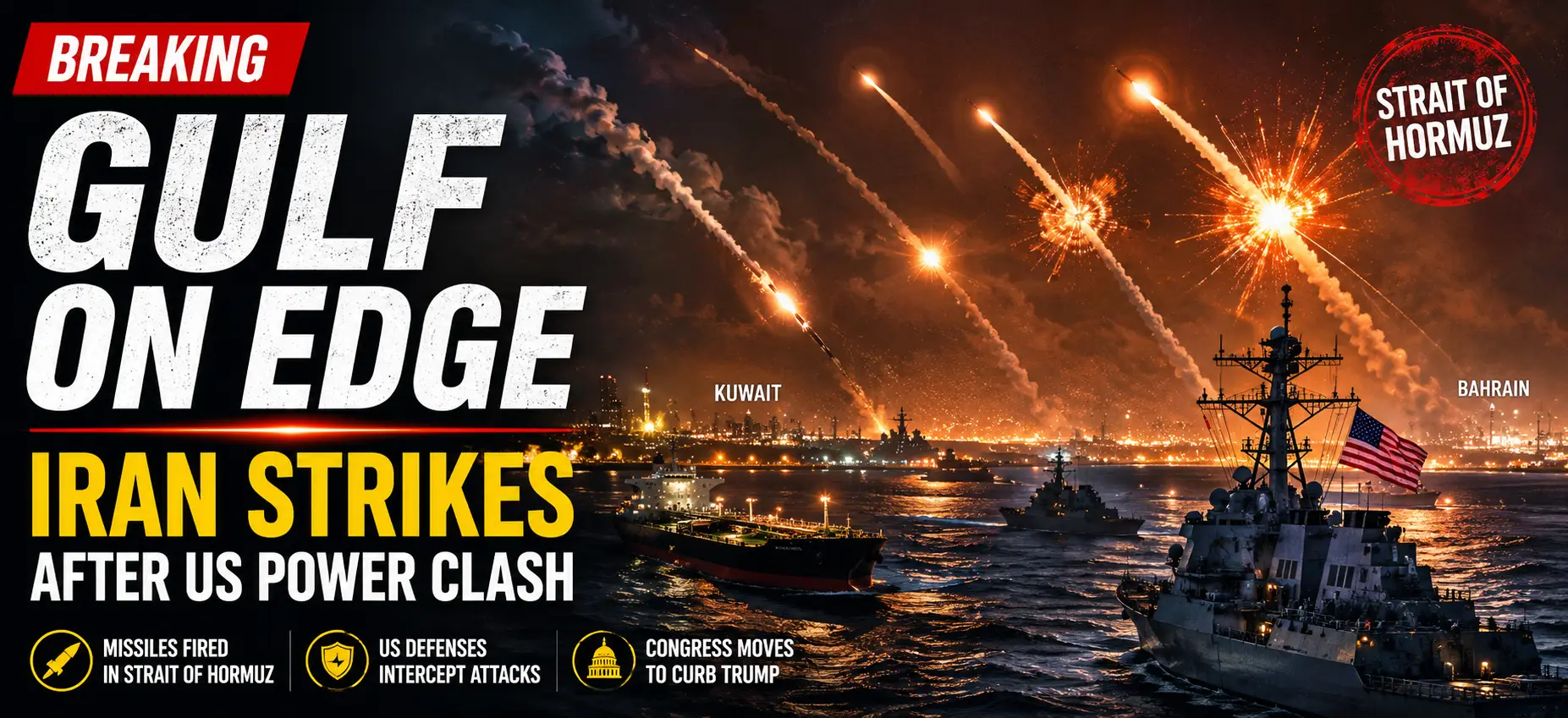
- US Iran Strait of Hormuz conflict intensifies with new Iranian missile launches targeting Gulf states
- US and allied defenses intercept ballistic missiles and drones, preventing casualties
- House passes resolution to limit Trump’s authority to launch further strikes on Iran
- Growing domestic pressure in Washington signals shift toward diplomacy over escalation
Two days after the U.S. House of Representatives moved to restrain President Donald Trump’s authority to launch further military strikes on Iran, tensions in the Gulf sharply escalated once again. Iran fired a new wave of missiles and drones toward the Strait of Hormuz and nearby Gulf states, signaling both defiance and a calculated acknowledgment of Washington’s shifting political landscape.
According to U.S. Central Command, Iranian forces launched seven ballistic missiles aimed at targets in Kuwait and Bahrain, shortly after American defenses intercepted multiple one-way attack drones headed toward vital maritime routes. U.S. and allied air defense systems successfully neutralized six of the missiles, while the seventh failed to reach its intended destination. Despite the absence of casualties, falling debris caused minor material damage in parts of Kuwait, underscoring the persistent danger posed by the conflict.
The Strait of Hormuz, a critical chokepoint for global energy supplies, has remained effectively paralyzed since late February, when U.S. and Israeli strikes on Iranian assets triggered a broader confrontation. The disruption has sent shockwaves through global markets, driving up fuel prices and amplifying economic uncertainty far beyond the region.
U.S.–Iran Negotiations Stall Amid Escalating Military Exchanges and Deepening Distrust
Iran’s latest missile barrage appears to serve a dual purpose. Militarily, it reinforces Tehran’s willingness to escalate pressure on U.S. interests and regional allies. Politically, however, the timing of the attack—coming just days after the House vote—suggests that Iran is closely watching developments in Washington. By continuing its operations while avoiding mass casualties, Tehran may be testing the limits of American response under increasing domestic constraints.
President Trump has repeatedly claimed that the conflict is nearing its conclusion, describing it as “largely finished,” though he has warned that it could still end “the hard way.” Behind the rhetoric, negotiations remain stalled. Iranian officials accuse the United States of violating a prior ceasefire understanding, while Washington maintains that its actions are defensive, aimed at protecting maritime security and regional stability.
Iran launched missiles and drones toward Strait of Hormuz, U.S. military says
The Iranian Revolutionary Guard Corps claimed responsibility for targeting oil tankers attempting to exit the Strait, as well as U.S. military facilities in the Gulf. American officials, however, rejected assertions that any U.S. installations were damaged, calling such claims inaccurate and part of a broader information campaign.
While the battlefield remains active, the political front in Washington has become equally significant. In a rare bipartisan move, the House of Representatives passed a resolution seeking to block President Trump from ordering further military action against Iran without congressional approval. The measure passed by a narrow margin of 215 to 208, marking the first time since the conflict began that such a resolution cleared either chamber of Congress.
The vote reflected growing unease among lawmakers over a war that has stretched beyond three months without a clear strategy or formal authorization. Notably, four Republican representatives broke ranks to support the resolution, joining Democrats in asserting Congress’s constitutional authority over war powers.
Supporters of the measure argued that continued military escalation risks entangling the United States in a prolonged and potentially unwinnable conflict. They emphasized that diplomacy, rather than additional strikes, offers the only viable path forward. Critics of the administration pointed to the lack of a defined objective, as well as the economic and human costs already incurred.
The resolution draws on the War Powers Act of 1973, which requires the president to withdraw U.S. forces from hostilities within 60 days unless Congress explicitly authorizes continued engagement. Although that deadline has technically passed, the administration has argued that active hostilities have ceased, citing a ceasefire framework—even as military operations continue in practice.
Despite its symbolic weight, the House resolution faces significant obstacles. For it to carry binding force, the Senate would need to pass a similar measure, and both chambers would likely have to overcome a presidential veto with a two-thirds majority—an outcome widely seen as unlikely. Nonetheless, lawmakers backing the resolution view it as a critical step in applying political pressure on the administration.
Senior officials within the Trump administration have warned that such congressional actions could weaken U.S. leverage in negotiations, potentially emboldening Iran. However, proponents counter that unchecked executive authority poses a greater risk, particularly in a conflict lacking clear public support.
Public opinion appears to align with congressional concerns. Recent polling indicates that a significant majority of Americans oppose the decision to go to war with Iran, reflecting fatigue with prolonged overseas conflicts and skepticism about their outcomes.
As missiles continue to streak across Gulf skies and political battles intensify in Washington, the trajectory of the U.S.-Iran conflict remains uncertain. What is clear, however, is that the war is no longer being shaped solely on the battlefield. Decisions made in Congress are now influencing calculations in Tehran, adding a new and unpredictable dimension to an already volatile confrontation.