



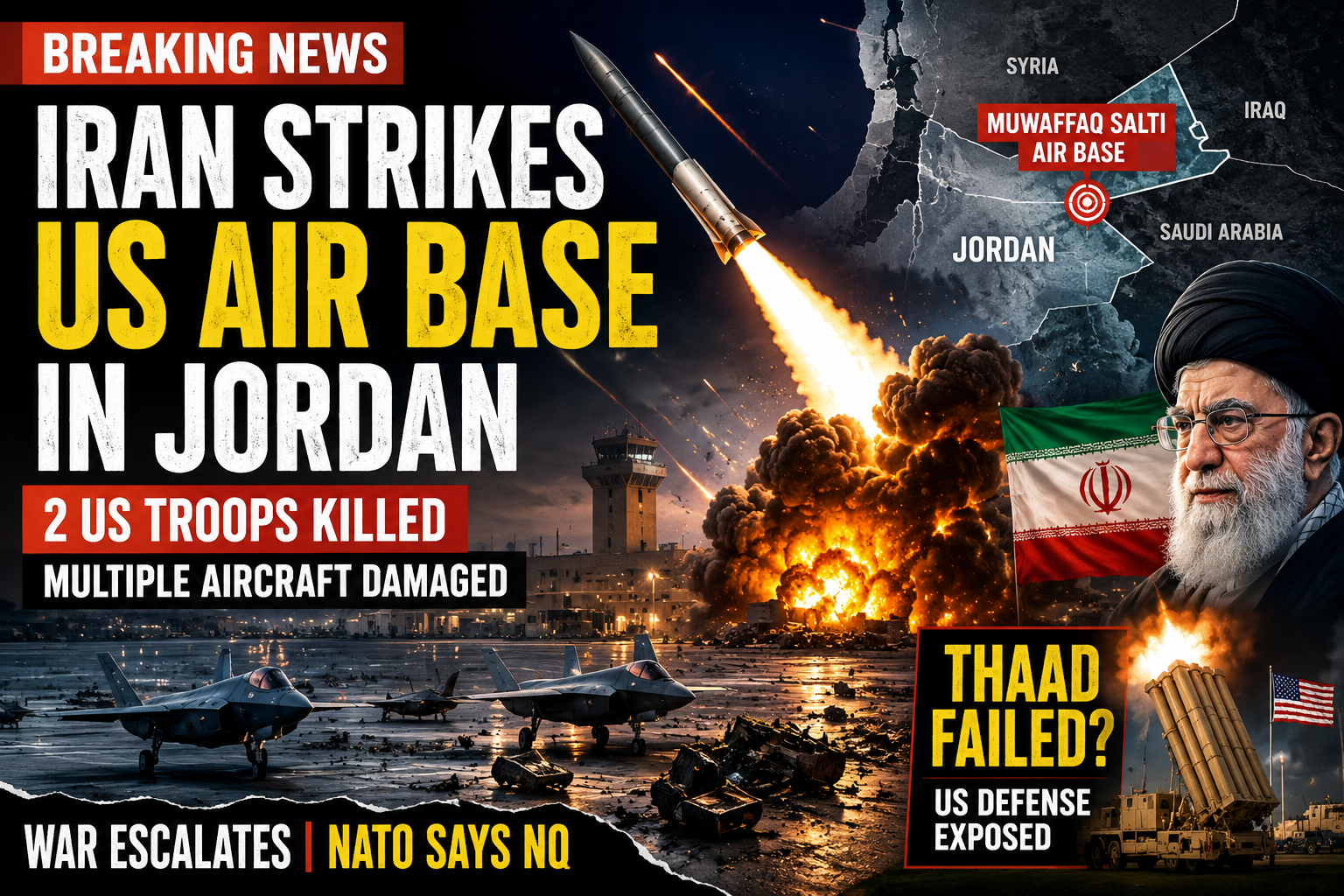
- Iran Missile Attack On Muwaffaq Salti Air Base killed two U.S. troops, injured four, and damaged multiple high-value aircraft, exposing vulnerabilities in America’s most advanced missile defense systems.
- The precision strike signals a major leap in Iran’s missile technology, raising concerns over possible technical support from China or Russia and shifting the regional military balance.
- The attack provides Washington with grounds for escalation while NATO’s reluctance to support the U.S. highlights a deepening alliance rift and pushes America closer to Türkiye.
On the night of July 17, 2026, Iran executed one of its most consequential military operations of the current conflict, launching a coordinated ballistic missile and drone assault on the Muwaffaq Salti Air Base (MSAB) in Al-Azraq, Jordan. The strike was not only lethal—it was precise, calculated, and strategically disruptive, raising urgent questions about the effectiveness of U.S. missile defense systems and the evolving balance of power in the Middle East.
According to U.S. Central Command (CENTCOM), the attack resulted in the deaths of two American service members, with one still missing in action. Four others were seriously wounded and evacuated to nearby Jordanian hospitals before being discharged. While the human toll remains limited compared to the scale of the assault, the symbolic and strategic impact is far greater.
Iran Missile Attack on Muwaffaq Salti Air Base Breached the Shield
MSAB is not an ordinary installation. It is one of Washington’s most fortified forward operating bases in the region, protected by a layered air defense architecture that includes the Terminal High Altitude Area Defense (THAAD) system—considered among the most advanced missile shields in the U.S. arsenal.
Yet Iran’s salvo penetrated this shield.
IRAN WAR EXPANSION: Inside the White House Plan to Scale the Iran War and the Collapse of the Hormuz Peace Framework
Missiles traveling at high speeds, reportedly maneuvering during their terminal phase, struck key sections of the base, including containerized housing units and active flight lines. Multiple American aircraft—both manned and unmanned—were damaged on the ground. While the Pentagon has refrained from confirming total losses, even partial damage to high-value platforms such as F-35A stealth fighters or MQ-9 Reaper drones suggests a financial hit running into hundreds of millions of dollars.
For a base that had expanded from roughly 20 aircraft in peacetime to more than 60 during the ongoing conflict, the strike represents a serious operational setback.
Intelligence and Defense Failure?
The central question emerging from the attack is unavoidable: how did such a sophisticated strike bypass one of the most advanced defense systems deployed by the United States?
Military analysts are increasingly framing the incident as a dual failure—of both intelligence anticipation and defensive interception. The U.S. had significant warning of escalating Iranian retaliation following recent American strikes on Iranian infrastructure. Yet the scale, coordination, and precision of this attack appear to have caught planners off guard.
Two U.S. Troops Were Killed, One Is Missing After Iran Missile Attack in Jordan
The breach of THAAD defenses is particularly alarming. Designed to intercept short- and medium-range ballistic missiles, the system’s inability to neutralize the incoming threats suggests that Iran may have deployed new-generation missile technology—potentially incorporating hypersonic characteristics or advanced maneuverable reentry vehicles (MaRVs).
Iran’s Technological Leap
What stands out most is not just that Iran struck—but how it struck.
The accuracy demonstrated in hitting specific sections of a heavily defended base nearly 1,000 kilometers away indicates a significant leap in targeting capability. Analysts point to the possibility of enhanced satellite guidance, real-time tracking, and advanced radar integration.
This has reignited speculation over whether external actors—particularly China or Russia—have quietly assisted Tehran in upgrading its missile and surveillance systems. While there is no official confirmation, U.S. defense officials have privately expressed concerns that Iran’s improved targeting precision may be linked to foreign technical support, including radar systems and guidance technologies.
If true, this would mark a dangerous evolution in the conflict, transforming Iran from a regional missile power into a far more formidable precision-strike actor.
Strategic Fallout
The implications of the Muwaffaq Salti strike extend well beyond Jordan.
For former President Donald Trump, who is once again steering U.S. military policy, the attack provides what many in Washington are calling a “legitimate trigger” for escalation. The killing of American personnel and the direct hit on critical military infrastructure strengthens the case for a broader, full-scale military operation against Iran.
Indeed, U.S. responses in the past 48 hours—targeting bridges, coastal defenses, and logistical infrastructure in Iran’s Hormozgan and Khuzestan provinces—suggest that Washington has already shifted toward a more aggressive operational posture.
NATO Fractures and a New Alignment
Perhaps even more consequential is the geopolitical ripple effect.
NATO’s reluctance to back Washington in a potential full-scale war against Iran has exposed deep fractures within the alliance. Several European members have reportedly refused to commit military support, signaling a strategic divergence that could redefine transatlantic relations.
For decades, NATO has been the cornerstone of U.S. global military strategy. But the alliance’s apparent hesitation in this crisis is being interpreted in Washington as a fundamental shift—one that could permanently alter U.S. policy toward its European partners.
In contrast, this vacuum is drawing the United States closer to Türkiye. President Trump’s recent diplomatic overtures toward Ankara, including high-profile engagements with President Recep Tayyip Erdoğan during the NATO summit in Türkiye, suggest a recalibration of alliances.
Analysts argue that Türkiye’s strategic geography, military capability, and willingness to engage could position it as a critical partner in any expanded U.S. campaign against Iran.
A War Redefined
The strike on Muwaffaq Salti Air Base marks more than just another escalation—it is a turning point.
It demonstrates that Iran is no longer relying solely on volume-based missile attacks but has entered the realm of precision warfare. It exposes vulnerabilities in even the most advanced U.S. defense systems. And it accelerates a geopolitical realignment that could reshape alliances for years to come.
Most importantly, it signals that the conflict is entering a far more dangerous phase—one where technological sophistication, strategic miscalculations, and shifting alliances converge.
The war, it seems, is not just back. It has evolved.