



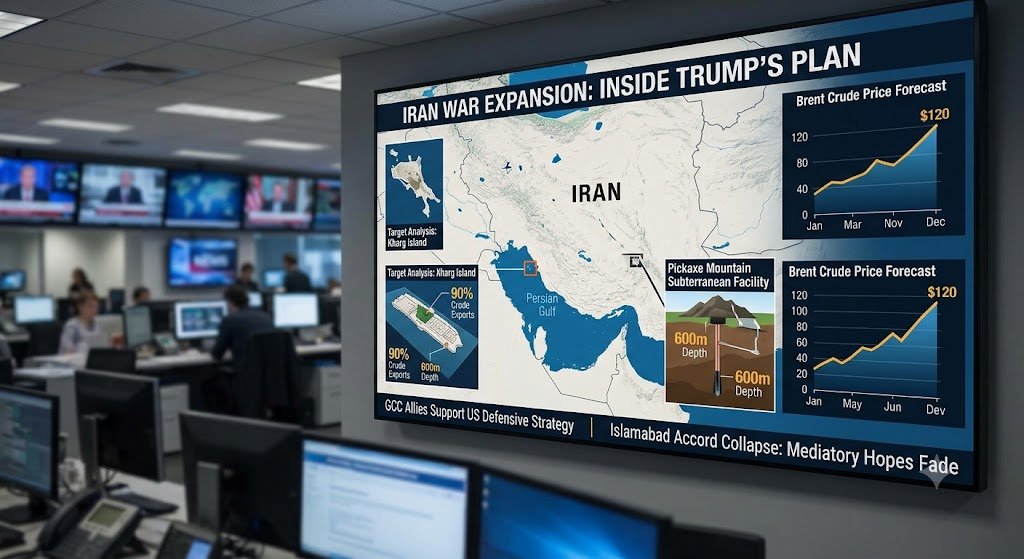
- Iran war expansion has quietly entered its most dangerous phase following the collapse of the April 8, 2026, Islamabad Accord, which has forced the Trump administration to transition from naval containment to preparing active strike operations inside sovereign Iranian territory.
- The Situational Room plans center on high-stakes targets including a potential amphibious ground seizure of Kharg Island—which handles roughly 90% of Iran’s crude oil exports—and bunkered airstrikes against the uncompleted “Pickaxe Mountain” nuclear facility buried up to 600 meters beneath solid granite.
- A major geopolitical realignment is taking place as Gulf Cooperation Council (GCC) allies, historically cautious of direct confrontation, are throwing their support behind Washington’s defensive strategies after facing direct drone and missile strikes on their own soil.
- Severe economic and domestic forecasts project global Brent crude prices immediately spiking past $120 per barrel if a blockade or seizure is finalized, presenting a massive inflation risk for the White House right ahead of the critical upcoming midterm elections.
MANAMA, Bahrain — Having spent the last 22 years reporting from the dusty frontlines of Baghdad, Kabul, Beirut, and the waters of the Persian Gulf, I have learned that the most dangerous phases of conflict are rarely preceded by loud declarations. Instead, they begin quietly, in the windowless rooms of the Pentagon and the hushed corners of the Situation Room.
Today, the Middle East stands on the precipice of an unprecedented regional war. The fragile peace brokered by Pakistan has disintegrated, the critical transit arterial of the Strait of Hormuz has descended back into an active combat zone, and the United States is systematically laying the groundwork to expand its military operations deep inside sovereign Iranian territory.
Despite public assurances that he prefers a diplomatic off-ramp, President Donald Trump is actively reviewing highly escalatory military options. Backed by a hawkish inner circle—including Vice President JD Vance, Defense Secretary Pete Hegseth, Secretary of State Marco Rubio, and Chairman of the Joint Chiefs of Staff Gen. Dan Caine—the administration is shifting its posture from containment to a decisive, potentially devastating campaign.
The Collapse of the Islamabad Accord
Only months ago, there was a fleeting moment of diplomatic optimism. On April 8, 2026, tireless mediatory efforts by Islamabad successfully established a fragile interim peace agreement.
READ MORE: Trump Nears Strategic Victory in Iran as U.S. Enters Final Phase Before Midterms
Under this framework, the United States lifted its tight naval blockade on Iranian ports and paused sanctions on Tehran’s oil sales in exchange for a verified pause in regional hostilities and attacks on shipping.
                    [ April 8, 2026: The Islamabad Accord ]
                                       │
                      (Sanctions Paused & Blockade Lifted)
                                       │
                                       ▼
                  [ Early July 2026: Escalation in the Strait ]
                                       │
                    (Resumed Attacks on Commercial Vessels)
                                       │
                                       ▼
                  [ July 12, 2026: Blockade Reimposition & War ]
That agreement has now completely shattered. Following a series of fresh Iranian-backed attacks on commercial vessels in the Strait of Hormuz, Trump declared the ceasefire dead, immediately reimposing the naval blockade and authorizing a ferocious wave of fresh air operations.
As of July 16, 2026, the U.S. military is executing its fifth consecutive day of heavy airstrikes against coastal-defense systems, missile batteries, and naval installations inside Iran.
RELATED NEWS: Trump Leans Toward Expanding U.S. Military Operations in Iran
Iran War Expansion And The Secret Target List: Kharg Island and Pickaxe Mountain
Senior U.S. defense officials confirm that the Situation Room discussions have centered around two highly fortified, high-value targets that represent the administration’s riskiest gamble of the five-month-old war.
1. The Seizure of Kharg Island
Kharg Island is the financial heart of the Iranian state, serving as the terminal for roughly 90% of Iran’s crude oil exports. While retired Marine Gen. Frank McKenzie argued on Face the Nation that occupying Iranian soil would grant the U.S. immense leverage in future negotiations, military planners warn of extreme risks. Ground forces deployed on the island would be highly vulnerable to swarms of asymmetric suicide drones and ballistic missile barrages launched from the Iranian mainland.
2. The Bunker of Pickaxe Mountain
Known locally as Kuh-e Kolang, Pickaxe Mountain is an underground facility under construction in central Iran, roughly 220 kilometers south of Tehran and just 2 kilometers from the Natanz nuclear complex. Unlike the Fordow enrichment site—which was heavily damaged by U.S. and Israeli bunker-buster strikes in June 2025—Pickaxe is buried up to 600 meters (nearly 2,000 feet) beneath solid granite.
Because the site’s vertical ventilation shafts have not been exposed on public satellite imagery, standard penetrating munitions may be ineffective, leaving the site highly insulated against traditional airstrikes.
“We’re going to take out Pickaxe Mountain,” Trump warned during a recent broadcast with radio host Hugh Hewitt. “Pickaxe is a possible, you know, target for a nice big, fat shot right in the front door. We’ll probably give Pickaxe a shot relatively soon.”
Comparative Analysis of Proposed U.S. Military Targets
| Target Location | Strategic Objective | Key Military Vulnerabilities | Projected Global Economic Impact |
| Kharg Island (Primary Oil Hub) | Cut off 90% of Iranian oil revenue; capture sovereign territory for negotiating leverage. | High exposure of U.S. ground troops to mainland ballistic missile and drone swarms. | Oil prices projected to immediately surge past $120/barrel; severe supply shocks in Asia. |
| Pickaxe Mountain (Kuh-e Kolang) | Destroy Iran’s deepest, most secure suspected centrifuge assembly and enrichment site. | Buried up to 600m under solid granite; highly resistant to standard bunker-busters. | Immediate retaliatory strikes on regional infrastructure; end of nuclear diplomacy. |
| Strait of Hormuz (Islands of Abu Musa & the Tunbs) | Clear out heavily militarized Iranian outposts to secure international shipping lanes. | Amphibious forces highly vulnerable during initial landings and prolonged occupation. | Shipper panic; massive spikes in maritime insurance premiums; potential transit freeze. |
Gulf Allies Fall in Line
In previous regional crises, Washington’s allies in the Gulf Cooperation Council (GCC) often engaged in delicate diplomatic hedging, attempting to balance their security alliances with the U.S. against the threat of direct Iranian retaliation. That hesitation is rapidly evaporating.
Faced with direct Iranian provocations—including missile strikes that have repeatedly hit infrastructure in Bahrain, Kuwait, and Jordan—the Gulf monarchies are quietly backing the U.S. campaign. GCC Secretary-General Jasem al-Budaiwi strongly condemned Iran’s “treacherous” actions, accusing Tehran of driving the region into chaos. Behind the scenes, regional partners are coordinating closely with U.S. Central Command (CENTCOM), integrating air-defense networks to intercept incoming drone swarms and securing vital energy infrastructure.
The Economic and Geopolitical Forecast
As a veteran conflict reporter, I look at the current maritime and economic data and see a global system standing on a trapdoor. The Strait of Hormuz normally carries 20% of the world’s petroleum and liquefied natural gas (LNG). Today, transit has slowed to a crawl.
- The Energy Shock: Brent crude futures have already jumped to $81.92 per barrel. If the U.S. carries out a full amphibious seizure of Kharg Island or strikes Iran’s remaining energy nodes, market analysts forecast oil prices will easily shatter the $120 barrier, triggering a devastating wave of global inflation.
- The Tariff Dilemma: Trump has floated a highly controversial policy to demand a 20% tariff on all commercial shipping transiting the Strait in exchange for U.S. Navy escort protection. Major Asian importers—dependent on Gulf crude—are already resisting the unprecedented maritime toll.
- The Domestic Risk: Dragging American ground forces into an open-ended territorial war or sending domestic fuel prices skyrocketing in late summer represents a massive political risk for the White House, threatening to severely disrupt Republican momentum ahead of the upcoming midterm elections.
Whether Trump’s public threats to “take out Pickaxe Mountain” are a high-stakes bluff designed to force Tehran back to the negotiating table—as Vice President JD Vance suggested to podcaster Joe Rogan—remains to be seen. But in the waters of the Gulf, the safety net is gone. The region has never been closer to a total war.