



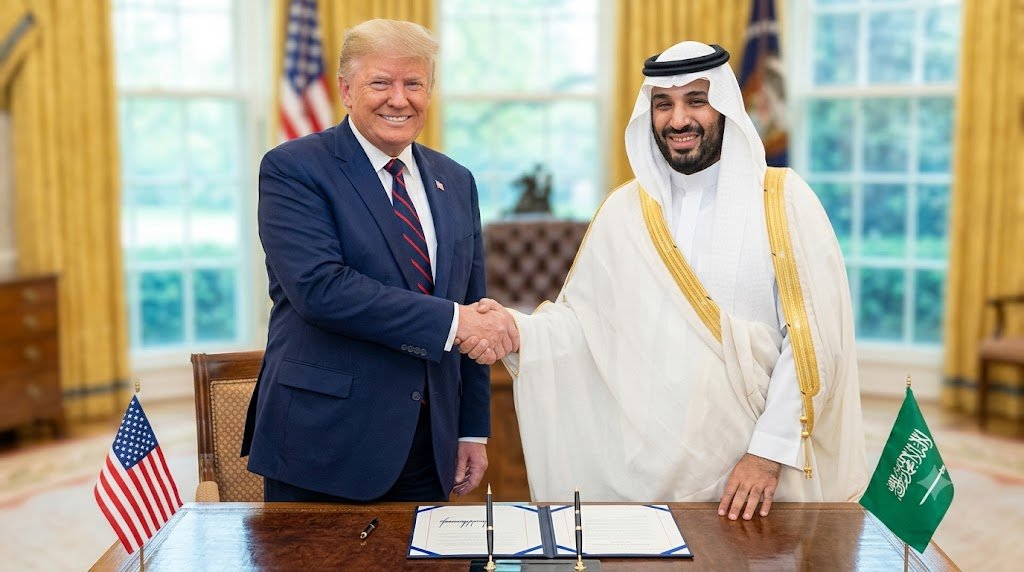
- Mohammed bin Salman secures historic Saudi nuclear deal from Donald Trump, cementing a powerful strategic alliance.
- The Saudi nuclear deal grants Riyadh access to civilian nuclear infrastructure with potential uranium enrichment under U.S. oversight.
- The agreement sidelines global competitors and strengthens Saudi Arabia’s position as a rising technological and energy power.
- Regional tensions likely to rise as Iran views the Saudi nuclear deal as a direct strategic setback.
In a sweeping geopolitical development with far-reaching consequences, Mohammed bin Salman has secured a historic Saudi nuclear deal from Donald Trump—a move that not only cements the enduring Trump–MBS alliance but decisively shifts the strategic equilibrium of the Middle East.
The Saudi nuclear deal, approved by President Trump late last week, establishes a 30-year civilian nuclear partnership valued at tens of billions of dollars. At its core, the agreement ensures that American firms will dominate the Kingdom’s nuclear infrastructure development, effectively shutting out strategic competitors such as Russia and China from a critical regional foothold.
Crucially, the Saudi nuclear deal includes a conditional pathway for uranium enrichment within Saudi Arabia—a provision that elevates Riyadh’s long-term strategic leverage while maintaining nominal U.S. oversight.
MUST READ: Crown Prince Mohammed bin Salman: The Architect of a New Middle East with Trump’s Renewed Backing
A Calculated Strategic Breakthrough
The Saudi nuclear deal is less about energy and more about power projection.
For Mohammed bin Salman, this is a defining strategic win. The deal aligns seamlessly with Vision 2030, enabling the Kingdom to diversify its energy architecture while preserving oil exports for maximum economic gain. However, beneath the economic rationale lies a more consequential reality: the normalization of nuclear capability pathways in the Gulf.
Read Next: Saudi Arabia Foreign Policy: How MBS and Trump Are Re-Engineering Middle East Stability
The Saudi nuclear deal positions Riyadh just steps away from a full nuclear fuel cycle—an achievement that significantly alters deterrence dynamics across the region.
Saudi Nuclear Deal: A Personal Victory for MBS and Trump
The agreement highlights the depth of trust between Donald Trump and Mohammed bin Salman. The Saudi nuclear deal would have faced far greater resistance under traditional U.S. policy frameworks, yet Trump’s decision reflects a preference for strategic alignment over bureaucratic caution.
By enabling this deal, Trump not only strengthens bilateral ties but also revitalizes the U.S. nuclear industry, ensuring American companies lead one of the most lucrative energy transitions in the Middle East.
Read More: Saudi Crown Prince Mohammed bin Salman: The Global Peacemaker Bringing Trump and Putin to the Table
For MBS, the Saudi nuclear deal is proof of his ability to convert personal diplomacy into tangible strategic outcomes—solidifying his image as the Kingdom’s most transformative leader in decades.
Regional Shockwaves: Iran Faces Strategic Setback
The implications for Iran are immediate and profound.
Tehran has long maintained that its nuclear program is purely civilian. However, recent regional escalations and Iran’s aggressive posture toward neighboring states have amplified skepticism about its intentions. The Saudi nuclear deal introduces a powerful counterweight to Iran’s ambitions.
Read More: Trump Approves Landmark Nuclear Deal With Saudi Arabia in Big Win for Kingdom
While Iran has invested heavily in nuclear infrastructure, the Kingdom now enjoys U.S.-backed legitimacy and technological access—an advantage Tehran lacks due to sanctions and diplomatic isolation.
In strategic terms, the Saudi nuclear deal narrows Iran’s margin of maneuver and complicates its long-term nuclear calculus.
Echoes of the U.S.–Iran Nuclear Deal
The agreement inevitably draws comparisons with the Joint Comprehensive Plan of Action. However, the contrast is striking.
Where the U.S.–Iran deal imposed restrictions, the Saudi nuclear deal enables controlled expansion. Where Iran faced limitations, Saudi Arabia gains conditional opportunity.
This divergence reflects a broader shift in U.S. regional policy—rewarding strategic allies while containing adversaries.
Congressional Resistance and Strategic Reality
Despite its strategic significance, the Saudi nuclear deal is expected to face scrutiny in Congress. Critics argue that enabling uranium enrichment in a volatile region could trigger a nuclear domino effect.
Yet blocking the agreement will prove politically difficult. Overriding a presidential veto would require a two-thirds majority—an unlikely threshold given the economic and strategic stakes involved.
A Defining Moment in Middle East Geopolitics
The Saudi nuclear deal stands as a landmark achievement for Mohammed bin Salman and a clear demonstration of Donald Trump’s commitment to strategic alliances.
For Saudi Arabia, it secures energy diversification, technological advancement, and enhanced geopolitical leverage. For the United States, it reinforces influence while sidelining global competitors.
For the Middle East, however, the consequences are far more complex.
The Saudi nuclear deal does not merely introduce nuclear energy to the Kingdom—it redefines the rules of power, deterrence, and diplomacy in one of the world’s most volatile regions.