



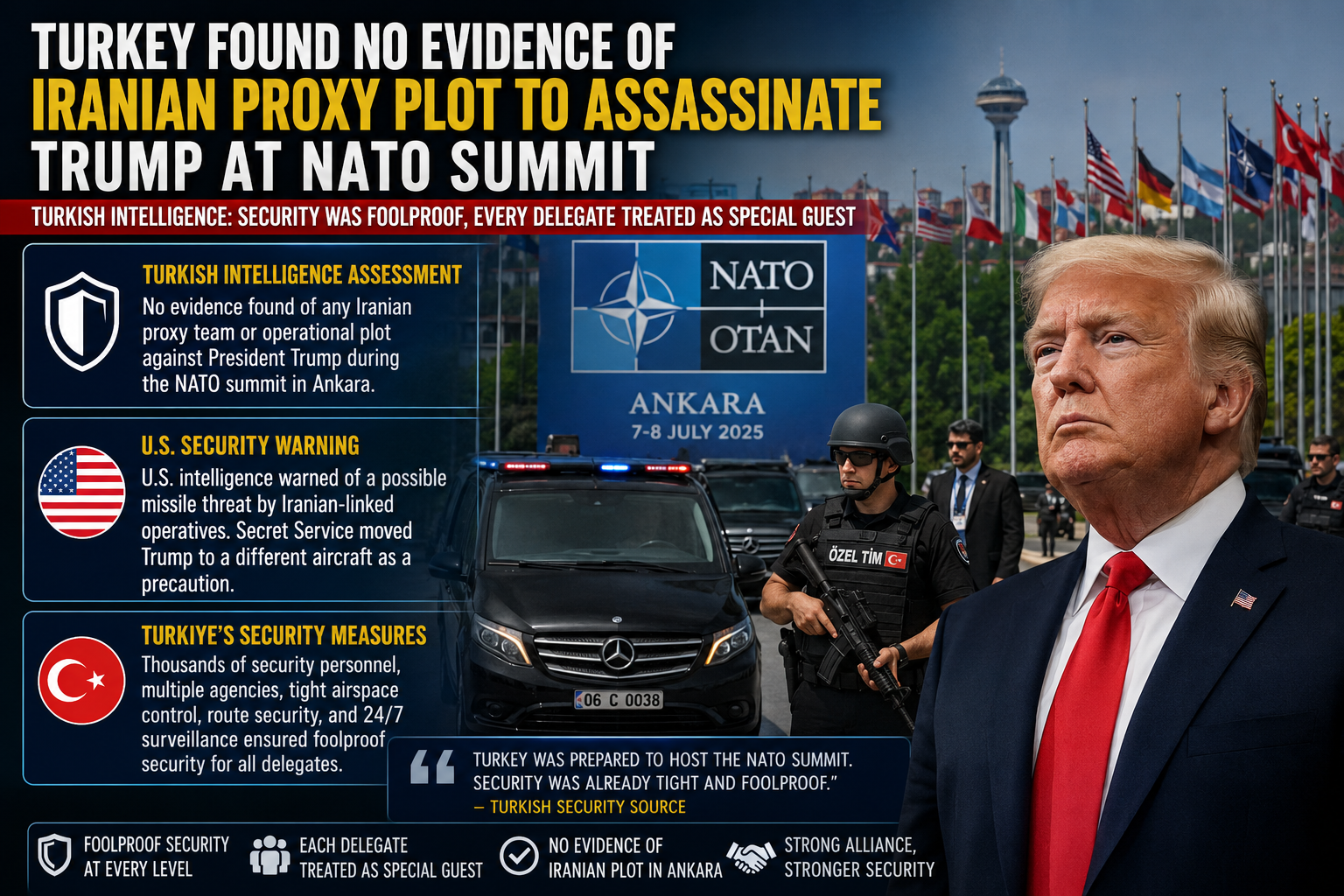
- Iranian plot to assassinate Trump: Turkish intelligence found no evidence that Iranian proxies had established an operational assassination plot against President Donald Trump during the NATO summit in Ankara.
- U.S. intelligence warnings nevertheless prompted the Secret Service to secretly move Trump to another aircraft before his departure from Türkiye.
- Turkish officials said Ankara had already deployed comprehensive, foolproof security measures and treated every NATO delegate, including Trump, as a special guest.
WASHINGTON — Turkish intelligence agencies found no evidence that Iranian proxies had established an operational plot to assassinate President Donald Trump during the NATO summit in Ankara, according to Turkish security sources.
Sources in Türkiye’s Interior Ministry and intelligence community said Ankara placed the summit under an exceptionally tight security umbrella, treating every leader, delegate, aircraft, hotel, and transit route as part of a single high-security operation.
The assessment comes after U.S. officials received warnings that Iranian-linked operatives might attempt to attack Trump’s aircraft with a shoulder-fired missile upon departure.
Trump’s Secret Turkey Escape: Loyal Aides Joined Him, But Cabinet Chiefs Stayed Behind
The warning prompted the U.S. Secret Service to execute an extraordinary deception operation, secretly moving Trump across the airport in a catering vehicle to a smaller C-32A military jet while his standard presidential travel aircraft acted as a decoy.
Unbeknownst to journalists and cabinet officials remaining on the decoy jet—including Secretary of State Marco Rubio—the president departed separately.
READ MORE: Netanyahu’s Calculated Defiance: Why Israel Rejected Trump’s Gaza Plan—and What Comes Next
Türkiye’s Security Assessment
Turkish officials stated that security for the NATO summit was a nationwide operation involving police, intelligence, counterterrorism, gendarmerie, and special operations personnel. Thousands of security officers covered airports, venues, hotels, transit corridors, and cybersecurity.
“Security was already tight and foolproof,” one Turkish security source stated on condition of anonymity. A second source noted that Ankara identified no evidence of an Iranian team preparing a portable air-defense system (MANPADS) attack. Nevertheless, officials acknowledged why the U.S. team adopted a conservative approach given their own intelligence.
Iranian plot to assassinate Trump And Washington’s Threat Landscape
For the Secret Service, waiting for absolute confirmation was unacceptable. A shoulder-fired missile presents an extreme danger during takeoff when an aircraft is low, predictable, and within range. Heat-seeking or laser-guided portable air-defense systems can target hot jet engines without emitting radar signals, making real-time interception exceptionally challenging.
READ MORE: How Trump’s Ruse to Evade an Iranian Threat Unfolded on the Tarmac in Turkey
The decision also reflected a severe threat environment. Trump previously survived a campaign rally shooting in Butler, Pennsylvania, and an armed incident at his Florida golf course. More critically, American agencies have tracked documented Iranian assassination planning targeting U.S. officials following the 2020 killing of Islamic Revolutionary Guard Corps (IRGC) commander Qassem Soleimani.
In March 2026, a federal jury convicted Pakistani national Asif Merchant for his role in an IRGC murder-for-hire plot directed against political figures, including Trump. Additionally, the Justice Department previously charged Farhad Shakeri in 2024 for allegedly working with Iranian intelligence to plan an assault on Trump.
The threat dynamics intensified further following the 2026 war, during which Iran’s Supreme Leader Ayatollah Ali Khamenei was killed in U.S.-Israeli strikes. Trump publicly claimed credit for the operation, transforming him into a primary symbol for potential Iranian retaliation.
A Difference in Mandate
The diverging actions between Washington and Ankara reflect overlapping but distinct operational priorities rather than contradictory intelligence:
-
Washington’s Priority: Eliminate any residual risk to the U.S. president during travel, regardless of whether a threat warning is fully corroborated.
Türkiye Today -
Ankara’s Priority: Secure the broader, multi-national summit environment and investigate localized operational footprints.
Intelligence agencies routinely operate with incomplete data. An agency may receive a warning from an overseas source while local host-country investigators find no physical evidence on the ground. The lack of physical evidence in Ankara does not mean the initial warning was fabricated, nor does the U.S. response indicate that Turkish summit security failed.
Iranian plot to assassinate Trump: Coordinated Layering
The Ankara episode illustrates how host-nation security and independent presidential protection interact during high-risk foreign travel. Türkiye provided a comprehensive national security apparatus for all attending world leaders. Simultaneously, the U.S. Secret Service added an extra layer of protection tailored to its specific intelligence profile.
Questions later surfaced regarding the defense capabilities of the newly inducted Boeing 747-8 aircraft gifted by Qatar, which Trump flew into Ankara. While the administration maintained that the presidential fleet meets high security standards, the rapid switch to backup aircraft underscored how acute threat calculations dictate modern executive travel.
Ultimately, there was no confirmed attack, no operational Iranian team discovered in Ankara, and no failure of the host nation’s security perimeter. The NATO summit concluded with Türkiye fulfilling its security commitments, while the United States exercised maximum caution amidst an escalating international conflict.