



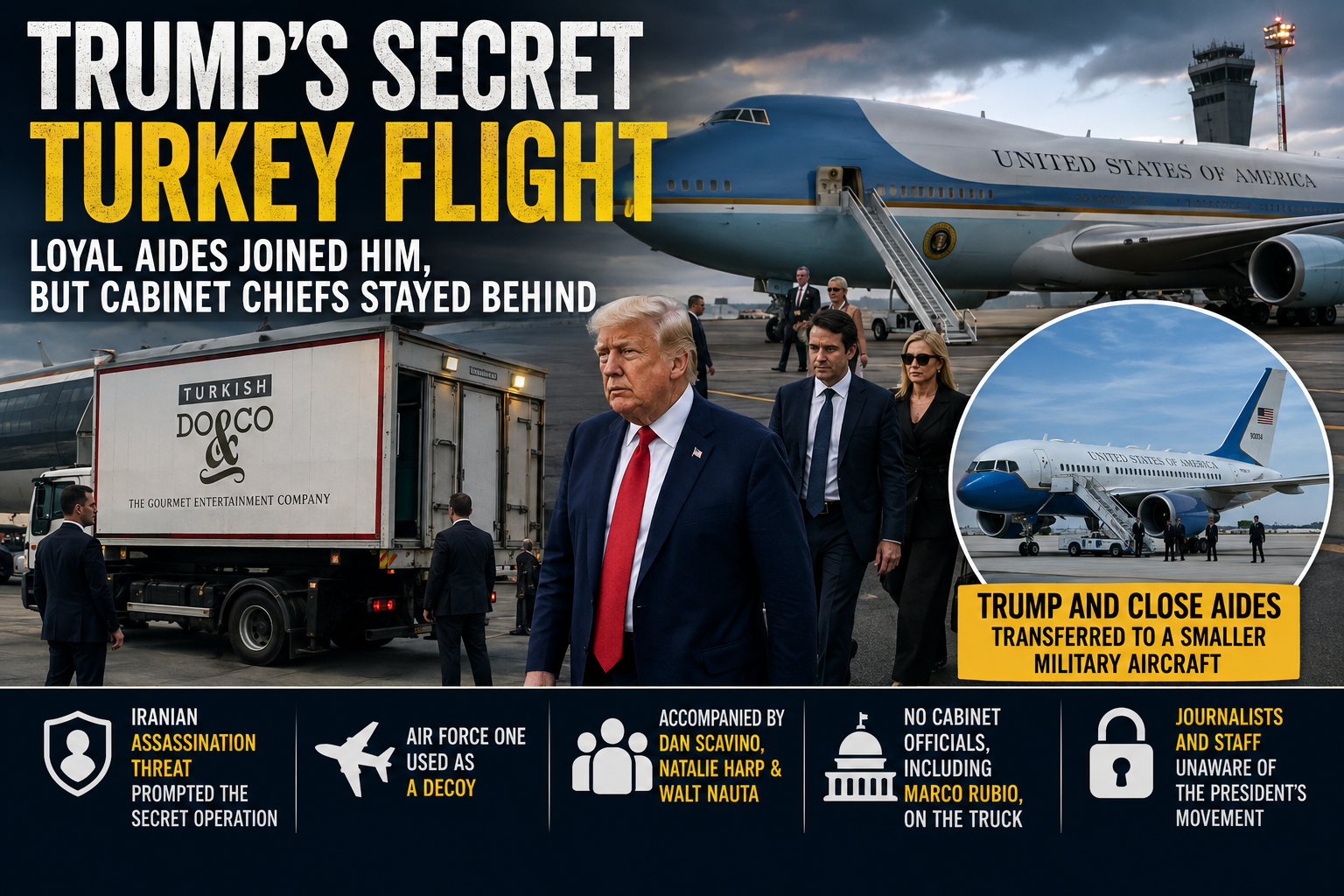
- Trump’s secret flight from Turkey involved a small group of trusted aides who secretly moved from Air Force One to a smaller military aircraft.
- The operation reportedly followed concerns over a potential Iranian assassination threat, with the original Air Force One allegedly used as a decoy.
- The presence of journalists and senior officials on the larger aircraft has triggered new questions about presidential security and congressional oversight.
A highly unusual security operation that secretly moved President Donald Trump from Air Force One to a smaller military aircraft in Turkey involved some of his closest political aides but apparently excluded senior Cabinet officials, according to new reporting by The Washington Post.
The revelation adds another layer to an extraordinary operation carried out on July 8, when Trump was quietly transferred from the presidential aircraft to a U.S. Air Force C-32A before leaving Turkey amid concerns over a potential Iranian assassination threat.
According to The Washington Post, Trump was accompanied during the covert movement by White House Deputy Chief of Staff Dan Scavino, executive assistant Natalie Harp and Walt Nauta, the director of Oval Office operations. Several less prominent aides were also part of the group.
However, senior Cabinet officials, including Secretary of State Marco Rubio, were not among those secretly transferred.
Inside the Trump Assassination Attempt That Turned a White House Gala Into Chaos
The distinction is significant because the operation effectively created two groups of passengers. Trump and a small circle of trusted aides moved discreetly to another aircraft, while senior officials, military personnel, Secret Service agents and journalists remained aboard the older Air Force One.
The Post reported that Trump’s group was moved under concealment using an airport catering truck before boarding the smaller military aircraft. The maneuver was designed to prevent anyone observing the airport from determining that the president had left the larger Boeing 747.
Iran–US War Nears Endgame as Tehran Sends Response via Pakistan, Breakthrough Expected Ahead of Trump’s China Visit
The larger aircraft subsequently served as a decoy.
A presidential security operation kept secret
The operation was apparently triggered by concerns that Iran could identify and target Trump’s aircraft.
Trump later defended the decision, saying the Secret Service had determined that he should travel separately.
“I just follow what they like to do,” Trump told reporters, explaining that the Secret Service wanted him on another aircraft.
Close Trump aides — but no Cabinet officials — made secret catering truck move
He also argued that the aircraft carrying him represented the greater potential target because an adversary would be more likely to identify it as the presidential plane.
Trump has repeatedly said that he faces continuing threats from Iran. After arriving in the United States, he described himself as being at the top of Tehran’s target list.
The White House has not publicly disclosed the full details of the operation, including exactly which officials knew about the deception in advance.
That uncertainty has become one of the most politically sensitive aspects of the episode.
Trump’ secret flight from Turkey: Why the aides matter
The presence of Scavino, Harp and Nauta is particularly notable because all three belong to Trump’s highly trusted inner circle.
Scavino has worked with Trump for more than a decade and remained closely associated with him during the period between Trump’s presidencies. Harp is known for accompanying Trump closely and providing him with printed material, while Nauta served Trump during his first administration and later became a prominent figure in the investigations surrounding classified documents at Mar-a-Lago.
Their presence suggests that the decision over who would accompany Trump was based not simply on government rank but also on personal trust and operational necessity.
That does not necessarily mean Cabinet officials were excluded because they were considered untrustworthy. Senior officials may have had to remain with the main aircraft for operational, diplomatic or security reasons.
Nevertheless, the division raises questions about how the White House determined who needed to know that the president was leaving separately.
Journalists and staff were apparently unaware
The most controversial aspect of the operation may be that journalists traveling with Trump were reportedly unaware that the president was no longer aboard their aircraft.
The White House had directed journalists to keep their window shades closed during the flight from Turkey. Reporters later discovered that the aircraft they believed was carrying Trump had effectively functioned as a decoy.
The Post has reported that even some White House personnel may not have known the president was traveling separately.
That creates a difficult security question: if the original Air Force One was considered sufficiently dangerous that Trump could not safely remain aboard, what protections were provided to everyone else who remained on it?
Democratic lawmakers have demanded answers.
Senator Richard Blumenthal has called for a congressional briefing, arguing that Congress needs to understand what precautions were taken to protect staff and journalists who unknowingly remained aboard the aircraft regarded as the greater potential target.
Trumps’ secret flight from Turkey: A wider message about Iran’s reach
The episode also illustrates the continuing security consequences of the confrontation between Washington and Tehran.
Even while Trump was attending the NATO summit in Ankara, concerns about Iranian retaliation apparently remained serious enough to alter the movement of the U.S. president.
The use of deception demonstrates how presidential protection can change rapidly when intelligence agencies identify a specific threat. It also highlights the difficulty of balancing secrecy with the safety of people who must travel alongside the president.
Trump has sought to portray the incident as evidence that the Secret Service is doing its job.
But the political controversy is unlikely to disappear quickly.
The central issue is no longer simply why Trump changed aircraft. It is whether the administration adequately protected everyone who remained on the decoy aircraft and whether senior officials, congressional leaders and the traveling press were given sufficient information to understand the risks.
The episode therefore raises a broader question about presidential security in an era of increasingly sophisticated intelligence and assassination threats.
For Trump, the secret flight was ultimately successful: he left Turkey safely.
For the White House, however, the operation has created a second challenge — explaining why protecting the president required deceiving so many people traveling with him.