



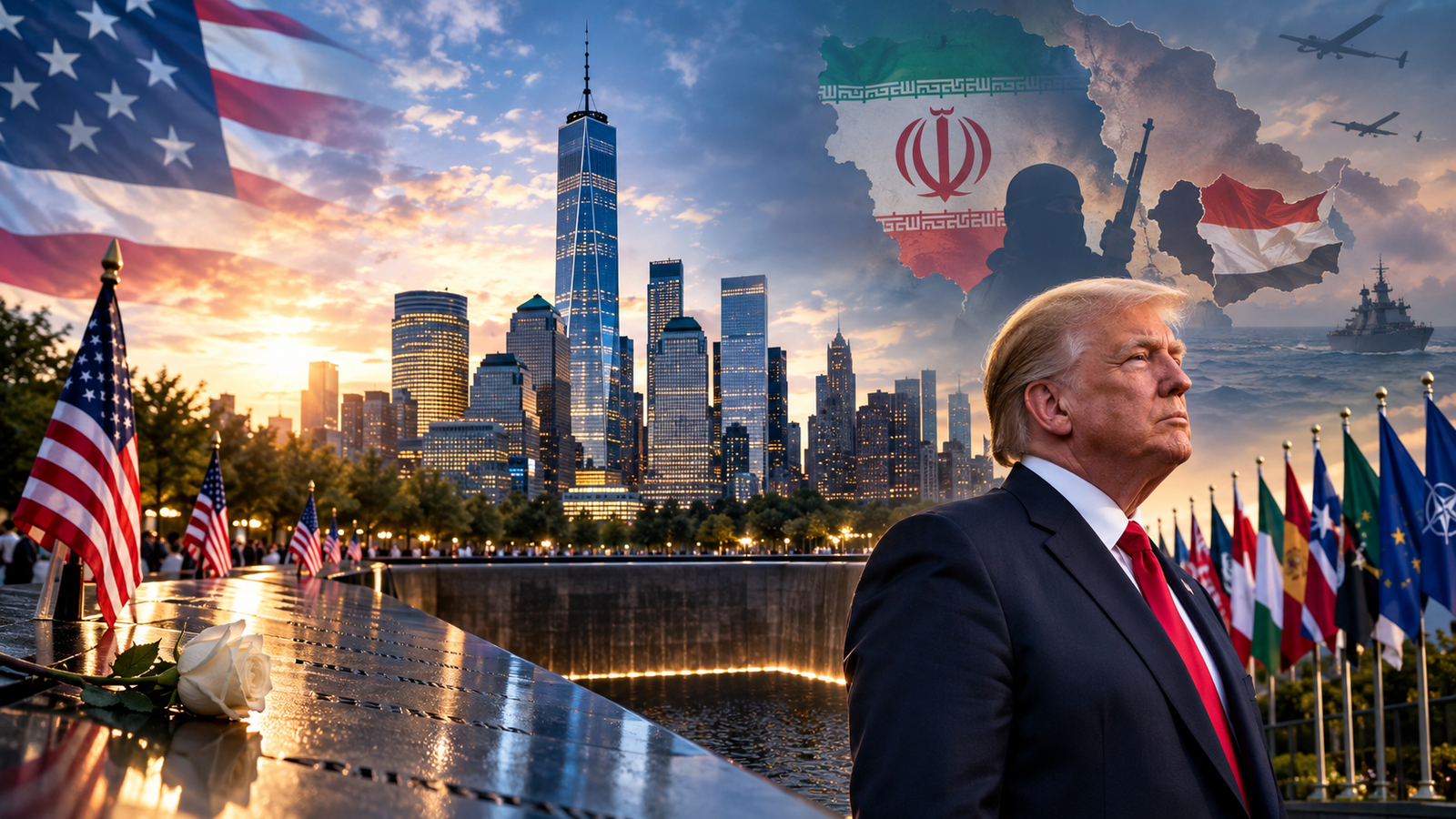
- 25th anniversary of 9/11 marks a quarter century since the attacks transformed America and the global security system.
- America’s war against terrorism has evolved from Afghanistan and al-Qaeda into a broader confrontation involving Iran, the Houthis, drones, missiles and proxy warfare.
- President Donald Trump has an opportunity to use American strength and diplomacy to move the world from perpetual conflict toward deterrence and stability.
NEW YORK — Twenty-five years after the attacks that transformed America’s understanding of terrorism, New Yorkers are once again gathering at Ground Zero to remember the 2,977 people killed on Sept. 11, 2001 — a day that permanently altered the city, American foreign policy and the global security order.
The anniversary is both a commemoration and a moment of national reflection. The names of the dead will be read, families will remember those they lost and Americans will again confront the images of the World Trade Center towers collapsing into Lower Manhattan.
But there is another story beneath the ceremonies: New York survived. America adapted. And the world moved on — although it never completely escaped the security crisis unleashed that morning.
Twenty Five Years After 9/11: The War on Terror Isn’t Over — It’s Evolving
In the immediate aftermath of 9/11, predictions about New York’s future were bleak. Businesses were expected to leave, tourism was threatened, property values were feared to collapse and Lower Manhattan appeared destined to become a monument to tragedy rather than a functioning part of the world’s greatest city.
The opposite happened.
New York rebuilt. Lower Manhattan became a residential, commercial and cultural center again. The city became larger, wealthier and even more diverse. Perhaps most symbolically, a city that once fought bitter political battles over the construction of a mosque near Ground Zero eventually elected its first Muslim mayor.
That transformation says something important about America.
Twenty-five years after 9/11, America remembers the victims while confronting a transformed terrorism threat. From Iran and the Houthis to geopolitical rivalry, Donald Trump faces an opportunity to replace endless conflict with deterrence, diplomacy and a more secure world.
Terrorism can destroy buildings. It can kill people. It can generate fear. But it does not necessarily win the larger battle for the character of a society.
The real test of a democracy after terrorism is whether fear permanently changes its values.
Twenty-five years later, America’s answer remains complicated.
The United States responded to 9/11 by launching the war in Afghanistan, invading Iraq, dismantling terrorist networks, expanding intelligence operations and building an enormous international counterterrorism architecture. Al-Qaeda was weakened, Osama bin Laden was killed and the Islamic State was territorially defeated.
READ NEXT: Gulf States Consider Retaliation To Iranian Attack: Middle East War Enters Dangerous New Phase
Yet terrorism did not disappear. It has evolved.
25th Anniversary of 9/11: The War That Never Really Ended
The war that began in 2001 has therefore entered a different phase rather than reached a clean conclusion.
America today faces a security environment radically different from that of 2001. Washington is dealing not only with remnants of jihadist organizations but also with Iran, the Houthis, missile proliferation, drones, maritime attacks, proxy warfare and an increasingly contested Middle East.
The battlefield has moved.
It now stretches from underground missile facilities and drone factories to commercial shipping lanes, military bases and cyberspace.
READ MORE: New York changed in dramatic and surprising ways in the 25 years since 9/11
Iran represents perhaps the clearest example of this transformation. The Islamic Republic has demonstrated that a state does not need to confront the United States through a conventional war alone. Missiles, drones, proxies, maritime disruption and economic pressure can impose enormous strategic costs without producing a traditional battlefield.
The Houthis have demonstrated another dimension of the same problem. Attacks on shipping can turn a regional conflict into a global economic problem almost overnight.
This is why the post-9/11 security challenge cannot be measured simply by counting terrorist organizations destroyed by American forces.
The larger question is whether the international system has learned how to prevent regional conflicts from becoming global crises.
That is where the next chapter of American leadership will be determined.
The World After 9/11 Needs a Different Strategy
The lesson of the past quarter century should not be that America must fight every threat militarily.
It should be that American power works best when military strength is combined with diplomacy, economic leverage, alliances and credible deterrence.
The United States remains the world’s most powerful military and one of its most influential economic powers. But the age in which Washington could solve every international crisis primarily through military superiority is disappearing.
The future will require something more sophisticated.
America will need strong alliances with Europe, the Gulf states and Asian partners. It will need to prevent Iran from destabilizing the region while keeping channels for diplomacy open. It will need to confront terrorism without allowing extremism to become an excuse for collective suspicion against entire communities.
And it will need to distinguish between legitimate security concerns and ideological confrontation.
This is particularly important after the experience of 9/11.
The evolution of New York offers a powerful lesson. A city that experienced extraordinary trauma did not remain frozen in the politics of 2001. Its population changed. Its political culture changed. Its relationship with Muslim Americans changed.
That does not mean America’s security challenges have disappeared. Antisemitism, Islamophobia, political violence and extremism remain serious threats.
But the long-term answer cannot be permanent fear.
25th Anniversary of 9/11: Trump’s Opportunity
President Donald Trump enters this chapter of American history with an opportunity to pursue what could become one of the most consequential foreign-policy goals of his presidency: reducing the number of wars America is drawn into while maintaining overwhelming American deterrence.
Trump’s political instinct has consistently emphasized strength, negotiation and putting American interests first. Properly executed, that approach can mean something larger than isolationism.
It can mean using American power more selectively.
The United States does not have to abandon its allies to avoid endless wars. Nor does it have to fight every conflict directly to demonstrate strength.
The more powerful strategy is to convince adversaries that attacking America or its partners will carry unbearable consequences — while simultaneously giving them diplomatic avenues to step away from confrontation.
That combination of deterrence and diplomacy could become the defining security doctrine of the next quarter century.
The forecast is therefore neither another endless war nor an unrealistic era of global peace.
The more likely future is a world in which major powers compete intensely but increasingly recognize that uncontrolled escalation is economically and strategically disastrous.
If Trump can help move American foreign policy toward that balance — strong enough to deter aggression, pragmatic enough to negotiate and disciplined enough to avoid unnecessary wars — he could help shape a post-9/11 era fundamentally different from the one that followed the attacks.
Twenty-five years after 9/11, the greatest tribute to those who died is not simply remembering them.
It is building a world in which fewer families have to experience the same loss.
The towers fell in 2001. New York rose again.
The next challenge for America and its allies is to ensure that the security architecture built after 9/11 evolves from a perpetual war against terrorism into a broader strategy for preventing wars themselves.
That would be a fitting legacy for the next 25 years.