



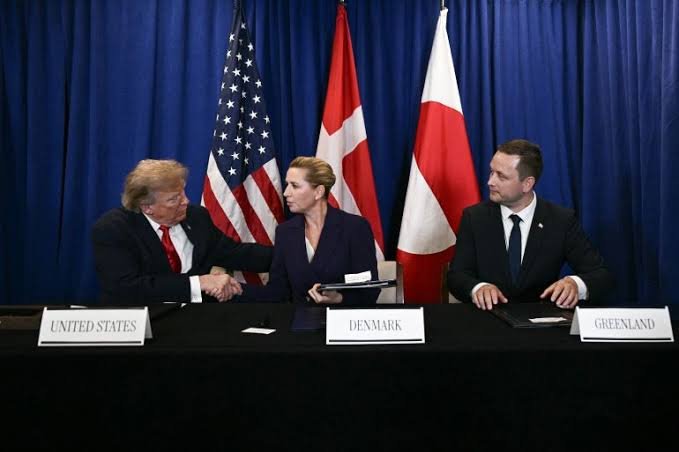
- Trump Greenland Deal transforms a sovereignty dispute into a broader US-Denmark-Greenland security arrangement.
- Diplomacy allowed Washington to pursue strategic Arctic interests without requiring a transfer of Greenland’s sovereignty.
- The agreement demonstrates why negotiation can convert geopolitical confrontation into practical security cooperation.
President Donald Trump’s Greenland strategy has produced one of the most consequential Arctic agreements of his second term, but its significance goes beyond Greenland itself. The September 22 agreement between the United States, Denmark and Greenland demonstrates how a confrontation that initially appeared capable of producing a major rupture inside the Western alliance was eventually redirected toward negotiation, compromise and shared strategic interests.
Trump began from an uncompromising position. His administration argued that Greenland’s geography was too important to American national security to remain outside Washington’s strategic control. The island sits between North America and Europe and occupies a critical position for Arctic surveillance, missile defence and the North Atlantic. Trump had previously spoken about acquiring Greenland and raised the possibility of using force, generating strong opposition in Denmark and Greenland.
Yet the agreement signed in New York represents something fundamentally different from the original sovereignty demand. Denmark retains sovereignty, while Greenland retains its right to self-determination. At the same time, Washington obtains expanded and more permanent security access, including arrangements for additional military facilities and the potential deployment of the Golden Dome missile-defence architecture.
READ NEXT: Trump and Greenland: The Arctic Chessboard Between U.S. Ambitions and Sovereign Resolve
This is where the Greenland episode becomes an important geopolitical lesson. Trump’s pressure put the issue at the centre of Western strategic calculations, but diplomacy ultimately provided the mechanism through which the dispute could be converted into an agreement.
Denmark’s response was crucial. Rather than accepting the American demand or allowing the dispute to escalate into an irreversible confrontation, Copenhagen maintained that Greenland was not available for transfer while simultaneously acknowledging Washington’s legitimate security concerns in the Arctic. Danish officials repeatedly connected Greenland’s security to NATO and the broader defence of Europe.
READ MORE: Denmark’s Greenland deal with Trump is a victory for diplomacy over bullying
That distinction changed the negotiating equation. The question gradually moved away from whether Washington could obtain sovereignty over Greenland and toward what America actually required to protect its strategic interests.
The answer was military access, surveillance capabilities, defensive infrastructure and guarantees against rival powers establishing a strategic foothold in the Arctic. Those objectives could be addressed without changing Greenland’s sovereignty.
Denmark Greenland Visit: Royal Unity Tested as US Presses Europe Over Arctic Future
The final agreement therefore reflects a classic diplomatic principle: separating positions from interests. The original American position centred on control. The underlying American interest was security. Once negotiators concentrated on the second question, a potential deadlock became negotiable.
The agreement also builds upon an existing framework. The United States has maintained military interests in Greenland for decades, and the 1951 defence arrangement already provided the foundation for American military activity there. The new agreement expands and modernises that relationship rather than creating an entirely new American presence.
Another important element is the broader NATO dimension. The new arrangement places Arctic security within a wider Western strategic framework, making Greenland not simply a bilateral dispute between Washington and Copenhagen but part of a collective security calculation involving North America and Europe. NATO Secretary-General Mark Rutte welcomed the agreement, while European governments described enhanced Arctic cooperation as important to alliance security.
For Trump, this approach also demonstrates the practical value of keeping maximum negotiating pressure on the table while ultimately accepting an arrangement that addresses the central strategic objective. The administration can point to expanded American security access and restrictions on potential adversarial strategic footholds, while Denmark and Greenland can point to continued sovereignty and self-determination.
That does not mean every interpretation of the agreement is identical. The White House describes it as giving Washington lasting control over Greenland’s security interests, while Danish officials have emphasised sovereignty and territorial integrity. Reuters reported that Denmark did not confirm the broader American interpretation of “permanent control.”
That difference matters because the durability of the agreement will depend not merely on what was signed, but on how Washington, Copenhagen and Nuuk interpret and implement it over time.
The larger lesson is nevertheless clear. Great-power diplomacy does not always require choosing between strength and negotiation. Pressure can force an issue onto the strategic agenda, but diplomacy is what can turn incompatible public positions into workable arrangements.
Greenland therefore offers a case study in the limits of coercion as well as the possibilities of negotiation. Military threats may create urgency, but they can also unite opponents and produce resistance. Diplomacy provides a pathway for opponents to protect their core interests while allowing the stronger party to pursue its strategic objectives.
Trump’s Greenland policy began with a demand that Denmark and Greenland could not accept. It ended with an agreement that gives Washington substantially greater strategic access while leaving Danish sovereignty intact. The transformation from confrontation to cooperation is precisely why the Greenland episode will remain relevant far beyond the Arctic.