



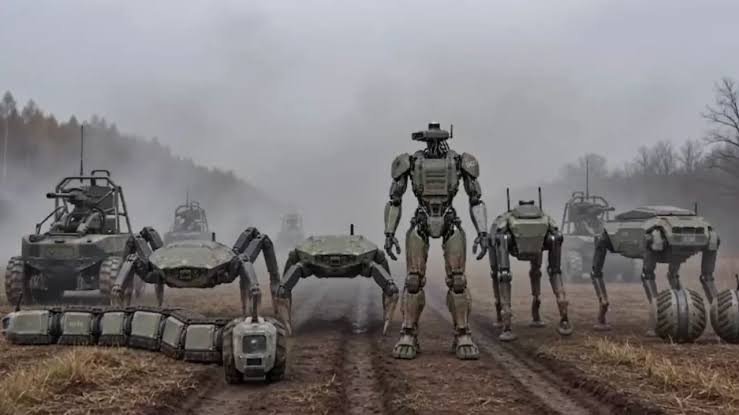
- Future Warfare is shifting rapidly from traditional human-centric force projection to machine-speed autonomous decision-making.
- Defense contractors like Lockheed Martin, General Dynamics, and Anduril are embedding AI algorithms across modern combat ecosystems.
- Advanced robotics drastically reduce human exposure in high-risk operational environments while speeding up tactical response cycles.
- Geopolitical shifts driven by AI integration force regional powers to adopt novel asymmetric capabilities.
The next era of warfare will not be defined by the size of armies or the reach of airpower. It will
be defined by autonomy—machines that see, decide, and act faster than human operators ever
could.
Across the United States defense sector, the largest military contractors are quietly
accelerating a robotics revolution that will reshape global conflict, deterrence, and strategy.
This transformation is not theoretical. It is already underway in testing ranges, classified labs,
and forwarddeployed units. And its implications—technological, ethical, and geopolitical—are
profound.
Future Warfare Shift: The Rise of Autonomous Combat Systems
The U.S. military’s pivot toward robotics is driven by a simple reality: modern battlefields are
too fast, too complex, and too lethal for human reaction times alone. Contractors have responded
with a surge of innovation.
READ NEXT: Trump Assassination Plot: How a Mother’s Call Foiled a White House Attack
Lockheed Martin, the world’s largest defense contractor, is developing autonomous ground
vehicles capable of navigating contested terrain, identifying threats, and supporting infantry
without direct human control. Their systems integrate AIdriven targeting, sensor fusion, and
battlefield networking—turning each robot into a node in a larger combat ecosystem.
General Dynamics is leading the U.S. Army’s Robotic Combat Vehicle (RCV) program,
producing unmanned armored platforms that can carry machine guns, antitank missiles, and
reconnaissance payloads. These vehicles are designed to accompany human soldiers, absorbing
risk and extending reach.
READ MORE: AI at War: What the Ongoing Conflicts Reveal About Power, Technology and Ethics
Anduril Industries, the insurgent newcomer in the defense world, is pushing the boundaries of
autonomy with its Roadrunner interceptor drone and its Lattice AI command system. Their
technology is built around rapid decisionmaking—machines that can detect, classify, and
respond to threats in seconds.
Boston Dynamics, though not a traditional weapons manufacturer, has become central to
military robotics research. Its quadruped robots, capable of navigating complex environments,
are being tested for reconnaissance, explosive ordnance disposal, and perimeter security.
Together, these companies are constructing the architecture of a battlefield where robots are not
accessories—they are participants.
Why the Pentagon Wants Robots
The strategic logic behind robotic warfare is clear
Reduced risk to human soldiers Robots can take point in urban combat, clear mines, or
scout enemy positions without exposing troops.
Faster decision cycles Autonomous systems can process sensor data and react in
milliseconds—far faster than human operators.
Persistent presence Robots do not tire, fear, or require rest. They can maintain
surveillance or defensive postures indefinitely.
Cost efficiency over time While expensive upfront, robotic systems can reduce longterm
personnel and logistics costs.
Deterrence through technological superiority Adversaries must rethink strategy when
facing machines that cannot be intimidated or psychologically manipulated.
For a military preparing for potential conflict with technologically advanced adversaries, these
advantages are decisive.
Future Warfare Shift And The Risks and Ethical Fault Lines
Yet the rise of robotic warfare carries serious concerns—many of which remain unresolved.
Autonomy vs. accountability If a robot misidentifies a target, who is responsible? The
programmer? The operator? The contractor? The chain of accountability becomes murky.
Escalation risk Autonomous systems reacting at machine speed could trigger unintended
conflict spirals before human commanders can intervene.
Cyber vulnerability Robots are only as secure as their code. A hacked autonomous
weapon becomes a liability—or a tool for the enemy.
Erosion of human judgment Warfare has always relied on human intuition, restraint,
and moral reasoning. Replacing those instincts with algorithms introduces unpredictable
consequences.
Global proliferation Once robotic weapons become standard, they will spread. Nations
with fewer ethical constraints may deploy fully autonomous lethal systems long before
the U.S. does.
These risks are not hypothetical. They are already being debated inside the Pentagon, NATO, and
the United Nations.
A New Geopolitical Reality
For countries observing from abroad—including Pakistan, India, and China—the U.S. robotics
surge signals a shift in global military balance. Nations that cannot match American autonomy
may seek asymmetric responses: cyber warfare, electronic disruption, or massproduced lowcost
drones.
Meanwhile, defense contractors are shaping the future battlefield more than generals or
diplomats. Their innovations will determine how wars are fought, how deterrence is maintained,
and how nations defend their sovereignty.
The Road Ahead
The robotics revolution in U.S. defense is irreversible. The question is not whether autonomous
systems will dominate future warfare—it is how quickly they will do so, and under what rules.
America’s contractors are building machines that will change the nature of conflict. Whether
those machines make war more precise or more dangerous will depend on the choices made
now—by engineers, policymakers, and military leaders.
The world should watch closely. Because the next war may not be fought soldier against soldier,
but algorithm against algorithm.