



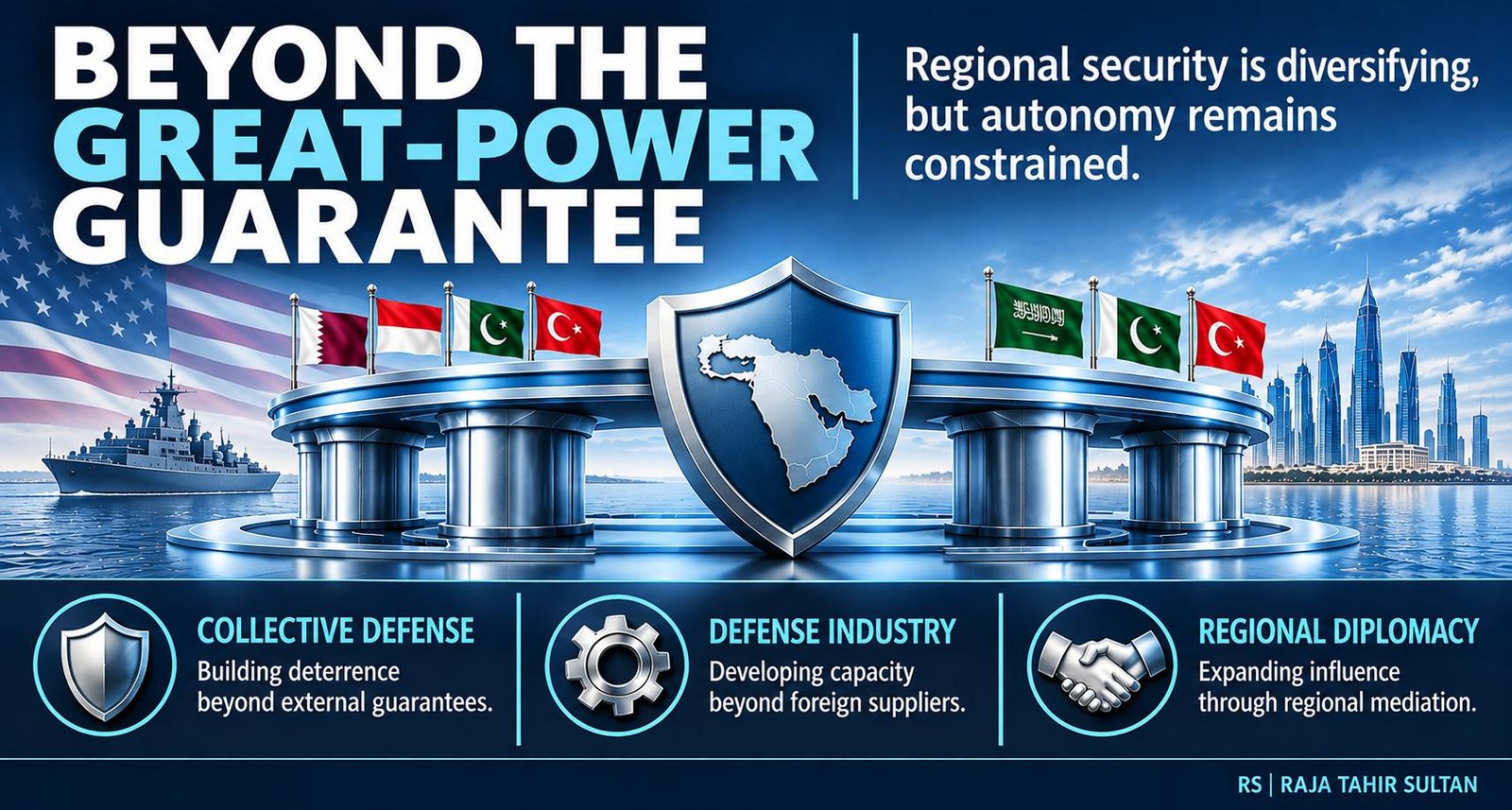
- Regional autonomy is reshaping Middle Eastern security as Gulf states diversify defense relationships beyond traditional US security guarantees.
- The Makkah Joint Defence Agreement and the Badr memorandum provide new collective-defense and defense-industrial frameworks among states like Saudi Arabia, Türkiye, and Pakistan.
- External powers like China and the US continue to play pivotal economic and military roles, meaning the emerging order is one of managed dependence rather than total independence.
Iranian negotiators had just concluded talks in Doha on November 2, with a draft proposal for an agreement with Washington circulating through Qatari mediators. At the same time, Xi Jinping hosted Oman’s Sultan and called for a ceasefire and safe passage through the Strait of Hormuz.
Diplomacy was unfolding across Doha, Muscat, and Beijing. Yet the decisive instrument of immediate pressure, the US naval blockade of Iranian ports, remained in Washington. This contrast captures the central tension in the emerging regional order: diplomatic activity is spreading across more capitals, while decisive military leverage remains concentrated.
The war has exposed a weakness in the Gulf’s long-standing security arrangements. Regional governments have invested heavily in American weapons, hosted US military facilities, and relied on Washington’s security commitments.
Crown Prince MBS Houthi Strategy: A Masterclass in Long-Term Regional Security
Yet the conflict has shown that military protection does not necessarily prevent attacks on critical infrastructure, guarantee freedom of navigation, or ensure that US strategic priorities align with those of regional partners. The question is whether dependence on a single external guarantor provides a sufficient foundation for regional security.
This does not signal an American withdrawal or the collapse of US influence. Washington retains unmatched military capabilities, regional infrastructure, intelligence networks, and arms relationships. But a security guarantee depends not only on the guarantor’s capabilities, but also on the protection partners believe those capabilities will provide when they face direct threats. The conflict has widened the gap between the region’s dependence on the United States and the confidence that dependence inspires.
READ MORE: 7 Powerful Insights on the Makkah Defence Pact Reshaping Middle East Security
The emerging response is strategic diversification, not the replacement of the United States. Regional governments are exploring additional security layers through collective defense, defense-industrial partnerships, and diplomatic coordination. These initiatives do not yet constitute an integrated regional security system. They reflect a growing recognition that external protection and bilateral relationships cannot address interconnected vulnerabilities on their own.
The Makkah Joint Defence Agreement, signed on August 7 by Saudi Arabia, Türkiye, and Pakistan, represents the collective-defense dimension of this approach. It establishes a framework for security cooperation and deterrence among states with different capabilities and diplomatic relationships.
However, a treaty does not automatically create an operational alliance. Credible collective defense requires agreed procedures, command arrangements, intelligence sharing, interoperability, logistics, and clarity about the circumstances that could trigger a joint response. Its value will depend on translating political commitments into practical capabilities.
The Badr memorandum, signed on October 21 in Doha by Qatar, Indonesia, Pakistan, and Türkiye, addresses a different but complementary dimension. It does not establish a mutual-defense obligation. Instead, it provides a framework for defense production, technology transfer, joint manufacturing, and integrated supply chains. Its strategic value lies in the potential to reduce long-term dependence on foreign suppliers and build industrial capacity among participating countries.
The distinction matters. Makkah addresses political and collective defense; Badr focuses on the industrial and technological foundations of defense capacity. Neither offers an immediate substitute for external capabilities. Industrial autonomy requires investment, technology access, skilled labor, research, procurement commitments, and sustained coordination.
SIPRI data for 2021 to 2025 illustrate the scale of dependence: the United States accounted for 54 percent of major arms imports into the Middle East, including 77 percent of Saudi Arabia’s imports and 48 percent of Qatar’s. Reducing that reliance requires production capacity for equipment, maintenance, upgrades, and innovation, not simply memoranda or joint-venture announcements.
READ MORE: Saudi Arabia, Qatar, Jordan, Egypt condemn Iranian attack on Bahrain – as it happened
Diplomacy is the third layer of diversification. Qatar, Oman, and Pakistan have maintained communication channels and facilitated engagement because of their relationships and access to different parties. Such access can create opportunities for de-escalation, but it does not give mediators control over outcomes. They can facilitate talks and transmit proposals; they cannot compel agreement or prevent escalation.
Their involvement also carries risks. Qatar is exposed to regional conflict, Oman sits beside the Strait of Hormuz, and Pakistan must balance its security relationship with Saudi Arabia against its proximity to and diplomatic relationship with Iran.
Pakistan consequently occupies a consequential but complicated position. Its participation in Makkah, involvement in Badr, military relationship with Saudi Arabia, and engagement with Washington and Tehran give Islamabad several channels of influence.
READ NEXT: Pete Hegseth Impeachment: House GOP Braces for Critical Defections Amid Post-Midterm Fallout
The opportunity is to contribute to regional security, industrial cooperation, and crisis management. The constraint is that commitments to Saudi Arabia could become difficult to reconcile with diplomatic engagement with Iran if a crisis tests collective-defense obligations. Pakistan’s value as a bridge will depend on converting participation into institutional influence without becoming excessively exposed to confrontation.
China adds economic and diplomatic weight to the equation. It is a major energy customer and an important partner for Gulf states, with a clear interest in protecting energy flows through Hormuz and preventing wider conflict. But its economic influence and diplomatic access do not make it an equivalent substitute for the American military presence. Beijing has not assumed Washington’s regional defense commitments or military infrastructure responsibilities. Its role is consequential, but different.
Hormuz illustrates why regional autonomy cannot rest on defense agreements alone. Disruption to maritime traffic would affect energy exports, insurance, shipping, and economies far beyond the conflict zone. Gulf security is inseparable from international energy-market stability. Resilience therefore requires military preparedness, diplomatic engagement, commercial planning, and cooperation with external powers.
The central constraint is the divergence of national interests. Saudi Arabia, Türkiye, Pakistan, Qatar, Indonesia, and Oman do not share identical threat perceptions or relationships with major powers. Their cooperation is significant, but those differences may limit collective action when treaty commitments, national priorities, and regional stability come into tension.
The emerging order is not a transition from American dominance to regional independence. It is a movement toward managed dependence. Regional governments want to diversify defense relationships, develop industrial capabilities, and expand diplomatic options without abandoning external partnerships. The United States will remain central to the military balance, while China and other powers retain economic and diplomatic influence. The change is that regional states are seeking greater room to shape the terms of their engagement.
The decisive question is whether they can turn shared vulnerability into durable institutions. The Makkah agreement, Badr framework, and diplomatic activity across Doha, Muscat, Islamabad, and Beijing are early elements of that effort. Their credibility will depend on implementation, investment, operational capacity, and the ability to manage competing interests. Regional autonomy will not come from replacing one guarantor with another. It will depend on whether regional states can cooperate, absorb risk, and exercise collective agency while preserving the external relationships on which their security and prosperity still depend.