



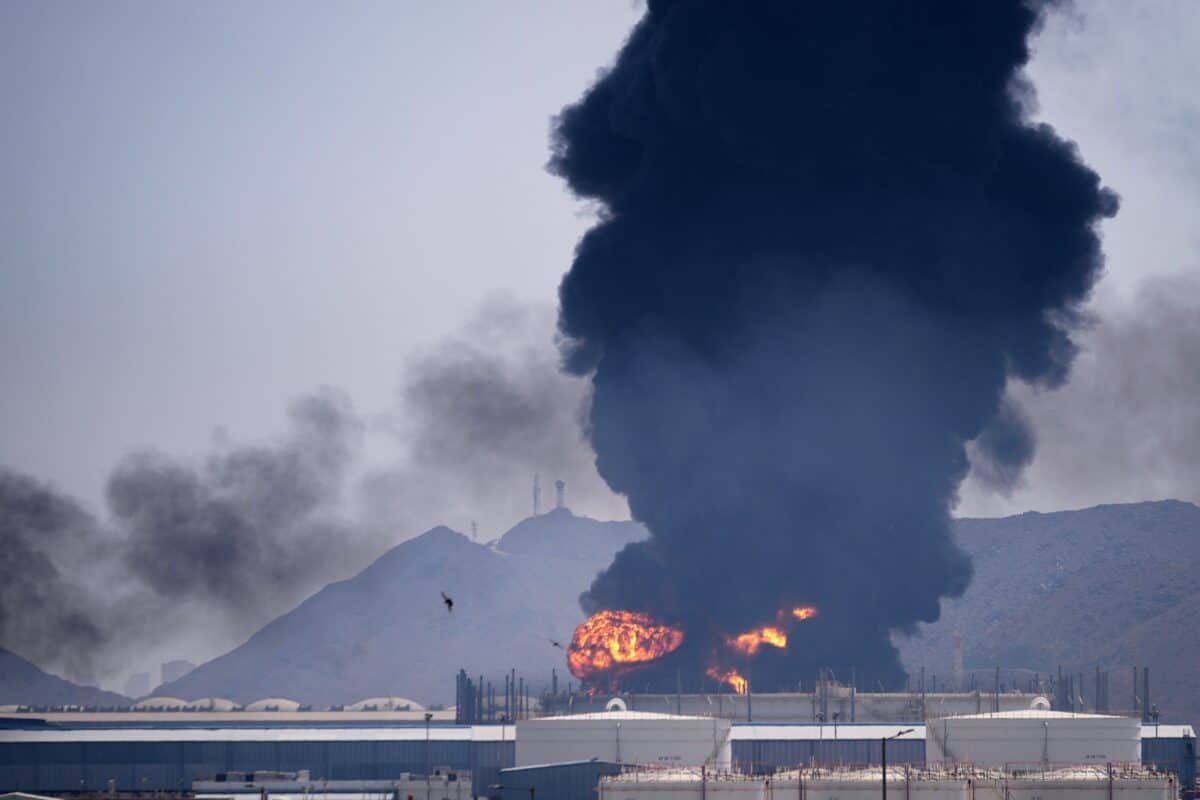
- US strike on Iran’s Qeshm Island was reportedly carried out on Tuesday in apparent retaliation after Iran confirmed firing missiles toward Oman again alongside drone attacks on Bahrain.
- Oil prices pushed upward toward $94 per barrel for Brent crude following the escalation, with analysts warning that further maritime disruptions near the Strait of Hormuz could drive prices even higher.
- Resilient US economic data—including a 0.2% rise in October retail sales and a 1.1% jump in import prices—compounded inflation concerns and strengthened the US dollar.
Global energy markets and geopolitical observers were jolted on Tuesday after the United States reportedly carried out airstrikes on Iran’s strategic Qeshm Island in the Strait of Hormuz. According to regional intelligence assessments and Iranian state media reports, the American military action was apparently launched in retaliation after Iran confirmed it fired missiles toward Oman again on Tuesday, alongside a third consecutive wave of drone attacks targeting a US radar installation in Bahrain.
The rapid tit-for-tat escalation immediately rattled commodities trading, pushing Brent crude oil futures slightly upward toward the $94 per barrel mark. Energy analysts warn that if naval hostilities intensify across the Gulf’s vital maritime chokepoints, crude prices could surge significantly higher, threatening global supply chains and reigniting worldwide inflation.
Escalation in the Strait of Hormuz and Regional Spillover
Tensions across the Persian Gulf have reached a boiling point as the months-long US-Iran war grinds on without a diplomatic breakthrough. On Tuesday, Iran confirmed renewed missile activity targeting Omani waters—a critical juncture near the southern mouth of the Strait of Hormuz—while its navy claimed a third commercial oil tanker caught fire after striking a sea mine east of the waterway.
READ NEXT: U.S. Strikes on Qeshm Island Spark Regional Panic and Looming Water Crises
Simultaneously, the Islamic Revolutionary Guard Corps (IRGC) claimed responsibility for its third drone assault in less than a week against the al-Riffa air base in Bahrain. While US Central Command (CENTCOM) and Bahraini air defenses confirmed that all incoming one-way attack drones were intercepted without casualties or infrastructure damage, the frequency of strikes underscores Tehran’s determination to pressure Washington and its Gulf allies.
Regional instability widened further on Tuesday across two additional fronts:
-
Red Sea Chokepoint: Iran-aligned Houthi forces declared they had seized control of Yemen’s coastline along the Bab el-Mandeb Strait from Saudi-backed troops, vowing to blockade Saudi ports and placing nearly a third of global seaborne oil transit under dual maritime threat.
-
Iraqi Standoff: In Iraq, the powerful Iran-backed militia Kataib Hezbollah vowed to confront Iraqi government forces preparing to enter its Jurf al-Sakhar stronghold near Baghdad, raising fears of internal sectarian conflict.
Despite diplomatic overtures from Tehran offering to reopen the Strait of Hormuz if Washington lifts its naval blockade and unfreezes Iranian assets, President Donald Trump indicated this week that the White House is no longer pursuing a negotiated settlement, instructing Vice President JD Vance to pivot back toward domestic policy.
US Retail Sales Resilience and Federal Reserve Rate Outlook
The geopolitical shockwaves in the Middle East collided on Tuesday with fresh macroeconomic data from Washington that complicates the Federal Reserve’s monetary policy path. October US retail sales rose by 0.2% month-over-month, edging past consensus forecasts of 0.1% and bringing annual retail growth to 6.8%. Core retail sales—which exclude automobiles, gasoline, building materials, and food services—climbed 0.6%, comfortably beating expectations of 0.4%.
READ MORE: Oil Prices Rise: US Strikes Iran’s Qeshm Island? US Retail Sales Beat Forecasts
While the pace moderated from September’s robust 0.8% headline surge, the numbers demonstrate remarkable resilience among American consumers despite elevated borrowing costs and geopolitical uncertainty. However, underlying price pressures remain stubborn:
-
US Import Prices: Jumped 1.1% month-over-month in October, outpacing forecasts of 0.7%.
-
US Export Prices: Rose 1.1% month-over-month, more than double the 0.5% consensus estimate.
Economists note that the combination of sticky import inflation, a tightening energy market driven by the US-Iran conflict, and steady consumer spending strengthens the case for the Federal Reserve to maintain a hawkish posture. Backed by rising crude benchmarks and firm domestic data, the US dollar gained ground against major currencies, leaving investors bracing for heightened volatility across equity, bond, and energy markets in the days ahead.