



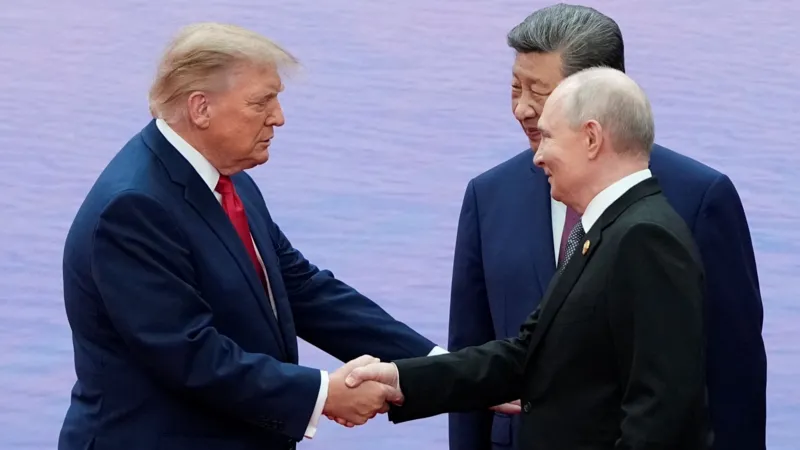
- Trump Xi Putin summit brings together the leaders of the United States, China and Russia in an unprecedented trilateral meeting in China.
- Nuclear arms reduction, the Iran conflict and the Ukraine war are among the critical geopolitical issues surrounding the historic talks.
- The meeting presents China with a major diplomatic and security test as the world watches the three most powerful leaders.
SHENZHEN, China — The leaders of the United States, China and Russia are preparing for a meeting on Thursday that has no modern precedent: Donald Trump, Xi Jinping and Vladimir Putin will hold the first trilateral summit among the heads of the three nuclear-armed powers.
The Shenzhen meeting, held on the sidelines of the Asia-Pacific Economic Cooperation summit, brings together strategic competitors whose decisions affect global security and markets.
The leaders appeared at APEC events on Wednesday. Xi personally greeted Trump at Shenzhen airport, the first such welcome for a visiting leader since he became president, Reuters reported. Xi and Putin also held talks. The trilateral is scheduled for Thursday.
From Washington and London to Islamabad, New Delhi, Paris and Brussels, capitals are watching whether the meeting can produce understandings or mainly deliver a powerful image.
Their agendas are markedly different.
US, China, Russia summit: Trump, Xi, and Putin Chart a New Global Security Architecture
Trump has publicly identified nuclear weapons reduction as a priority. The White House says he wants to discuss reducing nuclear arsenals and preventing further proliferation. The timing is significant: the New START treaty, the last major US-Russian agreement limiting strategic nuclear weapons, expired in February, leaving the two largest nuclear arsenals without its constraints.
A three-way arms-control negotiation faces formidable obstacles. China says Washington and Moscow, with much larger stockpiles, must cut first. The Washington Post cites estimates of roughly 4,000 militarily available warheads each for the US and Russia, against about 600 for China. A breakthrough is unlikely; continued dialogue or safeguards against accidental escalation would be more realistic.
READ MORE: Trump shakes hands with Putin and Xi ahead of historic talks in China
For Putin, Ukraine is likely to dominate. Moscow wants to shape discussion of a settlement and European security. Trump says he will raise the war, despite earlier US signals it might not feature. Putin can also demonstrate that Russia is not diplomatically isolated.
Xi has reasons to avoid a mediation role that could damage China’s relationships or expose it to pressure. Beijing maintains close ties with Moscow while invoking sovereignty and dialogue. Ukraine’s absence will fuel concern in Kyiv and Europe that its future could be discussed without it. Yalta comparisons are potent, but the three have neither agreed on a common agenda nor shown they can divide influence.
Iran is another possible subject. Trump has said the conflict involving Iran will be discussed, and US officials have indicated that he intends to raise it with Xi and Putin. China is a major economic partner of Tehran, while Russia has its own strategic relationship with Iran. Whether either government can use its influence to prevent further escalation remains uncertain. There is no public indication of a negotiated initiative or agreed outcome.
READ NEXT: US Strike on Iran’s Qeshm Island Escalates Middle East Conflict, Lifting Crude Oil Prices Amid Resilient US Economic Data
Trade and technology will also feature. Xi defended open trade at APEC and promised lower tariffs and wider market access, as Washington announced new restrictions on China’s access to advanced AI chips. Tariffs, critical minerals and technology competition will shadow the talks; Russia opposes Western sanctions.
For China, hosting the encounter is itself a strategic achievement. Xi can portray Shenzhen as a venue where the world’s principal powers communicate amid deep international uncertainty. Beijing says the objective is to strengthen communication, manage differences and promote strategic stability. But convening the meeting does not mean China controls its outcome. Xi must balance the prestige of the occasion against the risk that Trump or Putin will press issues Beijing would rather keep outside the room.
The intelligence dimension is unusually sensitive because each delegation will include senior political, military and diplomatic officials, while the summit itself creates opportunities to read signals beyond public statements. Host authorities will be expected to secure transport routes, accommodation, meeting rooms and communications against disruption. That does not establish any particular operation; it explains why security professionals well beyond China will follow the summit. The stakes extend beyond the meeting room to every movement and message.
The summit is a major test for Chinese security and law-enforcement agencies. Protecting the leaders, delegations and venues requires exceptional coordination. Intelligence services will assess developments and seek insight into the leaders’ intentions, although specific surveillance claims cannot be verified. China must maintain tight security while the APEC programme proceeds.
Expectations should remain measured. The leaders may look relaxed in public and exchange courtesies, but their governments arrive with competing priorities. Any joint statement may emphasise dialogue and stability rather than resolve a conflict. Thursday’s significance may lie less in an immediate deal than in Washington, Beijing and Moscow placing their leaders in the same room.
For capitals from Islamabad to Brussels, that alone matters. The world will be watching not only what the three leaders say, but what they avoid saying — and whether this rare encounter opens a channel for managing crises or merely stages the rivalries defining the international order.