



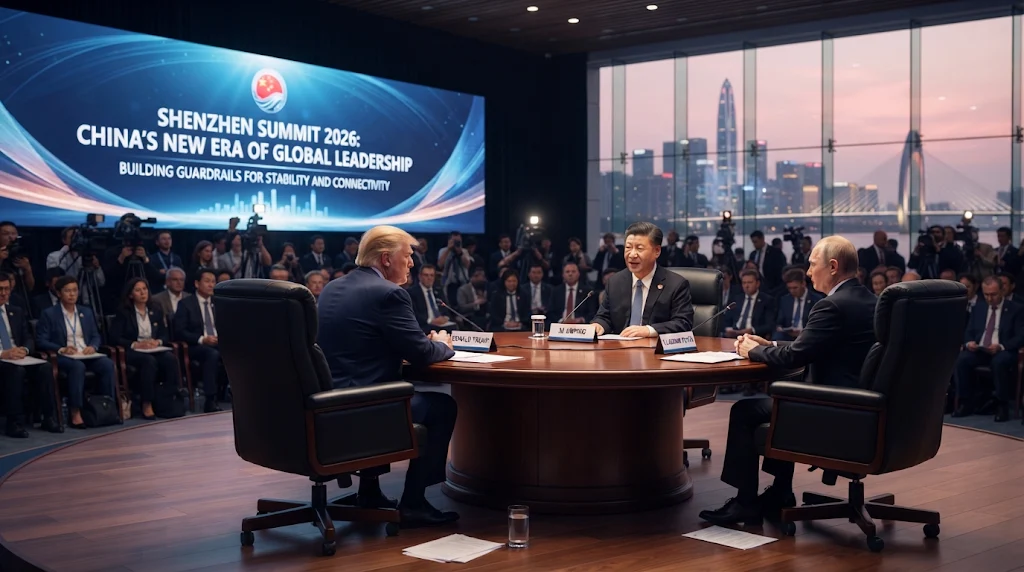
- Not “Yalta 2.0”: Rather than carving up spheres of influence, the November 19 Shenzhen summit demonstrated China’s diplomatic convening power and established structural guardrails around nuclear risk, UN reform, and energy stability.
- Pragmatism Over Grand Bargains: Follow-up U.S.–China maritime safety talks in Shanghai reinforce Beijing’s preference for practical crisis-management mechanisms over coercive mediation in regional conflicts.
- The China–Pakistan Bridge: While Beijing sets macro-level stability frameworks, Islamabad’s regional diplomacy in the Gulf and CPEC connectivity translate global de-escalation into tangible security and trade gains for the Global South.
On Thursday, November 19, the eyes of the international community were fixed on Shenzhen as Chinese President Xi Jinping hosted U.S. President Donald Trump and Russian President Vladimir Putin on the sidelines of the APEC meetings. Barely twenty-four hours later, on Friday in Shanghai, Chinese and American military officials sat across the table for critical maritime safety consultations.
Together, these twin diplomatic engagements stand in stark contrast to the volatile realities stretching across the Middle East—from the ongoing tensions in Tehran to the fragile security architecture in Riyadh and the wider Persian Gulf.
While Western commentators have rushed to label the Shenzhen gathering a modern “Yalta 2.0,” viewing it through the dated prism of nineteenth- and twentieth-century spheres of influence, the view from South Asia is markedly different.
The Shenzhen Declaration: G3 Diplomacy and the Limits of Strategic Convergence
Shenzhen was not a secret carve-up of the world; rather, it was an unmistakable stamp on China’s leading role in global governance, showcasing both Beijing’s organizational prowess and a pragmatic new model of great-power stabilization.
Beijing’s Strategic Calculus: Guardrails Over Grand Bargains
For anyone watching the proceedings in Shenzhen, the sheer scale of China’s logistical and diplomatic execution was impossible to ignore. Hosting the leaders of the United States and Russia simultaneously amid heightened global friction required exemplary security protocols and profound institutional coordination.
READ MORE: Yalta 2.0: US-China-Russia talks could shape Southeast Asia’s economic and strategic outlook
World leaders arrived in Guangdong province not merely to negotiate, but to witness firsthand the administrative might, technological modernity, and diplomatic gravity of twenty-first-century China—and, in coming to Beijing’s table, they implicitly embraced that reality.
Yet what made Shenzhen truly consequential was what Beijing chose not to do. Rather than forcing premature, top-down settlements on intractable crises in Ukraine or Iran, Chinese diplomacy prioritized broad, structural guardrails. The resulting Declaration Toward Peace anchored great-power consensus around four stabilizing pillars: nuclear risk reduction, United Nations reform, diplomatic immunity, and the stabilization of global energy supplies.
This approach reflects a deliberate strategic calculus. By refusing to act as a coercive arbiter in regional wars, Beijing preserved its strategic autonomy while fulfilling its self-defined role as a responsible major power and champion of the Global South.
MUST READ: Shenzhen Trilateral Summit: Optimism Meets High-Stakes Diplomacy as Trump, Putin, and Xi Gather
The follow-up maritime safety talks in Shanghai reinforce this logic. Beijing and Washington recognize that tactical crisis-management mechanisms—preventing accidental collisions at sea or miscalculations in contested waters—are far more valuable to global commerce than hollow ideological grand bargains.
The South Asian and Gulf Link: Translating Stability into Connectivity
From Islamabad’s vantage point, the Western obsession with “Yalta 2.0″ misses the fundamental transformation occurring across the Global South. Middle powers like Pakistan have zero appetite for a world order in which superpowers divide regions into exclusive zones of control. Instead, countries across Asia and the Middle East welcome any framework in which Beijing and Washington lower the geopolitical temperature, establish predictable rules of engagement, and prevent great-power rivalry from spilling over into catastrophic conflict.
When the world’s largest economies commit to energy market stability and naval de-escalation, developing nations gain the breathing room required to focus on trade, industrial modernization, and regional connectivity. However, macro-level declarations issued in Shenzhen still require granular, on-the-ground diplomacy to hold together in flashpoint regions—and this is precisely where the China–Pakistan partnership demonstrates its enduring value.
While Beijing sets the overarching architecture for global stability, Islamabad is actively engaged in delicate regional shuttling across the Persian Gulf. Leveraging its historic ties with both Riyadh and Tehran, Pakistan has worked tirelessly to encourage restraint, advocate for the protection of vital shipping lanes, and ensure that regional actors respect broader frameworks for de-escalation.
Furthermore, the Shenzhen emphasis on securing global energy supplies underscores the strategic foresight of the China–Pakistan Economic Corridor (CPEC). As maritime chokepoints from the Red Sea to the Strait of Hormuz face persistent security threats, overland and alternative maritime routes linking the Arabian Sea to western China via Gwadar are no longer just bilateral infrastructure projects; they are vital insurance policies for Asian energy security and supply-chain resilience. In this sense, Islamabad’s regional diplomacy and connectivity infrastructure act as practical extensions of Beijing’s macro-stability goals.
Not “Yalta 2.0”: A Practical Bridge for a Multipolar Era
History will likely remember November 2026 not for the resurrection of Cold War power politics, but for the maturation of a distinctly Asian approach to international statecraft. Through impeccable execution in Shenzhen and quiet pragmatism in Shanghai, China demonstrated that true global leadership in a multipolar world is not about dominating weaker states, but about convening rivals and constructing the guardrails that keep the international system from derailing.
For the Global South, the takeaway is clear. Great-power cooperation does not have to come at the expense of smaller nations’ sovereignty. As the China–Pakistan axis continues to evolve in 2026, it serves as an essential bridge—connecting Beijing’s high-level diplomatic convening power with Islamabad’s agile regional conflict resolution, and turning the promise of a stable, multipolar world into tangible economic reality.