



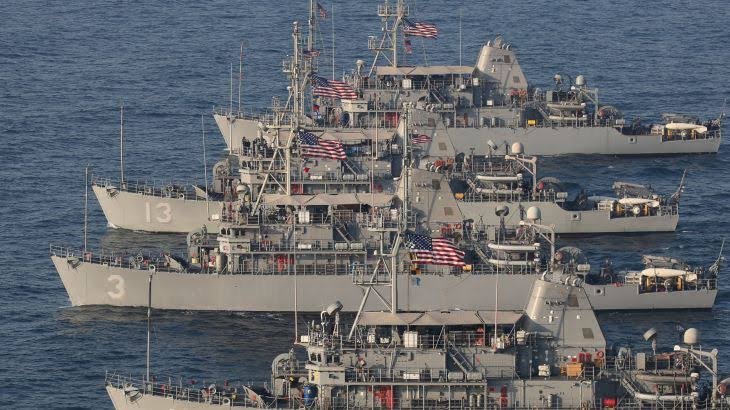
- US-Iran naval blockade tensions have pushed the Persian Gulf to the brink of full-scale war over the next 24 hours as Iran prepares a 14-tanker convoy at Kharg Island.
- Severe domestic shortages of food and essential goods have forced Tehran into a high-stakes standoff, while President Donald Trump has ordered U.S. commanders to stop any breakout at all costs.
- Any kinetic clash in the Strait of Hormuz or Gulf of Oman threatens immediate Iranian retaliation against Gulf energy infrastructure, risking an overnight spike in global oil prices.
The Persian Gulf is balanced on a razor’s edge. Over the next 24 hours, the maritime chokepoint of the Strait of Hormuz—and the waters stretching from Kharg Island into the Gulf of Oman—could transform from a tense blockade zone into the opening theater of a full-scale military confrontation. Reports that Tehran has positioned a convoy of more than 14 oil tankers at Kharg Island, with crews assigned and Iranian flags raised to run the United States naval blockade, have placed regional capitals and global energy markets on high alert.
For Washington, the rules of engagement leave zero room for ambiguity. President Donald Trump has issued an uncompromising warning to Tehran, daring the regime to test American sea power and declaring that any blockade-running vessels will end up “at the bottom of the sea” alongside the rest of Iran’s naval assets.
According to diplomatic and security sources, U.S. Central Command (CENTCOM) and Indo-Pacific Command (INDOPACOM) commanders have standing orders to halt any breakout at all costs. Even if an Iranian convoy were to slip past the 5th Fleet’s immediate perimeter in the Persian Gulf, the 7th Fleet stands ready across the broader Indian Ocean to intercept, board, or disable the vessels. Washington has also closed off clandestine workarounds, warning that third-party ships conducting ship-to-ship transfers of Iranian crude—such as a dark-fleet transfer observed south of Kharg Island earlier this week—face immediate seizure.
Inside Tehran, however, the calculus is no longer governed by conventional military deterrence; it is driven by regime survival. Since the U.S. naval blockade was first imposed in April and reinstated in July after diplomatic talks collapsed, Iran’s economy has been pushed toward freefall. With crude exports—the regime’s primary lifeline for foreign currency—effectively paralyzed, domestic inflation has surged past 70 percent, triggering severe shortages of food, medicine, and essential commodities. As the Institute for the Study of War (ISW) notes, Tehran’s willingness to risk the annihilation of its remaining tanker fleet underscores just how unsustainable its internal crisis has become.
To relieve that pressure, Iran has spent recent days attempting to widen the battlefield and distract American forces. Over the past week, Iranian forces and their regional proxies have escalated attacks across the Gulf—targeting U.S. air defense radar installations in Bahrain, striking maritime infrastructure near Oman, and claiming responsibility for downing an American drone over the strait.
READ MORE: US Strike on Iran’s Qeshm Island Escalates Middle East Conflict, Lifting Crude Oil Prices Amid Resilient US Economic Data
Simultaneously, commercial shipping through Hormuz has plummeted roughly 65 percent below pre-war levels amid naval mine threats and tanker fires, including fresh incidents flagged by the UK Maritime Trade Operations (UKMTO) in the Gulf of Oman. By raising the security cost for Gulf neighbors like Saudi Arabia, Bahrain, and Oman, Tehran hopes to fracture regional support for Washington’s blockade and force a diplomatic concession.
Yet skepticism remains over whether the 14-tanker convoy is an imminent kinetic operation or a high-stakes game of brinkmanship. Maritime sanctions experts, including advisers at United Against Nuclear Iran (UANI), point out that satellite imagery of Kharg Island shows limited recent loading activity, suggesting the convoy threat may be psychological warfare aimed at rattling oil traders.
READ NEXT: Iranian Foreign Minister Abbas Araghchi Calls on COAS Field Marshal Asim Munir in Rawalpindi
Even if Tehran intends to bluff, the margin for miscalculation is virtually nonexistent. With civilian crews caught between Revolutionary Guard directives and U.S. Navy warning shots, a single refusal to comply with an American radio order to stand down could trigger an irreversible chain reaction.
Global oil markets are currently caught between two competing forces. While Brent crude hovered near $92 a barrel today—weighed down by broader equity sell-offs and global supply expectations—analysts warn that an actual naval clash in the next 24 hours would instantly erase any bearish sentiment. Should American warships open fire on an Iranian convoy, Tehran has vowed to retaliate directly against Persian Gulf energy facilities, a move that would choke off global crude supplies and send prices skyrocketing past triple digits overnight.
Whether the Kharg Island standoff ends in a quiet stand-down or a fiery naval engagement will be decided in the coming hours. Both Washington and Tehran have backed themselves into corners where backing down carries immense political peril—and in the narrow waters of the Persian Gulf, a single spark is all it takes to ignite the next major war.