



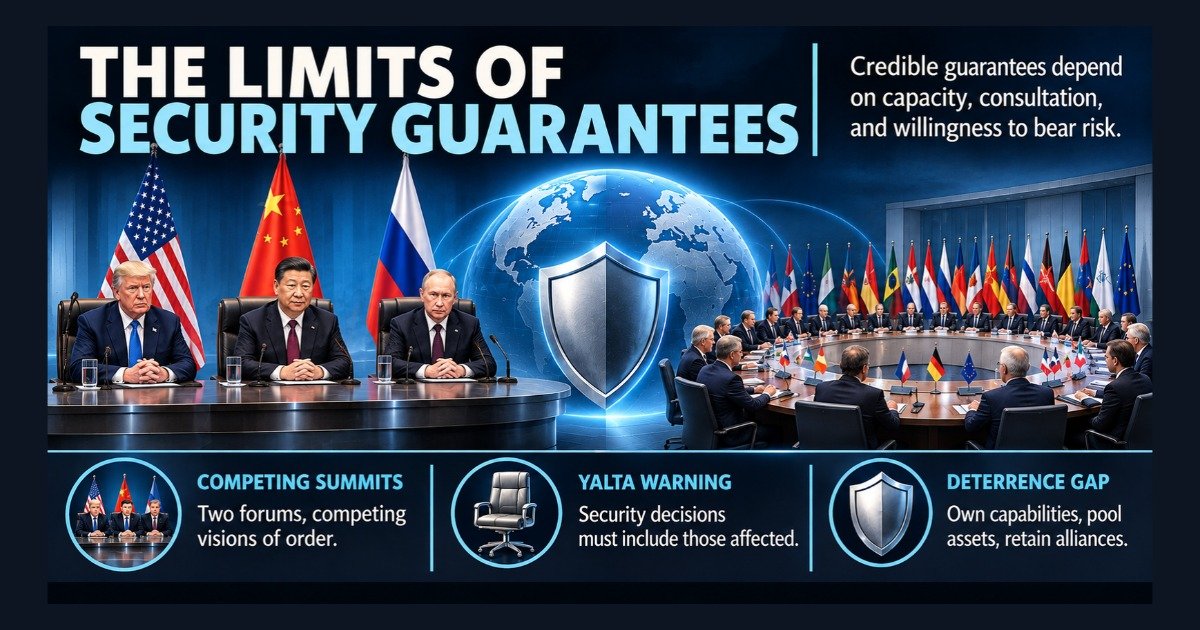
- Gulf to Berlin: Trump, Putin, and Xi met in Shenzhen, while more than 30 allied nations convened in Berlin for the Coalition of the Willing.
- Rejection of a Yalta-Style Settlement:German Chancellor Friedrich Merz warned against a settlement based on great-power spheres of influence that excludes Ukraine and Europe from decisions affecting their security. He argued that such an approach cannot deliver durable peace.
- The Dual Deterrence Crisis:The 2026 Iran conflict and the Ukraine war have exposed the limitations of relying on external US security assurances. Europe and Gulf states are responding by strengthening their own defense capabilities and reducing strategic dependence.
On November 19, 2026, two meetings presented different approaches to the same strategic question. In Shenzhen, Trump, Putin, and Xi signed a four-point declaration that mentioned neither Ukraine nor Iran.
In Berlin, German Chancellor Friedrich Merz hosted more than 30 delegations of the Coalition of the Willing and rejected a Yalta-style settlement that would exclude Ukraine and Europe from decisions affecting their security. The contrast highlights a weakness in the security order: guarantees depend on the guarantor’s capacity, attention, and willingness to accept risk.
The European Search for Credible Guarantees
Strain on US air-defense inventories illustrate the capacity problem. CSIS warns that the Iran war has drawn heavily on Patriot and THAAD stocks, while replenishment takes time.
The Coalition discussed a proposed post-ceasefire arrangement for Ukraine, including continued assistance, US-led monitoring, and a European-led multinational force supported by Washington. Its joint statement referred to legally binding commitments to respond to a future Russian attack, subject to national procedures. These proposals do not yet constitute an operational guarantee.
Shenzhen APEC Summit Reality Check: Symbolism Over Substance in Asia
Political bargaining creates another constraint. After envoy Jared Kushner indicated that Moscow had grown comfortable with Article 5-style guarantees for Ukraine, Russian Deputy Foreign Minister Sergei Ryabkov rejected even a quasi-membership formula and said Moscow wanted guarantees for Russia itself.
Russia’s objection may constrain negotiations, but it does not determine what Ukraine and its partners can decide. A guarantee ultimately depends on the guarantor’s willingness and capacity to implement it.
READ NEXT: Not “Yalta 2.0”: What the Xi–Trump–Putin Summit Means for Asia and the Global South
Europe is responding with higher defense spending and a stronger negotiating role. The European Commission has proposed additional support for Ukraine, but expenditure alone does not create military capability. European states still face gaps in equipment, ammunition, air defense, and production. Autonomy requires a seat at the table and the industrial capacity to make commitments credible.
The Gulf’s Exposure to Strategic Dependence
The Gulf faces a similar problem. Regional leaders reportedly had limited consultation before a war that brought large-scale Iranian missile and drone attacks onto their territory. Saudi Arabia and Kuwait briefly restricted US base access in May. This raises questions about whether host countries can influence decisions that expose them to retaliation.
READ MORE: Trump, Xi and Putin Seek to Project Power at Their First Summit
NATO rests on a ratified treaty with a collective-defense commitment under Article 5. Gulf states rely on bilateral defense arrangements, arms sales, and forward bases.
These arrangements differ in legal status and obligations. None alone ensures adequate supplies during a prolonged conflict. Gulf security remains dependent on American technology, intelligence, and military capabilities. Diversifying partnerships and strengthening domestic defense capacity are necessary, but neither can quickly replace the US role.
The Mecca Joint Defence Agreement of August 7 commits Saudi Arabia, Pakistan, and Turkey to treat an attack on one as an attack on all. The pact remains untested and is not a non-aggression arrangement with Iran.
It establishes collective defense among its signatories, while managing tensions with Tehran remains a separate challenge.
Strategic Autonomy Without Strategic Isolation
The European and Gulf responses point toward a three-layer approach: own, pool, and retain. States should own essential capabilities, including stockpiles, drones, interceptor production, and the right to be consulted.
They should pool expensive capabilities through joint procurement and regional defense arrangements. They should retain the American alliance while seeking clearer terms on consultation and risk-sharing.
Each layer carries costs. Domestic production competes with other priorities. Defense pacts can divide regions, while visible hedging may accelerate retrenchment. Strategic autonomy means protecting essential interests while maintaining militarily indispensable partnerships.
The Berlin framework proposes a European-led force and US-led ceasefire monitoring. Implementation, however, requires workable ceasefire terms, agreed mandates, and sufficient support. Moscow’s rejection of a quasi-membership formula does not establish its position on every element of the framework.
Whether Russia would accept the proposed arrangements remains unresolved. From the Gulf to Berlin, a guarantee is credible only when capabilities are available, political terms are clear, and states have a meaningful role in shaping the commitment.