



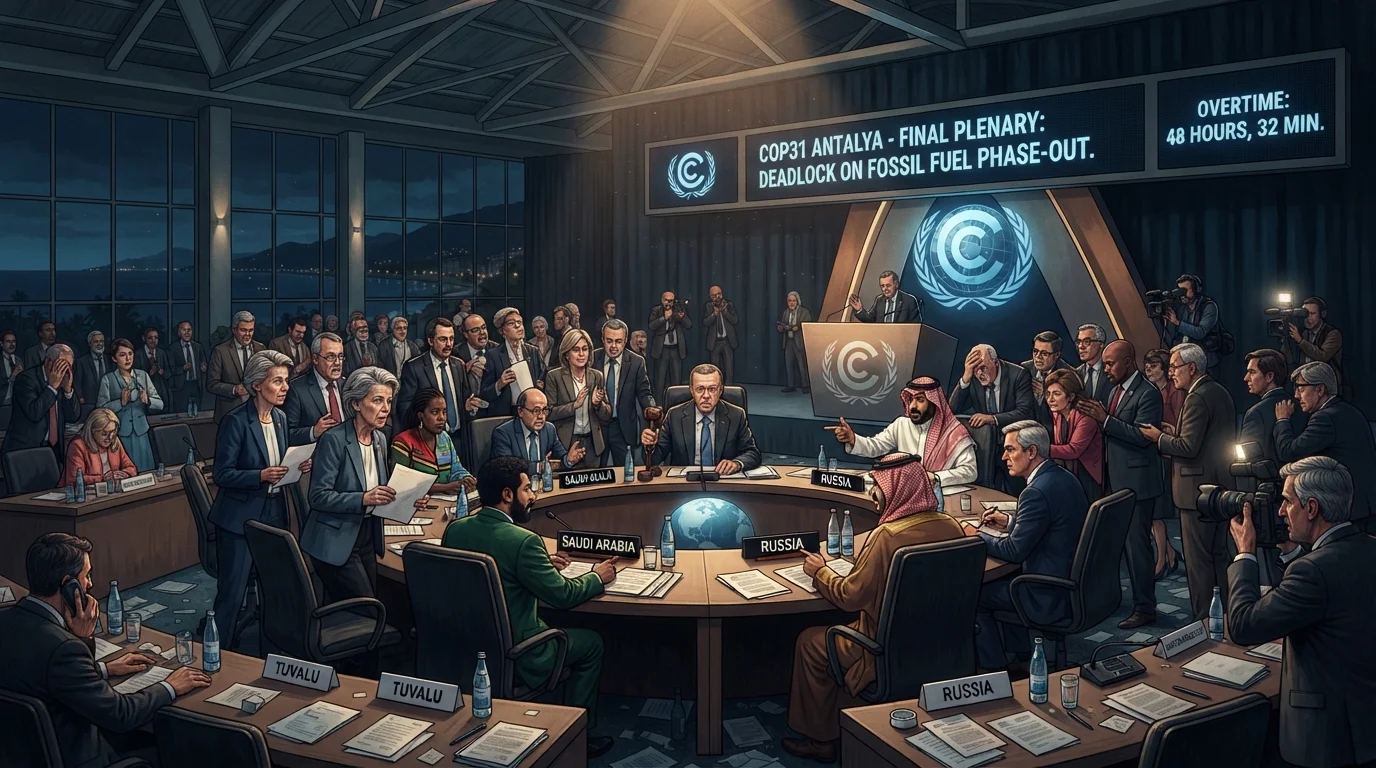
- COP31 collapse in Antalya marked the first failure of a major UN climate deal since Copenhagen 2009, after the longest summit on record ended without consensus.
- Saudi Arabia and Russia blocked any language on transitioning away from fossil fuels, prioritising energy security and economic interests over stronger commitments.
- The European Union, UK, and vulnerable island nations rejected the weak Antalya Pact, prompting UN Secretary-General Guterres to express deep disappointment.
The United Nations climate conference COP31 in Antalya, Turkey, ended in failure on 22 November 2026—the longest summit on record and the first time a core political deal has collapsed since Copenhagen in 2009.
After more than two weeks of talks that stretched nearly 50 hours into overtime, the joint Turkish-Australian presidency was forced to abandon its proposed “Antalya Pact.” The European Union, the United Kingdom, Panama, several small island states, and roughly 130 countries in total rejected the draft because it contained no explicit language on transitioning away from fossil fuels.
The breakdown was not a sudden accident. Early drafts had called for an “immediate transition away from fossil fuels in energy systems.” By the final version, every direct reference to fossil fuels, oil, coal, or a phase-out had disappeared.
READ MORE: Solomon Islands Tilts to Australia: Blow for Beijing?
In their place, the text emphasised carbon capture and storage—at a scale of hundreds of millions of tonnes a year by 2035—and a Turkish-backed goal of raising electricity’s share of final energy consumption to 35 percent by 2035. Adaptation finance targets, including a proposed $120 billion figure favoured by many developing countries, were also weakened or removed.
Why Saudi Arabia and Russia Drew a Hard Line
Saudi Arabia, speaking for the 22-member Arab Group, led the opposition. Negotiator Mohammad Ayoub argued that Arab countries had contributed less than 2 percent of historical greenhouse gas emissions and that wealthy industrialised nations bore the overwhelming responsibility for the crisis.
He insisted that countries must retain the right to choose their own pathways according to national circumstances, and defended the inclusion of carbon capture as a legitimate solution rather than greenwashing. Saudi officials and their allies viewed any fresh mention of fossil fuels as an unacceptable attempt to rewrite the 2023 COP28 Dubai agreement or to impose restrictions that would damage their economies.
READ NEXT: Longest-ever UN climate talks end with no deal as deep divisions exposed
Russia’s delegate Sergei Kononuchenko went further. He warned that cutting oil and gas supplies faster than demand falls would produce shortages, price shocks, and energy poverty, with the poorest countries suffering first. “We cannot agree to any formulation on fossil fuels,” he said. Moscow also criticised climate finance packages that often take the form of loans rather than grants, describing them as an “old colonial distribution of labour under a new banner.”
These positions reflected deep material interests. For major oil and gas producers, an explicit transition mandate threatens both current revenues and long-term market share at a moment when global energy markets are already strained by the ongoing US-Iran conflict and disruptions around the Strait of Hormuz. China and India accepted the weaker text; the United States, having withdrawn from active participation in the Paris process, was largely absent.
Why the EU and vulnerable nations walked away
Ireland’s Environment Minister Darragh O’Brien, speaking for the EU, called the draft “unconscionable” and said the bloc would not “endorse a cover decision that does not even mention fossil fuels” or accept a COP that “greenwashes” them.
Small island states and least-developed countries argued that a text silent on the primary driver of warming represented a step backwards from the Dubai commitment to transition away from fossil fuels “in a just, orderly and equitable manner.” They also objected to the dilution of adaptation finance, which they see as essential for survival as climate extremes intensify.
Guterres’s disappointment
UN Secretary-General António Guterres issued a sharp statement. “I am deeply disappointed that COP31 has ended without consensus on an overarching outcome,” he said.
“I share the very profound frustration of all those who expected governments to rise to the moment the climate crisis demands,” he added.
He stressed that the absence of consensus in the negotiating room does not change the science: temperatures continue to shatter records, extremes are intensifying, and emissions remain far too high. “We can’t put out the fire while pouring fuel on it,” he declared, noting that powerful fossil-fuel interests continue to distort science, delay policy, and profit while others pay the price. He reminded governments that all countries had already agreed at COP28 to transition away from fossil fuels and that the task now is to accelerate, finance, and deliver that shift.
COP31 Collapses: The fallout
The collapse has intensified criticism of the UNFCCC’s consensus rule, which gives any significant group of countries an effective veto. UN climate chief Simon Stiell and others have called for process reform. The next major attempt will come at COP32 in Addis Ababa in 2027. In the meantime, the failure does not halt national or market-driven action—renewable deployment, electrification, and corporate commitments continue—but it removes the political signal that many investors and governments had hoped for.
In a year already dominated by the Russia-Ukraine war, the US-Iran conflict, and great-power manoeuvring, Antalya showed how easily climate diplomacy can be crowded out or blocked by competing economic and security priorities. The world is on course to overshoot the 1.5°C limit. The longer the gap between scientific necessity and diplomatic agreement persists, the more costly and difficult the eventual response becomes.