



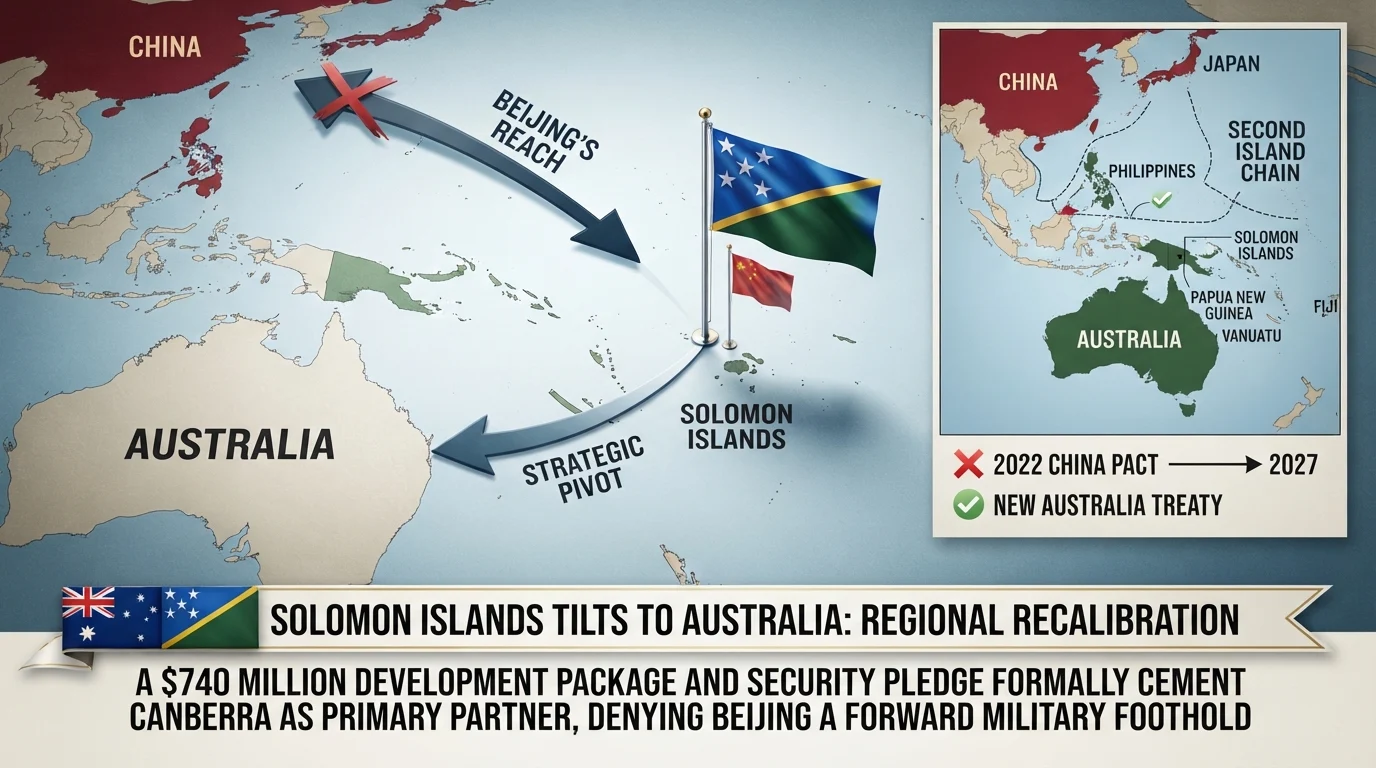
- Solomon Islands Tilts to Australia through a landmark bilateral treaty signed in Canberra, formally establishing Australia as Honiara’s primary security partner and banning foreign military bases on its soil.
- Termination of the 2022 Beijing Pact: Prime Minister Matthew Wale’s government has notified China that it will allow their secretive five-year security agreement to expire in April 2027 without renewal, effectively ending Chinese policing deployments by mid-2027.
- A $740 Million Development Package: In exchange for strategic alignment and regional stability, Canberra committed AU$740 million over ten years toward universal K–12 education, policing, infrastructure, and expanded labor mobility pathways for Solomon Islanders.
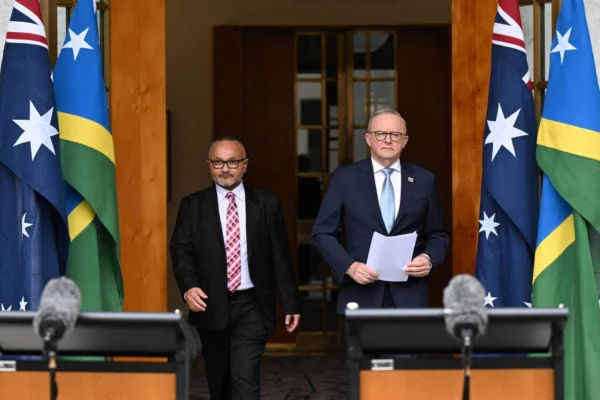
In a decisive diplomatic realignment in Canberra on Wednesday, Solomon Islands Prime Minister Matthew Wale and Australian Prime Minister Anthony Albanese signed a sweeping bilateral treaty that formally cements Australia as the Pacific nation’s primary security partner. Accompanied by 15 cabinet ministers—a delegation size signaling intense institutional consensus—Wale declared that the era of his archipelago serving as a “source of uncertainty and doubt in the region” had come to an end.
Under the terms of the new agreement, Canberra has committed AU740million(US740 million (US490 million) over ten years—comprising AU670millioningrantsandAU670 million in grants and AU70 million in loans—beginning in January.
In exchange for funding universal kindergarten-to-Year-12 education, expanding labor mobility pathways into Australian aged care and early childhood sectors, and bolstering domestic policing, Honiara made a binding geopolitical pledge: it will prohibit foreign military bases or major security infrastructure on its territory, keep sensitive systems free from unauthorized foreign access, and ensure the departure of Chinese police instructors by mid-2027.
China Military Exercise 2025: Justice Mission Triumphs as Quad Stays Silent on Massive Taiwan Drills
Simultaneously, Wale’s government has notified Beijing that it will allow its controversial 2022 security pact with China to expire without renewal when its five-year term ends.
A Calculated Domestic and Strategic Choice
Honiara’s pivot toward Canberra is neither accidental nor merely the result of Western diplomatic pressure; it is a deliberate calibration driven by domestic electoral realities and pragmatic developmental arithmetic.
When former Prime Minister Manasseh Sogavare abruptly switched diplomatic recognition from Taipei to Beijing in 2019 and inked the secretive 2022 security agreement, the move alienated large segments of the Solomon Islands electorate and regional neighbors. Voter anxiety over opaque foreign entanglements and economic stagnation proved decisive in the elections that brought Wale to power.
READ MORE: China’s Military Expansion: China’s Massive South China Sea Drill Sends Shockwaves Through Australia and the Quad
Rather than ideological alignment, Wale’s government pursued transactional statecraft. With a third of Solomon Islands children out of school and fewer than 20 percent completing secondary education, Canberra offered tangible social infrastructure and immediate labor-market access that Beijing’s state-backed loans could not match.
By anchoring its security architecture to Australia—a neighbor located just 1,600 kilometers away—Honiara neutralized domestic political instability while extracting long-term fiscal commitments.
Solomon Islands Tilts to Australia: Eyeing the Quad by Proxy?
While Solomon Islands has no formal intention of joining or formally aligning with the Quadrilateral Security Dialogue (the Quad—comprising Australia, the United States, India, and Japan), its realignment inevitably draws Honiara closer to the grouping’s strategic orbit.
Australia acts as the Quad’s primary operational node in the South Pacific. By locking Solomon Islands into a broader “ring of security” alongside similar treaties Canberra recently concluded with Papua New Guinea, Tuvalu, Vanuatu, and Fiji, the agreement effectively denies China a forward logistics foothold along critical maritime corridors linking the United States and Australia.
READ NEXT: Solomon Islands plans to replace China security pact with Australia treaty, report says
For Washington, Tokyo, and New Delhi, Honiara’s refusal to host foreign bases accomplishes a core Quad objective—preserving a free, open, and demilitarized Indo-Pacific—without forcing a small island state to formally choose sides in great-power bloc politics.
The Shadow of the 2022 Beijing Pact
To understand the magnitude of this reversal, one must examine the opaque architecture of the April 2022 China–Solomon Islands security framework. Because the final text of the 2022 agreement was never officially published—and remains shielded by strict confidentiality clauses that even Prime Minister Wale cited when declining to discuss its termination—leaked drafts have long fueled regional alarm.
Those drafts appeared to authorize Chinese armed police and military personnel to deploy to the islands to protect Chinese-funded infrastructure and maintain social order, alongside provisions allowing Chinese naval vessels to make logistical stopovers. For four years, that ambiguity allowed Beijing to project strategic depth into the Second Island Chain and beyond, testing Canberra and Washington’s traditional sphere of influence.
Beijing’s Reaction and Strategic Calculus
For Beijing, Honiara’s decision represents a sharp setback to its South Pacific ambitions, demonstrating that elite-level diplomacy can unravel swiftly when democratic turnovers occur in recipient nations.
Yet China’s immediate public response has been notably measured, reflecting a desire to project composure to both domestic audiences and the broader Global South. Foreign Ministry spokesperson Guo Jiakun reiterated that China’s cooperation with Pacific Island nations rests on “mutual respect and equality,” rejects “geopolitical rivalry or bloc confrontation,” and prioritizes autonomous development rather than targeting third parties.
Behind this diplomatic restraint lies a complex dilemma for Chinese policymakers. Heavy-handed retaliation—such as abrupt economic coercion or aggressive naval posturing—would validate Western narratives of Chinese overreach and drive other Pacific Island states directly into Canberra’s treaty network.
Conversely, Beijing retains substantial economic leverage through Belt and Road infrastructure projects, telecommunications networks, and commercial ties in Honiara. China is therefore likely to pivot away from overt security pacts toward quieter, long-term economic and sub-national engagement, waiting out political cycles while recalibrating its Pacific strategy.