



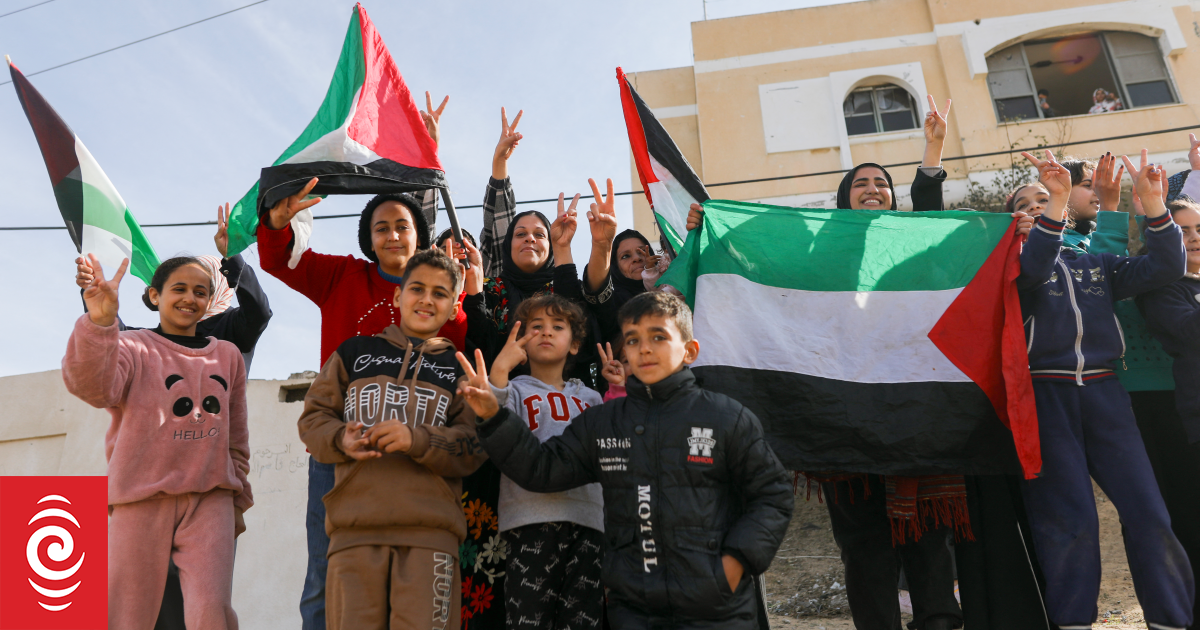
- Palestinians celebrated in Khan Younis after news of the ceasefire.
- Israelis gathered in Tel Aviv’s Hostages Square to welcome the deal.
- Agreement includes prisoner exchange and humanitarian aid for Gaza.
- Over 67,000 Palestinians killed during the two-year war underline the human cost.
For the first time in two years, the sound of warplanes over Gaza gave way to the sound of cheers. Thursday’s announcement of a ceasefire between Israel and Hamas was not just a political breakthrough; it was an emotional release for two peoples who have endured unimaginable loss.
In Tel Aviv’s Hostages Square, families of Israeli captives embraced, waving flags and crying tears of relief. In Khan Younis, in southern Gaza, crowds of Palestinians filled the streets, welcoming a deal they hope will end an ordeal that has cost them more than 67,000 lives.
This simultaneous celebration—Israeli families over the imminent return of hostages, Palestinians over the end of bombardments and the promise of prisoner releases—underscores the shared humanity so often buried under the politics of the Middle East. But for Palestinians, this ceasefire is more than just a pause in the bloodshed. It is a recognition, however small, of their suffering and their right to live free from siege, occupation, and constant fear.
A War of Unequal Suffering
It must be remembered: this was not a war of equals. Since the October 7, 2023 attack that killed 1,200 Israelis and triggered the conflict, Gaza has been subjected to relentless Israeli bombardment and invasion.
A Long-Awaited Dawn: How the Hamas-Israel Peace Deal Could Change the Middle East
The human cost has been staggering—over 67,000 Palestinians killed, entire neighborhoods razed, and hundreds of thousands forced to live in tents with barely enough food or water. Gaza’s cities were turned into ghostly ruins, its hospitals overwhelmed or destroyed, its children traumatized for life.
The deal, brokered through indirect talks in Egypt’s Sharm el-Sheikh resort, calls for a halt to fighting, the release of Israeli hostages in Gaza, and the freeing of Palestinian prisoners from Israeli jails. Hundreds of trucks loaded with food and medical supplies are expected to enter Gaza, offering a lifeline to a population that has been on the brink of famine for months.
READ MORE:Israel and Hamas sign Gaza ceasefire and hostage deal
For Palestinians, this ceasefire is not a gift—it is survival. It is the bare minimum after two years of unrestrained destruction.
Joy in Khan Younis
The images from Khan Younis told the story best. Men and women, young and old, poured into the streets, raising Palestinian flags and chanting for freedom. Some wept openly; others shouted prayers of thanks. “Thank God for the ceasefire, the end of bloodshed and killing,” said Abdul Majeed Abd Rabbo, a resident of the southern Gaza city. “I am not the only one happy, all of the Gaza Strip is happy, all the Arab people, all of the world is happy with the ceasefire and the end of bloodshed.”
ALSO READ:A Long-Awaited Dawn: How the Hamas-Israel Peace Deal Could Change the Middle East
These words capture the exhaustion of a people who have seen too much death. While politicians argue about timelines and technicalities, Palestinians cling to the hope that this agreement might finally allow them to bury their dead in peace and rebuild their shattered communities.
Israeli Families’ Relief
In Tel Aviv, the mood was also euphoric. Families gathered in Hostages Square, lighting flares and waving Israeli flags. Einav Zaugauker, whose son Matan has been held in Gaza, broke down as the deal was announced. “I can’t breathe, I can’t explain what I’m feeling … it’s crazy,” she said.
Her words echoed across borders, proof that the agony of losing loved ones to war is universal. The simultaneous celebrations in Tel Aviv and Khan Younis should remind the world that ordinary Israelis and Palestinians are not enemies—they are both victims of a conflict that has been perpetuated by political agendas and hardline ideologies.
A Fragile Path Forward
The ceasefire is far from guaranteed. Key details remain unresolved, including the list of Palestinian prisoners to be freed and the recovery of the bodies of deceased Israeli hostages. Far-right members of Prime Minister Benjamin Netanyahu’s coalition have already voiced opposition, threatening to collapse the fragile political consensus. Hamas, too, is demanding guarantees that Israel will not resume attacks once the hostages are released.
History offers little comfort. Similar agreements in 2023 and early 2025 collapsed under pressure, plunging the region back into chaos. Many Palestinians worry this deal could also unravel, leaving them once again under bombardment. “We have seen ceasefires before, and then the bombs return,” one resident of Gaza City told reporters. “We are happy tonight, but cautious tomorrow.”
A Chance for Justice
Yet despite the uncertainty, the ceasefire represents a rare moment of shared relief—and perhaps the first step toward addressing deeper injustices. For Palestinians, the war has laid bare the unsustainable nature of Israel’s occupation and blockade. No ceasefire can endure unless it tackles the root cause of the conflict: the denial of Palestinian statehood and dignity.
The release of prisoners—many of them young men detained without charge—will be seen by Palestinians as a long-overdue correction of an imbalance that has scarred families for decades. The flow of aid trucks into Gaza, if sustained, could prevent further humanitarian catastrophe. And the recognition, however reluctant, that Palestinians deserve peace is itself a victory after years of erasure.
Celebrating Cautiously
The scenes of jubilation in both Tel Aviv and Khan Younis should be seared into the memory of the international community. They prove that the people themselves—Israeli and Palestinian alike—want peace. They want an end to bloodshed, an end to the endless cycle of revenge and retaliation.
But peace cannot be built on ceasefires alone. For Palestinians, real peace means freedom: freedom from occupation, freedom from blockades, freedom to rebuild their lives with dignity. This ceasefire is a step in that direction, but only if the world seizes the opportunity to turn a fragile truce into a lasting settlement.
For now, the people celebrate. And in Gaza, where the dead number in the tens of thousands, that celebration carries a message the world must heed: after years of fire and rubble, Palestinians are still standing, still hoping, still demanding justice.