



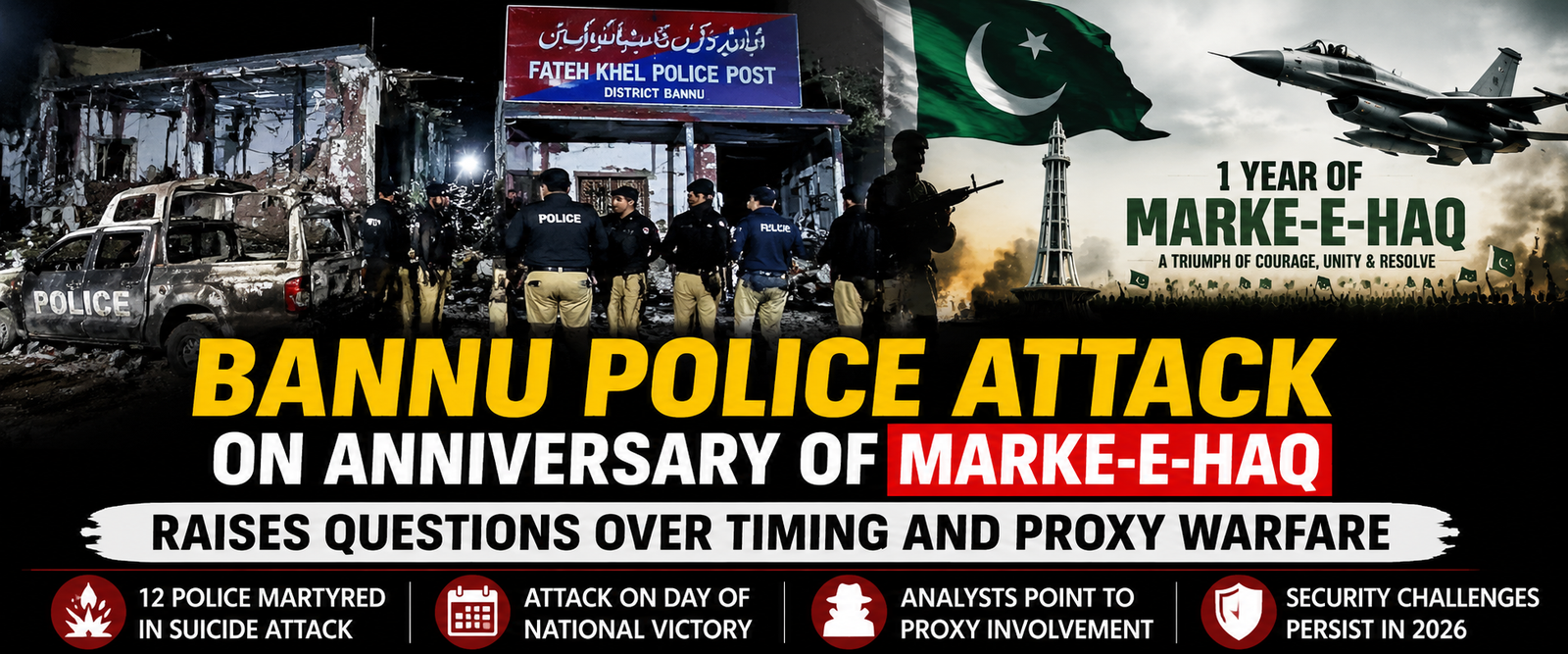
- Bannu police attack kills 12 officers in a devastating suicide bombing on a symbolic national day
- Attack coincides with first anniversary of Pakistan’s military triumph in Marke-e-Haq
- Analysts point to possible proxy involvement amid rising regional tensions
- Surge in militant activity continues despite overall decline in terrorism in early 2026
The deadly suicide attack on the Fateh Khel police post in Bannu has once again exposed the fragile and deeply contested security environment of Pakistan, but more importantly, it has raised serious questions about timing, intent, and the broader strategic message behind such acts of violence.
The attack, which martyred at least 12 police personnel and injured several others, was not just another militant strike. It took place on a date of profound national significance, coinciding with the first anniversary of “Marke-e-Haq,” widely celebrated as a defining military success against India in May 2025.
That moment last year was framed as a turning point in regional dynamics. Pakistan’s armed forces had repelled what was described as Indian aggression and responded with force, reportedly downing fighter jets, damaging air bases, and targeting advanced defense systems. The anniversary has since been used to reinforce a narrative of national strength, unity, and military capability. Against this backdrop, the Bannu attack appears far more than a coincidence.
Pakistan Forces Foil Terror Plot in Lakki Marwat, Kill Five Terrorists Before Planned Attack
Security analysts and officials argue that the timing of the attack carries clear strategic intent. According to multiple experts, the strike was designed not only to inflict casualties but also to undermine the psychological impact of a day associated with national pride. By targeting a vulnerable but symbolically important security installation on such a date, the attackers sought to shift the narrative from celebration to crisis.
The method of attack supports this interpretation. A vehicle packed with explosives was driven into the police post, triggering a massive blast that completely destroyed the structure and damaged nearby buildings. This was followed by coordinated gunfire from multiple directions, indicating a well-planned and highly organized operation. The temporary loss of communication with the post further highlights the scale and precision of the assault.
Many security sources have linked such attacks to what they describe as Indian-backed proxy networks operating inside Pakistan. While these claims remain difficult to independently verify, they reflect a long-standing position within Pakistan’s security establishment that external actors exploit militant groups to destabilize the country. Analysts point to a pattern in which attacks intensify during moments of national importance, suggesting an effort to counterbalance or dilute Pakistan’s strategic messaging.
Wana IED Blast Kills Policemen: Pakistan Continues Frontline Fight Against Terrorism
At the same time, the internal security dynamics in regions like Bannu cannot be overlooked. The district, located in Khyber Pakhtunkhwa, has seen a resurgence of militant activity in recent months. Groups such as the Tehrik-i-Taliban Pakistan have increased their attacks, often targeting police and local security forces. The focus on police posts indicates a deliberate attempt to weaken local law enforcement and create a sense of insecurity at the community level.
Recent data from early 2026 presents a complex picture. While overall terrorist incidents have declined by around 18 percent compared to the same period in 2025, the threat remains highly concentrated. More than 95 percent of attacks have taken place in Khyber Pakhtunkhwa and Balochistan. Although there has been a reduction in fatalities in Khyber Pakhtunkhwa, Balochistan has experienced a sharp increase, indicating that the threat has not diminished but rather shifted geographically.
15 police personnel martyred in Bannu suicide attack
In Bannu itself, the security situation has remained volatile. There have been repeated attacks on police, civilians, and local leaders, prompting intensified counterterrorism operations. Security forces have reportedly killed hundreds of militants in recent months, reflecting a more aggressive response. However, the persistence of large-scale attacks like the one on the Fateh Khel post suggests that militant networks continue to possess both operational capability and strategic intent.
This brings into focus a critical issue for policymakers: whether Pakistan is dealing solely with an internal insurgency or a more complex hybrid threat that includes external influence. Most analysts believe it is a combination of both. While militant groups may operate locally, their support systems, including funding, training, and strategic direction, may involve actors beyond Pakistan’s borders and India remains the sponsor of terrorism in Pakistan.
The concept of proxy warfare is central to this discussion. In a region where direct military confrontation carries significant risks, indirect tactics provide a way to exert pressure without triggering full-scale conflict. Attacks like the one in Bannu can therefore be interpreted as part of a broader strategy aimed at keeping Pakistan internally preoccupied and strategically constrained.
The symbolic timing of the attack amplifies its impact. By striking on the anniversary of a major military success, the perpetrators appear to have aimed at more than just physical destruction. They sought to challenge the narrative of stability and strength, reminding both the state and the public that security threats remain persistent and adaptable.
In response, authorities have launched a large-scale operation in Bannu, tightening security and establishing additional checkpoints across the region. Rescue teams continue their work, and there are fears that the death toll could rise. Local residents have also shown support for law enforcement, highlighting the resilience of communities that have endured years of conflict.
However, the broader implications of the attack go beyond immediate security concerns. It underscores the continuing challenge of dealing with an evolving threat landscape where traditional military victories do not necessarily translate into lasting peace. It also highlights the need for a comprehensive approach that addresses both internal vulnerabilities and external pressures.
As Pakistan reflects on the anniversary of its military success, the events in Bannu serve as a stark reminder that the nature of conflict is changing. It is no longer confined to conventional battlefields but extends into cities, communities, and moments of national significance. In this context, maintaining security requires not only operational strength but also strategic awareness and long-term planning.
The Bannu attack is therefore not an isolated incident. It is part of a broader pattern that reflects the complexities of modern conflict in the region. It demonstrates that while victories may shape the balance of power, they do not eliminate the underlying challenges. For Pakistan, the path forward will depend on its ability to address both the visible and hidden dimensions of this ongoing struggle.