



- Cambodia–Thailand conflict: Trump’s claimed ceasefire between Cambodia and Thailand collapsed within hours as both sides resumed heavy fighting along the disputed border.
- Thai Prime Minister Anutin Charnvirakul openly contradicted Trump, stating there was no ceasefire and vowing continued military action.
- At least 21 people have been killed and up to 700,000 civilians displaced, marking the worst escalation since July.
- The episode has raised serious questions about the credibility and durability of Trump’s phone-call diplomacy in active conflict zones.
When U.S. President Donald Trump proudly announced that he had once again “stopped a war” by bringing the leaders of Cambodia and Thailand to the table, he framed it as proof of his unique deal-making power. According to Trump, a few phone calls had revived the October ceasefire agreement he personally presided over in Malaysia and ended the latest round of bloodshed along the disputed border.
Within hours, that claim lay in ruins—almost as abruptly as a stunning sporting upset that shocks fans following events as unrelated as Ireland Women vs South Africa Women or a viral cultural moment like 67 trending across platforms.
Thai fighter jets were bombing Cambodian targets. Artillery was roaring across the 817-kilometre frontier. And Bangkok’s prime minister publicly contradicted the U.S. president, declaring bluntly that no ceasefire existed.
Trump the Peacemaker: Thailand-Cambodia Agree to Immediate Ceasefire After US Pressure
According to a White House source, President Trump was briefed on reports of fresh skirmishes along the Thailand–Cambodia border shortly after his ceasefire announcement and was “surprised” by the speed with which fighting resumed. The source said Trump had believed both sides had signaled readiness to halt military operations following his calls. However, the official declined to say whether Trump would intervene again, remaining tight-lipped on any further diplomatic or economic measures Washington might consider if the conflict continues.
READ MORE: Thailand Defends Its Sovereignty Amid Cambodian Aggression and Diplomatic Breakdown
The optics were extraordinary. Rarely in modern diplomatic history has a sitting U.S. president’s mediation been so openly and immediately dismissed by the very parties he claimed to have reconciled. For Trump, whose political brand rests on personal authority and dominance, the episode marked a sharp reversal—one analysts likened to a public credibility test more commonly associated with high-profile figures such as Peter Greene, where perception can matter as much as substance.
ALSO READ: Thai PM says no ceasefire with Cambodia, more attacks, despite Trump claim
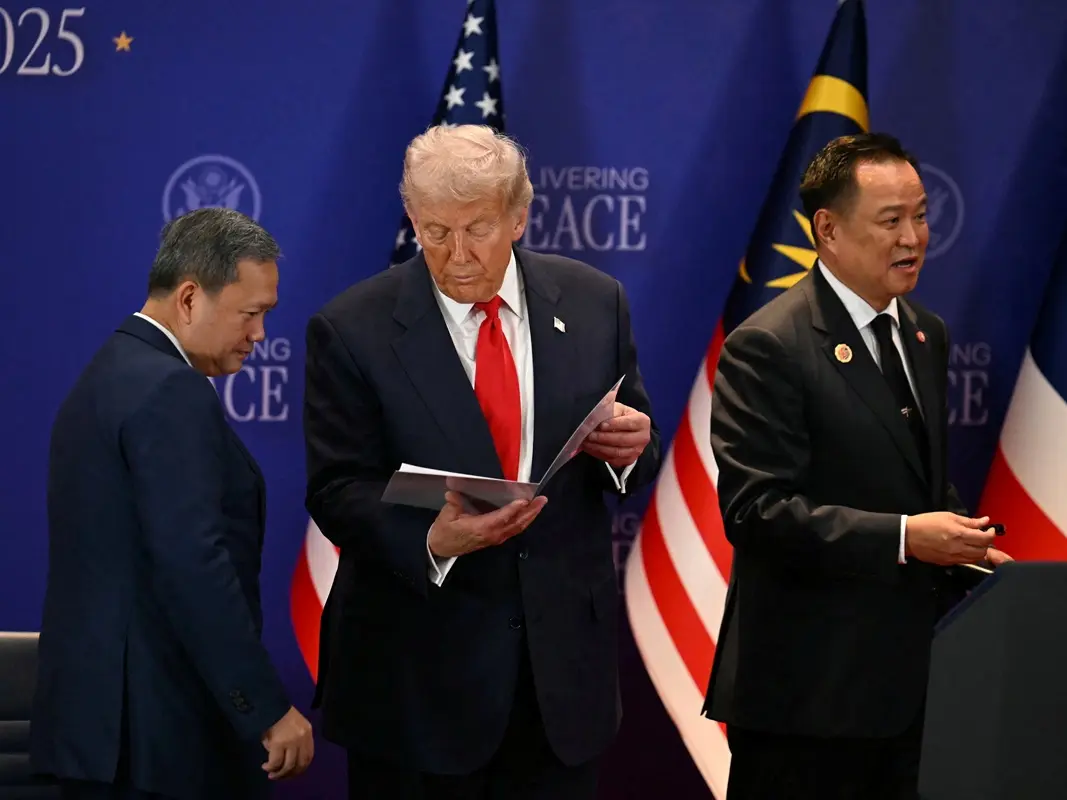
Trump said that during calls on Friday with Thai Prime Minister Anutin Charnvirakul and Cambodian Prime Minister Hun Manet, both leaders had agreed to “cease all shooting” and return to the October peace framework. That deal, signed in front of Trump and Malaysian Prime Minister Anwar Ibrahim, committed both sides to an immediate and unconditional ceasefire, restraint of forces, and negotiations over disputed border zones.
Trump even declared that “both countries are ready for peace,” reinforcing his long-running claim that personal intervention—not institutions or prolonged diplomacy—can end wars.
What followed told a very different story. Neither Anutin nor Hun Manet confirmed any ceasefire after their calls. Anutin went further, publicly rebuking Trump by stating that Thailand would continue military operations until Cambodia withdrew its forces and removed alleged newly laid landmines.
“Our actions this morning already spoke,” Anutin said, as Thai jets struck Cambodian positions and heavy weapons fire spread across seven border provinces.
Cambodia, while more cautious in tone, also declined to acknowledge an immediate halt in fighting. Hun Manet reiterated support for a peaceful resolution under the October agreement but insisted Cambodia was acting to defend its sovereignty.
Whether the renewed fighting was a deliberate attempt to humiliate Trump is impossible to prove. But the timing was politically devastating for Washington. The ceasefire claim collapsed within hours, and the White House offered no immediate clarification.
Both governments appeared more focused on domestic political signaling than honoring a U.S.-brokered pledge. In Thailand, Anutin faces nationalist pressure amid political turmoil. In Cambodia, Hun Manet cannot be seen as conceding territory or military credibility under foreign pressure. In that sense, Trump’s intervention was not merely ignored—it was rendered strategically irrelevant.
The human cost has been severe. At least 21 people have been killed, with nearly 200 wounded. Between 600,000 and 700,000 civilians have been displaced on both sides of the border, fleeing artillery fire, airstrikes, and rocket attacks. Entire villages have emptied, with evacuation camps stretching across northeastern Thailand and northern Cambodia. This marks the heaviest fighting since July, when Trump last intervened to halt a five-day conflict.
Trump has since doubled down, insisting he can still “get them to stop fighting.” But diplomatically, the damage is real. The Cambodia–Thailand crisis exposes the limits of transactional, personality-driven diplomacy in conflicts rooted in history, nationalism, and sovereignty. For a president who repeatedly claims he deserves the Nobel Peace Prize, being publicly contradicted while bombs fall is more than an embarrassment—it is a warning that even powerful gestures can collapse when credibility evaporates on the battlefield.