



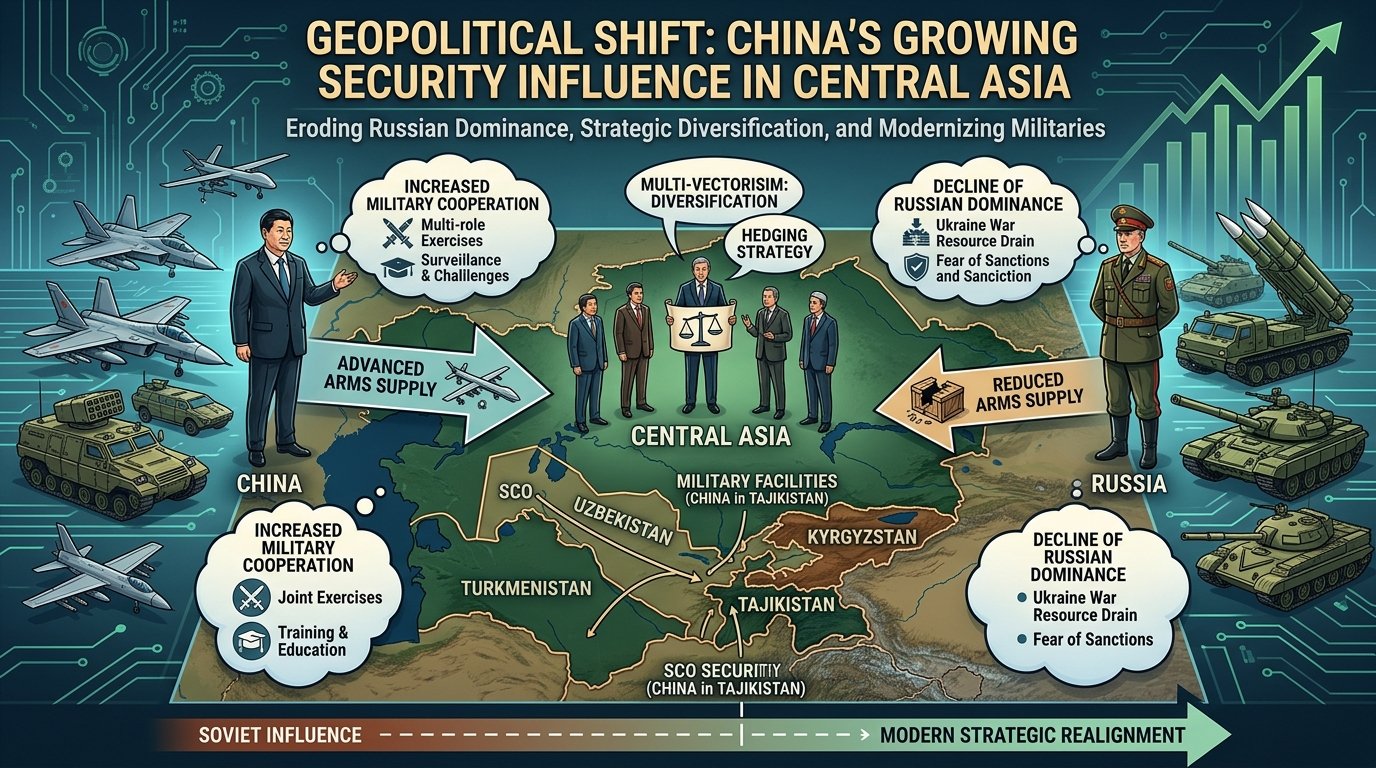
- China replacing Russia in Central Asia is becoming increasingly visible as Beijing expands its military sales across the region.
- China is particularly significant in fighters, missiles, drones and advanced air-defence systems.
- China replacing Russia in Central Asia could mark the end of Moscow’s decades-long monopoly over regional defence procurement.
For three decades after the Soviet collapse, Russia enjoyed an almost unchallenged position as Central Asia’s principal military supplier. Kazakhstan, Uzbekistan, Kyrgyzstan, Tajikistan and Turkmenistan inherited Soviet aircraft, tanks, artillery, air-defence systems, maintenance networks and military training structures. Buying Russian equipment therefore meant upgrading an existing ecosystem rather than rebuilding an army around an entirely different technology base.
That advantage is now eroding.
China has not completely replaced Russia in Central Asia, but it is increasingly doing something more consequential: breaking Moscow’s monopoly over the region’s military technology market.
Chinese drones, armoured vehicles, air-defence systems, transport aircraft and missiles are already present across Central Asia. The potential arrival of Chinese Chengdu J-10CE fighter jets in Uzbekistan would take that competition into an entirely new category.
Reports circulating in August 2026 indicate that Uzbekistan may have received four J-10CEs and could eventually operate as many as 24. Neither Beijing nor Tashkent has officially confirmed the reported deliveries, so the claims should be treated cautiously. But the possibility itself is strategically significant.
The broader transformation is part of a geopolitical shift that has been visible for years. The Guardian has described how Russia’s war in Ukraine accelerated Central Asian efforts to expand relations with China and reduce their dependence on Moscow.
Russia’s Arms Advantage Is Shrinking
The numbers explain why China has an opening.
According to the Stockholm International Peace Research Institute, Russian exports of major arms fell 64 percent between 2016–20 and 2021–25. Russia’s share of global arms exports dropped from 21 percent to 6.8 percent. China, meanwhile, accounted for 5.6 percent of global major-arms exports during 2021–25.
Russia remains a major defence power. But the Ukraine war has forced Moscow to prioritize domestic military requirements, while sanctions and production pressures have complicated export schedules and sustainment.
That matters enormously in Central Asia.
A country buying a fighter jet is not purchasing an isolated machine. It is buying engines, radar, missiles, spare parts, software, maintenance, training and upgrades that can bind its armed forces to the supplier for decades.
China understands this.
Beijing Is Already Inside Central Asian Defence
The Chinese military presence in Central Asia did not begin with the J-10CE.
Kazakhstan has acquired Chinese Wing Loong drones and Y-8 military transport aircraft. Turkmenistan has purchased Chinese air-defence systems, including HQ-series platforms. Uzbekistan has acquired Chinese air-defence technology, including the FD-2000, the export version of the HQ-9.
Tajikistan has received Chinese armoured vehicles and other military equipment while Beijing has become increasingly involved in border-security infrastructure.
The Washington Post documented China’s growing security footprint in Tajikistan years ago, reporting Chinese security personnel and infrastructure near the Tajik-Afghan border. The report described the development as an expansion of Chinese hard power alongside Beijing’s economic reach.
This is important because China’s strategy is broader than arms sales.
Beijing is embedding itself in the region’s security architecture.
That includes weapons, border security, training, infrastructure and intelligence cooperation.
China replacing Russia in Central Asia: Uzbekistan Could Be the Turning Point
Uzbekistan is potentially the most important test.
The country has traditionally operated Soviet- and Russian-designed aircraft, including MiG-29s and Su-27s. A transition to Chinese J-10CEs would therefore represent more than an equipment purchase.
It would mean adopting a different technological ecosystem.
The J-10CE is a modern multirole fighter designed around advanced avionics, radar and Chinese air-to-air weapons. If Uzbekistan ultimately receives 24 aircraft, China would gain a significant long-term position in the country’s combat aviation structure.
The significance is amplified by the aircraft’s performance narrative following the May 2025 India-Pakistan conflict.
Pakistan said its Chinese-built J-10C fighters were used against Indian aircraft, including French-made Rafales. India disputed aspects of Pakistan’s account, and the exact combat losses remain contested. But the confrontation nevertheless gave China’s fighter industry something it had lacked for years: a widely scrutinized combat record involving a modern Western fighter.
It would be wrong to claim that the May 2025 fighting conclusively proved Chinese aircraft superior to European aircraft. Modern air combat depends on pilot training, electronic warfare, intelligence, missiles, radar, command-and-control and tactics.
But the engagement changed the marketing environment.
The J-10CE is no longer being evaluated only through brochures and demonstrations.
It has acquired battlefield credibility—however contested the individual claims may be.
Central Asia Is Diversifying, Not Switching Sides
This does not mean Central Asian states are abandoning Russia for China.
Kazakhstan, Kyrgyzstan and Tajikistan remain deeply connected to Moscow. Russian aircraft, helicopters, armour and air-defence systems still dominate much of the region’s military inventory. Russia also retains military facilities and long-established training relationships.
The emerging model is multi-vector defence procurement.
Central Asian governments increasingly want Russian, Chinese, Turkish and Western options available simultaneously.
That gives them bargaining power.
It also reduces their vulnerability to sanctions, political pressure or supply disruptions from any single supplier.
China’s economic weight reinforces the trend. Beijing is already deeply integrated into Central Asian economies through infrastructure, energy, trade and the Belt and Road Initiative.
The Wall Street Journal has similarly documented the changing relationship between Beijing and Moscow in Russia’s traditional Central Asian backyard, where China’s economic influence increasingly overlaps with strategic competition.
Why Russia Should Be Worried
The danger for Moscow is therefore not that Central Asia will suddenly become Chinese.
It is that Russia is losing its status as the unavoidable security partner.
For decades, a simple division of influence existed: China was the economic power while Russia remained the military power.
That division is disappearing.
China now sells fighters, missiles, air-defence systems, drones, radar and armoured vehicles. It is also expanding security cooperation and infrastructure.
Türkiye is another emerging competitor, particularly in drones and armoured vehicles.
The result is a new Central Asian defence market in which Moscow must compete rather than dictate.
For Russia, that is a profound strategic change.
The Real Battle Is Over the Next 30 Years
Weapons contracts have exceptionally long political lives.
A fighter purchased today can remain operational for 30 years. An air-defence system can remain embedded in a national security network for decades.
Every missile, software upgrade, spare part and training programme strengthens the relationship between buyer and supplier.
That is why China’s advance matters far beyond the value of individual contracts.
If Uzbekistan ultimately fields J-10CEs, Kazakhstan expands Chinese aviation and drone purchases, Turkmenistan continues relying on Chinese air-defence technology and Tajikistan deepens Chinese border-security cooperation, Beijing will have inserted itself into almost every major layer of Central Asian defence.
The region will not necessarily become Chinese.
But it will no longer be exclusively Russian.
That distinction is crucial.
Russia may remain Central Asia’s most deeply rooted military power for years. Yet China is rapidly becoming the region’s most credible alternative.
And in geopolitics, losing the monopoly can be almost as consequential as losing the market itself.
The emerging reality is clear: Central Asia is moving from a Russian-dominated security system toward a competitive military marketplace in which China is no longer a secondary supplier.
It is becoming a principal player.
For Moscow, that should be a serious warning.