



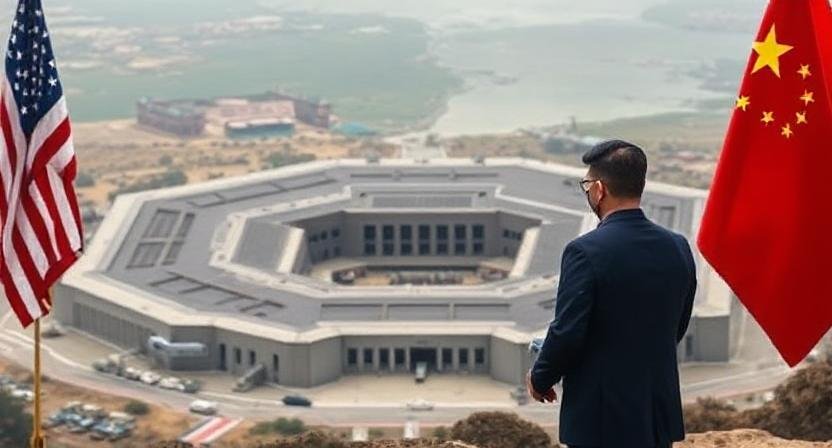
- Pentagon Strategic Pivot: Elbridge Colby urges focus on China over Ukraine or Iran.
- Taiwan as Flashpoint: U.S. may be preparing for potential conflict in the Indo-Pacific.
- Allies Uneasy: Japan, Australia concerned about reduced U.S. support and pressure to rearm.
- Republican Split: Internal GOP debate deepens over global commitments vs. prioritization.
WASHINGTON, D.C. — A classified memo from Elbridge Colby, the Pentagon’s top policy official, has ignited a fierce strategic debate in Washington—and sent shockwaves across allied capitals in Europe and Asia—by urging a wholesale shift in U.S. military focus away from Ukraine and the Middle East, toward what he calls the “primary theater”: China.
The memo, sent in early June to Defense Secretary Pete Hegseth, offered no policy directive but laid bare a sobering assessment of dwindling U.S. weapons stockpiles and how continued arms deliveries to Ukraine could hinder America’s ability to prepare for a possible high-intensity conflict in the Indo-Pacific.
“Exile Without Roots”: Trump’s Deportation Policy Faces Global Outcry Over Human Rights Violations
While President Donald Trump later reversed the short-lived pause in military aid to Ukraine, Colby’s warning has left its mark. It is now clear: the Trump administration, led by Colby’s strategic vision, is preparing for a future in which a war with China, particularly over Taiwan, is no longer theoretical—it’s a looming possibility.
“We’re lucky if we make it to the 2030s without a conflict with China,” Colby warned in a recent interview with Australian media.
A Strategic Pivot—and a Flashpoint in the Making
Colby, 45, has long advocated a doctrine of “strategic prioritization,” arguing that the U.S. must stop stretching itself thin across multiple global commitments and instead build the military muscle to deter or defeat China in a potential war, most likely over Taiwan.
READ MORE: Pentagon Official at Center of Weapons Pause on Ukraine Wants U.S. to Focus on China
In his influential book The Strategy of Denial, Colby outlined a vision of Taiwan not as a moral cause but as a strategic hinge—its fall to Beijing, he warned, would break the first island chain and give China unchecked access to the Pacific, directly threatening U.S. interests and allies like Japan and the Philippines.
According to sources close to the Pentagon, Colby has privately told allies that Japan and Australia must step up dramatically in the event of a Chinese strike on Taiwan, even as Washington maintains “strategic ambiguity” on its own role. That ambiguity, however, is increasingly being challenged by internal debates and external threats.
“Colby is putting Taiwan at the center of America’s defense posture,” said Wess Mitchell, a former senior State Department official. “That’s not posturing—it’s preparation.”
Republicans Divided, Allies Alarmed
Colby’s hardline pivot has deepened rifts within the Republican Party and unsettled key allies. Senator Mitch McConnell was the lone Republican to oppose Colby’s confirmation as Undersecretary of Defense for Policy, accusing him of promoting “geostrategic self-harm.”
ALSO READ: Iran-Israel Standoff Escalates: Experts Warn Only Diplomacy Can Defuse Nuclear Crisis
Meanwhile, Japan has delayed high-level defense talks with the U.S., irked by Colby’s demands that Tokyo raise its defense spending to 3.5% of GDP. Australian officials are also growing uneasy over Colby’s review of the AUKUS nuclear-submarine agreement, fearing that the U.S. may renege on its technology transfer promises.
“If America can’t commit to arming its closest allies, how can it commit to defending them?” an Australian defense official told The Telegraph, speaking on condition of anonymity.
Will Trump Back the Pivot?
While Trump has not openly endorsed Colby’s Taiwan-first strategy, the fact that he nominated Colby—despite opposition from key Senate Republicans—speaks volumes. Trump has long expressed skepticism about NATO, Ukraine aid, and extended commitments in the Middle East, but his instincts for transactional foreign policy may clash with Colby’s ideologically driven push to prepare for war with China.
“President Trump believes ‘America First’ means acting in multiple regions simultaneously,” said Matthew Kroenig of the Atlantic Council. “Colby says, let’s stop pretending we can fight three wars at once.”
A Clash of Titans on the Horizon?
The strategic shift toward China comes as Beijing continues to modernize its military and increase pressure on Taiwan, including frequent airspace incursions and simulated invasion drills. Meanwhile, U.S. forces in the Pacific are scrambling to bolster their deterrence posture with enhanced missile deployments, wargames, and alliance upgrades.
Defense analysts warn that the narrowing window to act—before China achieves parity or superiority in key military domains—may trigger a premature confrontation.
“This is a dangerous moment,” said Bonnie Glaser, a senior adviser for Asia at the German Marshall Fund. “If both sides think the other is about to strike first, deterrence could collapse.”
From Ukraine to the Taiwan Strait: The New U.S. Doctrine
While the war in Ukraine remains unresolved, Colby’s memo signaled a harsh truth: Washington may no longer be able to afford prolonged proxy wars while simultaneously bracing for a great-power conflict with China. This realist view is gaining traction, particularly as defense budgets come under strain and manufacturing delays slow arms replenishment.
“You can’t posture for World War III while conducting endless clean-up missions from World War II,” a senior Pentagon official told The Islamabad Telegraph.
What Comes Next?
Colby is now helping craft a new National Defense Strategy that could redefine America’s global military footprint for the next decade. If his ideas prevail, it will mark the end of the post-9/11 era of counterterrorism and the beginning of an unforgiving new age—one where Taiwan, not Kabul or Kyiv, becomes the test of U.S. resolve.