



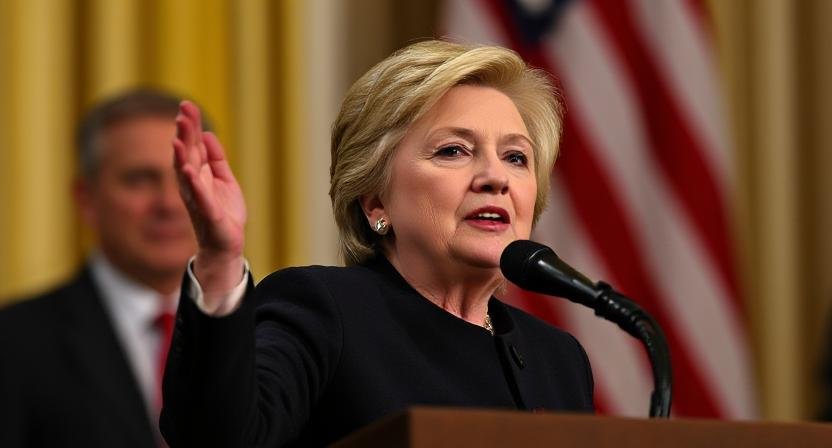
- The FBI investigated but could not verify reports that Clinton approved a Russia-related smear against Trump in 2016.
- The declassified annex includes emails allegedly hacked by Russian intelligence and intercepted by Dutch spies.
- Experts warn the document relies on murky sources and may be politically weaponized.
- Trump allies, including Ratcliffe and Gabbard, use the release to discredit prior Trump-Russia collusion findings.
In a move bound to reignite political controversy, the Trump administration on Thursday declassified and released an intelligence document alleging that Hillary Clinton approved a plan in 2016 to vilify then-candidate Donald Trump by linking him to Russian President Vladimir Putin. The document, a classified annex to Special Counsel John Durham’s 2023 report, details internal Clinton campaign emails and intelligence assessments—but ultimately admits that the FBI could not verify the existence of any coordinated smear operation.
The document shows that Clinton campaign aides discussed leveraging Trump’s alleged ties to Russia for political advantage. One memo cited in the annex, reportedly derived from Russian intelligence hacks and translated via Dutch intelligence services, states that Clinton’s policy adviser Julianne Smith approved a plan “to smear Donald Trump by magnifying the scandal tied to the intrusion by Russian special services.” Yet no conclusive proof of such a plan has emerged.
“This matters profoundly to the Trump administration because it reframes the 2016 narrative that haunted Trump’s first term,” said Dr. Matthew Holden, a political scientist at George Mason University. “If this annex gains traction, it’s a direct attack on the legitimacy of the Trump-Russia collusion story and bolsters Trump’s long-standing claim that his presidency was sabotaged by partisan intelligence actors.”
The Durham annex, though partially redacted, implies that the FBI debated the credibility of the information but “was ultimately unable to determine whether it was entirely genuine, partially true, or fabricated in its entirety.”
A key figure in the annex is Leonard Benardo of George Soros’s Open Society Foundations. According to the document, hacked emails from Benardo suggested that the Clinton campaign expected the FBI to amplify the Russia narrative. Both Benardo and Smith, however, told Durham’s team they had no recollection of such communications. The Open Society Foundations condemned the allegation as “outrageous disinformation traced to Russian intelligence.”
“The idea that Clinton approved a fake narrative is political TNT,” said Colleen Rowley, a former FBI legal adviser turned whistleblower. “But the problem is the intelligence trail is shaky. Russian disinfo, mistranslations, and partisan interpretation can’t serve as legal proof in a democracy.”
READ MORE: Trump the Peacemaker: Thailand-Cambodia Agree to Immediate Ceasefire After US Pressure
Despite the lack of verification, the release is being aggressively spun by Trump loyalists. Former CIA Director John Ratcliffe declared in a statement: “The declassified Durham document shows the false Trump-Russia collusion narrative for what it was—a coordinated plan to prevent and destroy Donald Trump’s presidency.” CIA spokeswoman Liz Lyons added that “a mountain of evidence” backs Ratcliffe’s claim and emphasized the need to prevent future weaponization of intelligence.
White House press secretary Karoline Leavitt echoed that sentiment, saying Clinton “approved the Russia hoax against President Trump. Her campaign financed it. She approved it. And the FBI and CIA were weaponized too.”
ALSO READ: FBI investigated, never verified, purported Clinton plan to link Trump with Russia
The origins of the intelligence reports remain murky. The annex cites sources that appear to be linked to Russian spy agencies’ cyber intrusions into U.S. think tanks and Democratic networks. Notably, the New York Times reported in 2023 that Dutch intelligence infiltrated Russian servers, retrieving Clinton-related memos later shared with the CIA. How those files were interpreted remains a matter of partisan dispute.
What adds urgency to the release is the Trump administration’s pattern of revisiting the 2016 election. Over the past month, intelligence officials have issued a flurry of documents that question the now widely accepted conclusion—affirmed by both the Mueller investigation and a bipartisan Senate Intelligence Committee report—that Putin interfered in the 2016 election to help Trump.
Critics argue the Trump team is selectively disclosing intelligence to undercut findings they view as politically motivated. Gabbard, now Director of National Intelligence, recently accused the Obama administration of orchestrating a “years-long coup” against Trump, a claim many in the intelligence community consider incendiary and unsubstantiated.
Whether the declassified annex proves to be a smoking gun or another round of political theater may hinge on how Americans weigh circumstantial foreign-sourced intelligence against the gravity of long-established investigations.
Either way, the stakes are high—and Trump’s team seems intent on rewriting the history books.