



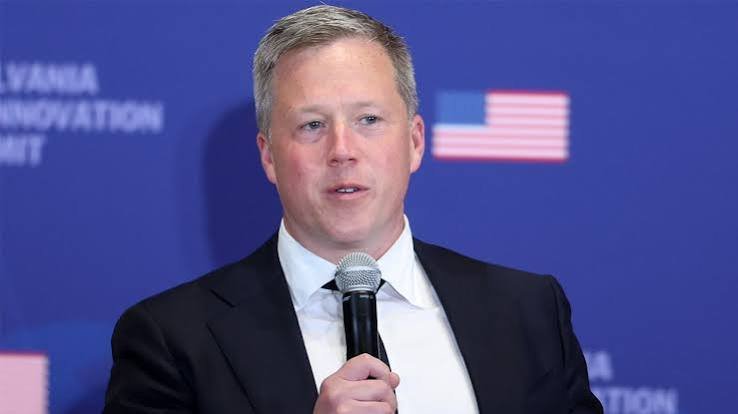
- Dan Driscoll resignation: The Army secretary’s departure follows months of reported friction with Defense Secretary Pete Hegseth and comes during an active US war with Iran.
- Iran war: The continuing American campaign against Tehran is placing extraordinary demands on US forces, missile defence, logistics and military leadership across the Middle East.
- Pentagon shake-up: Driscoll’s exit follows other senior military leadership changes, raising questions about institutional stability while Washington remains engaged in a major conflict.
WASHINGTON — The resignation of Army Secretary Dan Driscoll has opened a new question inside Washington’s national-security establishment: is the latest Pentagon shake-up merely the culmination of a personal and institutional feud, or is it also a symptom of deeper strains created by the United States’ prolonged war with Iran?
Driscoll submitted his resignation to President Donald Trump on Monday after months of reported clashes with Defense Secretary Pete Hegseth. The departure comes at an especially sensitive moment. The United States remains engaged in Operation Epic Fury, the military campaign against Iran that began on February 28, while American forces continue to confront Iranian missiles, drones and threats to regional bases and shipping.
The timing alone does not establish that the Iran war caused Driscoll’s resignation. Reporting from The Washington Post and Reuters indicates that the dispute between Driscoll and Hegseth predates the current crisis and has involved disagreements over senior-officer removals, promotions, Army management and the role of the service secretary.
But timing matters in national security.
A senior civilian responsible for the Army is departing while American forces are engaged in a major Middle Eastern conflict.
READ NEXT: US Troop Withdrawal Europe: Hegseth’s NATO Shock Signals Strategic Shift and Rising Risk for Russia-Ukraine War
That inevitably raises questions about continuity, readiness and whether political infighting is beginning to affect Washington’s ability to manage a war that has already placed extraordinary demands on the Pentagon.
A leadership vacuum at a difficult moment
Driscoll became Army secretary in February 2025 at only 38 years old. An Iraq War veteran, former Army cavalry scout and former venture-capital executive, he entered the administration with a mandate to modernize the Army and accelerate its adaptation to emerging technologies.
His agenda was particularly relevant to the Iran war.
The modern battlefield is increasingly dominated by drones, precision missiles, electronic warfare and rapidly evolving unmanned systems. Driscoll had been closely associated with efforts to make the Army more agile in weapons acquisition and more responsive to lessons emerging from Ukraine and other conflicts.
READ MORE: US army secretary resigns after months of tension
His departure therefore comes at a moment when the Army’s technological adaptation is not an abstract Pentagon reform project. It is directly connected to America’s ability to fight and sustain modern warfare.
The United States has already paid a price in the Iran conflict. Four Army Reserve soldiers supporting Operation Epic Fury were killed in an unmanned-aircraft attack at Kuwait’s Port of Shuaiba on March 1, according to the Army Reserve.
That incident illustrated a fundamental reality of the Iran war: American bases, logistics networks and military personnel across the Middle East remain vulnerable even when the United States possesses overwhelming air and naval superiority.
Dan Driscoll Resignation: The scale of the Iran campaign
The Pentagon’s own figures demonstrate the scale of the operation.
By April 6, U.S. Central Command said American forces had struck more than 13,000 targets and damaged or destroyed more than 155 Iranian vessels.
The American force employed an extraordinary range of capabilities, including B-1, B-2 and B-52 bombers; F-15, F-16, F-18, F-22 and F-35 aircraft; Tomahawk-capable naval forces; Patriot and THAAD missile-defence systems; electronic-warfare aircraft; attack helicopters; and unmanned systems.
CENTCOM has continued reporting strikes against Iranian military targets months after the campaign began, including attacks on IRGC facilities and Iranian naval infrastructure. In July, U.S. forces also used unmanned surface vessels to strike a submarine and ship-maintenance facility at Bandar Abbas.
This is therefore not a short punitive operation.
It has evolved into a sustained military campaign involving air power, missile defence, naval operations, intelligence, logistics and regional force protection.
That makes Pentagon stability more important, not less.
Hegseth’s consolidation raises questions
Driscoll’s resignation follows a series of high-profile personnel changes under Hegseth.
The most consequential was the removal of Gen. Randy George, the Army’s chief of staff, in April, alongside other senior Army officers. The Washington Post reported that Hegseth and Driscoll had disagreed over the treatment of senior officers, including George.
The pattern has generated concern because the Army is now facing a leadership transition at both the civilian and military levels.
That is unusual at any time.
It is particularly consequential during an active war.
The Pentagon can operate under acting leadership, and the military bureaucracy is designed to absorb personnel changes. But prolonged vacancies at the top can affect procurement decisions, strategic planning, congressional relations and long-term force development.
The central question is therefore not whether one secretary resigning will cripple the Army.
It will not.
The question is whether repeated leadership turnover is becoming a structural problem.
Does Driscoll’s exit weaken America’s grip on Iran?
The answer, at least immediately, is probably not in operational terms.
Iran policy is directed by the president, the secretary of defense, the Joint Chiefs and U.S. Central Command. The Army secretary is not the commander of the Iran campaign.
CENTCOM controls the operational fight.
But strategic influence is different from battlefield command.
The Army provides critical land-based capabilities, logistics, air defence, missile defence, special operations support and sustainment across the Middle East. A prolonged Iran conflict therefore requires close coordination between civilian leadership, service chiefs, combatant commanders and Congress.
The danger is cumulative.
If leadership changes continue while the war continues, America’s adversaries may begin to interpret personnel turbulence as evidence of political uncertainty.
Iran would have a strong incentive to test that assumption.
Tehran will be watching Washington
Iran does not need to defeat the United States militarily to benefit from American political divisions.
Its strategic objective can be considerably narrower: survive, preserve enough military capability to threaten American forces and regional partners, maintain leverage over the Strait of Hormuz and force Washington to calculate the political cost of continuing the war.
Every sign of disagreement in Washington therefore matters.
The resignation also comes after months in which Hegseth has sought to reshape the Pentagon and remove senior officials viewed as insufficiently aligned with the administration.
Supporters describe that as necessary reform.
Critics see dangerous politicization of the military.
The truth may ultimately depend on what happens next.
The bigger problem is institutional confidence
Driscoll’s departure should not automatically be interpreted as evidence that the United States is losing the Iran war.
America retains overwhelming advantages in air power, naval power, intelligence, logistics and precision-strike capabilities.
But wars are not won by weapons alone.
They require political coherence.
The United States is simultaneously dealing with Iran, Russia, China, European security commitments and global force requirements. The Pentagon must manage ammunition stocks, missile interceptors, replacement equipment, personnel and increasingly sophisticated drone warfare.
The United States has already demonstrated its ability to project enormous military power against Iran. The more difficult question is whether Washington can sustain that power while maintaining political and institutional cohesion.
That is where Driscoll’s resignation becomes significant.
His departure does not prove that the Iran war caused Pentagon instability. The feud with Hegseth clearly has deeper roots.
But the timing creates an uncomfortable strategic reality: America is fighting a major war while another senior layer of its military leadership is being reshuffled.
For Tehran, Moscow and Beijing, that is worth watching.
The immediate consequence of Driscoll’s resignation may be limited.
The longer-term consequence depends on whether it is an isolated personnel dispute—or another indication that the Pentagon is entering a period of sustained internal turbulence.
If the latter proves true, the real cost may not be measured in one vacant office.
It could be measured in America’s ability to sustain strategic pressure on Iran, reassure its regional partners and convince its adversaries that Washington’s political will is as durable as its military power.