



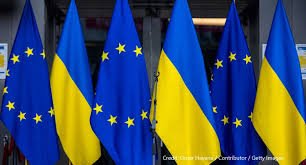
Brussels, January 16, 2026 – The European Commission is quietly exploring a groundbreaking proposal that could fundamentally alter the European Union’s expansion strategy: offering Ukraine accelerated accession with limited membership rights as part of a comprehensive peace settlement with Russia. This unprecedented approach represents both a diplomatic lifeline to war-weary Ukrainians and a potential powder keg in already explosive EU-Russia relations.
Breaking With Tradition: Membership Before Merit
The proposal, still in nascent stages according to EU officials, would dramatically reverse the bloc’s traditional accession process. Rather than requiring Ukraine to fully align its legal framework with EU standards before membership—a process that typically takes a decade or longer—Kyiv would receive immediate but conditional entry, with full membership privileges “earned” through subsequent transition periods.
This reversal of the merit-based system that has governed EU expansion since its inception marks a radical departure from established protocol. Under current rules, candidate countries must demonstrate comprehensive legal, economic, and institutional reforms before accession negotiations even conclude, with national parliaments of all 27 member states holding veto power over any new entrant.
Iran protests Reach Boiling Point as U.S. Bombers Move Into Position
The Ukrainian EU membership timeline discussed in a 20-point peace plan circulated among United States, Ukrainian, and European Union diplomats pencils in 2027 as a potential accession date—a timeframe many EU governments privately dismiss as “completely unrealistic” given the complex legal and political hurdles involved.
Ukraine’s Perspective: Economic Lifeline and Security Guarantee
For Ukraine, EU membership represents far more than economic opportunity—it embodies existential security after four years of devastating war. Having resisted Russian invasion at tremendous human and material cost, Ukrainians view integration with Western institutions as the ultimate guarantee against future aggression.
Iran protests Reach Boiling Point as U.S. Bombers Move Into Position
President Volodymyr Zelenskyy has consistently framed EU accession as a non-negotiable element of any peace agreement, arguing that economic prosperity and institutional alignment with Europe provide the foundation for long-term stability and deterrence. Ukrainian officials believe that even limited membership would anchor their nation firmly within the Western sphere, making future Russian military adventures politically and economically prohibitive.
The economic dimension cannot be understated. Ukraine’s infrastructure lies in ruins, its industrial capacity decimated, and its population displaced. EU membership—even in limited form—would unlock access to structural funds, agricultural subsidies, labor mobility, and investment protections that could accelerate reconstruction. For ordinary Ukrainians exhausted by conflict, EU integration offers tangible hope for stability and prosperity their children might inherit.
Russia’s Calculus: Existential Threat or Negotiating Leverage?
From Moscow’s perspective, Ukrainian EU membership represents a geopolitical nightmare that validates every security concern Russian leadership has articulated since the conflict began. The Kremlin has consistently framed NATO and EU expansion eastward as unacceptable Western encroachment on its sphere of influence, with Ukraine’s potential membership in either organization constituting a “red line.”
Venezuela Warms Up To Trump: Interim Government Embraces Trump Administration in Historic Oil Deal
Will Russia accept this arrangement? The answer depends entirely on what concessions accompany it. If Ukrainian EU membership occurs within a broader peace framework that addresses Russian security concerns—perhaps including permanent Ukrainian neutrality regarding NATO, demilitarized zones, or federal restructuring granting autonomy to Russian-speaking regions—Moscow might grudgingly acquiesce, viewing it as the lesser of two evils compared to NATO membership.
However, Russian Foreign Minister Sergey Lavrov has repeatedly stated that Ukraine’s integration into “hostile Western blocs” remains unacceptable. Any EU membership—limited or otherwise—would likely trigger demands for compensatory measures: formal recognition of territorial gains, lifting of sanctions, security guarantees for Russia itself, or veto power over future Ukrainian military partnerships.
The fundamental question is whether Russia views Ukrainian EU membership as primarily economic (potentially tolerable) or as a Trojan horse for eventual military integration with the West (absolutely unacceptable). Given that EU membership includes mutual defense cooperation through the Common Security and Defence Policy, Moscow has legitimate grounds for the latter interpretation.
The Brussels Dilemma: Political Will vs. Institutional Integrity
Within the European Union itself, this proposal faces formidable obstacles that extend beyond Russia’s potential objections. Several member states—particularly those with Ukraine-skeptic populations or strong agricultural lobbies—harbor serious reservations about Ukrainian accession under any circumstances.
Economic concerns loom large. Ukraine’s agricultural sector would immediately compete with farming interests in Poland, France, and other agricultural powerhouses, potentially triggering subsidy disputes and market disruptions. The country’s reconstruction needs could strain EU budgets already stressed by previous expansion rounds and ongoing economic challenges.
Institutional integrity presents another challenge. If the EU abandons merit-based accession for geopolitical expediency with Ukraine, what precedent does this set for other candidates like Moldova, Georgia, or Western Balkan nations that have patiently navigated the traditional process? Turkish officials, whose country has languished in candidate status for decades, have already voiced concerns about double standards.
Legal complications abound. Even “limited” membership would require unanimous consent from all 27 national parliaments—a high bar when countries like Hungary maintain close relations with Russia and Slovakia’s government has questioned continued Ukraine support. The precise legal mechanism for creating a tiered membership structure with delayed rights remains unclear and potentially vulnerable to legal challenges.
Strategic Implications: Redrawing Europe’s Future
This proposal represents more than a diplomatic maneuver—it potentially redefines European security architecture for generations. If implemented, Ukrainian EU membership, however limited, would mark the most significant eastward expansion since the 2004 enlargement that admitted former Soviet bloc nations.
For Russia, this would confirm its worst fears: complete loss of influence over a nation it views as historically, culturally, and strategically inseparable from Russian identity. The psychological impact of Ukraine firmly anchored in European institutions could prove as significant as the practical geopolitical consequences, potentially hardening Russian nationalism and authoritarian governance for decades.
For the United States, Ukrainian EU membership serves strategic interests by cementing European responsibility for Ukraine’s long-term security and reconstruction, potentially reducing American financial and military commitments while maintaining Western unity against Russian revisionism.
For Europe itself, absorbing a war-torn nation of 40 million people represents an enormous gamble. Success could demonstrate the EU’s capacity for bold, values-driven expansion and create a prosperous, democratic buffer against Russian aggression. Failure—marked by institutional paralysis, economic strain, or renewed conflict—could fracture European unity and discredit the enlargement process entirely.
The Path Forward: Negotiation or Dead End?
As peace negotiations intensify, this limited membership proposal will face its ultimate test: whether it can satisfy Ukrainian aspirations, reassure European skeptics, and avoid triggering Russian military escalation—an exceptionally narrow diplomatic corridor.
The coming months will reveal whether the European Union possesses the political courage and institutional flexibility to implement such a revolutionary approach, and whether Russia can be persuaded—or compelled—to accept an outcome that fundamentally reshapes the European order it has violently resisted.
One certainty emerges: the decision on Ukrainian EU membership, in whatever form, will define European geopolitics for the 21st century, determining whether the continent moves toward inclusive integration or descends into renewed division and confrontation.