



- Field Marshal Asim Munir has emerged as one of South Asia’s most consequential military leaders after guiding Pakistan to a decisive victory against a numerically superior Indian force in a full-scale conflict
- Pakistan Army’s multinational drills at Kharian underline the country’s growing credibility as a global hub for elite military training and joint warfare exercises
- The Pakistan Army Team Spirit competition showcases evolving doctrines of modern warfare, hybrid threats, and real-world battlefield coordination among allied forces
- Pakistan’s armed forces, under transformative leadership, are integrating advanced technology, simulator-based training, and joint operations to prepare for future conflicts
As he approached the stage to address the soldiers of many nations, his head was high with pride. His eyes were bright, his chest squared against the cold February wind sweeping across Punjab’s rugged plains. The dust of Kharian clung to boots and fatigues, but it also carried something rarer—a quiet certainty that history was being written not in conference rooms, but in the field. Field Marshal Syed Asim Munir stood before the assembled troops not merely as Pakistan’s highest-ranking soldier, but as a commander whose name had, within a single year, been etched into South Asia’s strategic memory.
Last May, in a full-fledged war that stunned global observers, Pakistan under Asim Munir’s command decisively repelled—and defeated—a military nearly ten times its size. The conflict with India reshaped deterrence calculations across the region, elevating Munir from a respected general to a Field Marshal whose operational clarity, restraint under pressure, and precision warfare earned attention far beyond Islamabad. For Pakistan’s armed forces, it was not just a battlefield victory; it was proof of doctrine, discipline, and leadership converging at the highest level.
Since his appointment first as Chief of Army Staff and later as Field Marshal, Asim Munir has been on an unrelenting mission to transform Pakistan’s armed forces into a modern, integrated, and technology-driven military. His daily routine has become emblematic of that ambition.
At dawn, he inspects naval preparedness along Pakistan’s littoral defenses. By midday, he is seen among jet fighters and combat pilots, discussing air dominance and joint operations. By evening, he returns to the ground—walking with infantrymen, observing armor maneuvers, and scrutinizing counterterror drills. It is a rhythm that reflects his belief that modern warfare is won not by isolated services, but by seamless integration across land, sea, air, and cyberspace.
That philosophy was on full display on Monday in the semi-mountainous terrain of Kharian, where the 9th International Pakistan Army Team Spirit (PATS) Competition concluded on 9 February 2026. The closing ceremony, held against a backdrop of rugged hills and live training zones, was graced by Field Marshal Asim Munir, NI (M), HJ, COAS & Chief of Defence Staff, as the chief guest. His presence underscored the strategic importance Pakistan now attaches to multinational military engagement—not as symbolism, but as preparation for the realities of modern conflict.
The Team Spirit Competition is a grueling 60-hour-long patrolling exercise designed to test physical endurance, tactical judgment, leadership under stress, and adaptability in complex environments. Conducted from 5 February 2026 onward, the exercise challenged participating teams with simulated combat scenarios, intelligence-driven missions, and rapid decision-making tasks in terrain that closely mirrors real operational theaters. It is not a spectacle; it is a crucible.
This year’s competition featured wide-ranging participation from 19 countries, including Bahrain, Bangladesh, Belarus, Egypt, Iraq, Jordan, the Kingdom of Saudi Arabia, Malaysia, Maldives, Morocco, Nepal, Qatar, Sri Lanka, Türkiye, the United States of America, and Uzbekistan. Indonesia, Myanmar, and Thailand attended as observers. Sixteen domestic teams from the Pakistan Army and Pakistan Navy competed, while observers from the Pakistan Air Force closely studied joint operational dynamics. The diversity of flags at Kharian reflected Pakistan’s expanding military diplomacy and its growing credibility as a professional training hub.
Over the years, PATS has evolved into a prestigious and highly competitive exercise, recognized for promoting professional excellence and mutual learning among participating nations. For many foreign teams, Kharian has become a benchmark—where doctrine meets terrain, and theory is tested against fatigue, uncertainty, and pressure. The forum continues to strengthen military-to-military cooperation while fostering camaraderie in an environment that mirrors the chaos of real-world operations.
Addressing the closing ceremony, Field Marshal Asim Munir commended all participating teams for their exceptional professionalism, physical and mental endurance, operational competence, and high morale. He emphasized that such multinational engagements are no longer optional in an era defined by hybrid threats, information warfare, and rapidly evolving battlefields. Collective preparedness, he noted, is the currency of modern security.
Reaffirming the core values of the Pakistan Army, the COAS & CDF underscored the enduring soldiery attributes of “character, courage, and competence.” These values, he said, are not slogans but lived principles—demonstrated repeatedly by Pakistani soldiers, particularly in the ongoing fight against terrorism. His remarks carried added weight given Pakistan’s long and costly counterterrorism campaign, which has shaped one of the world’s most battle-hardened forces.
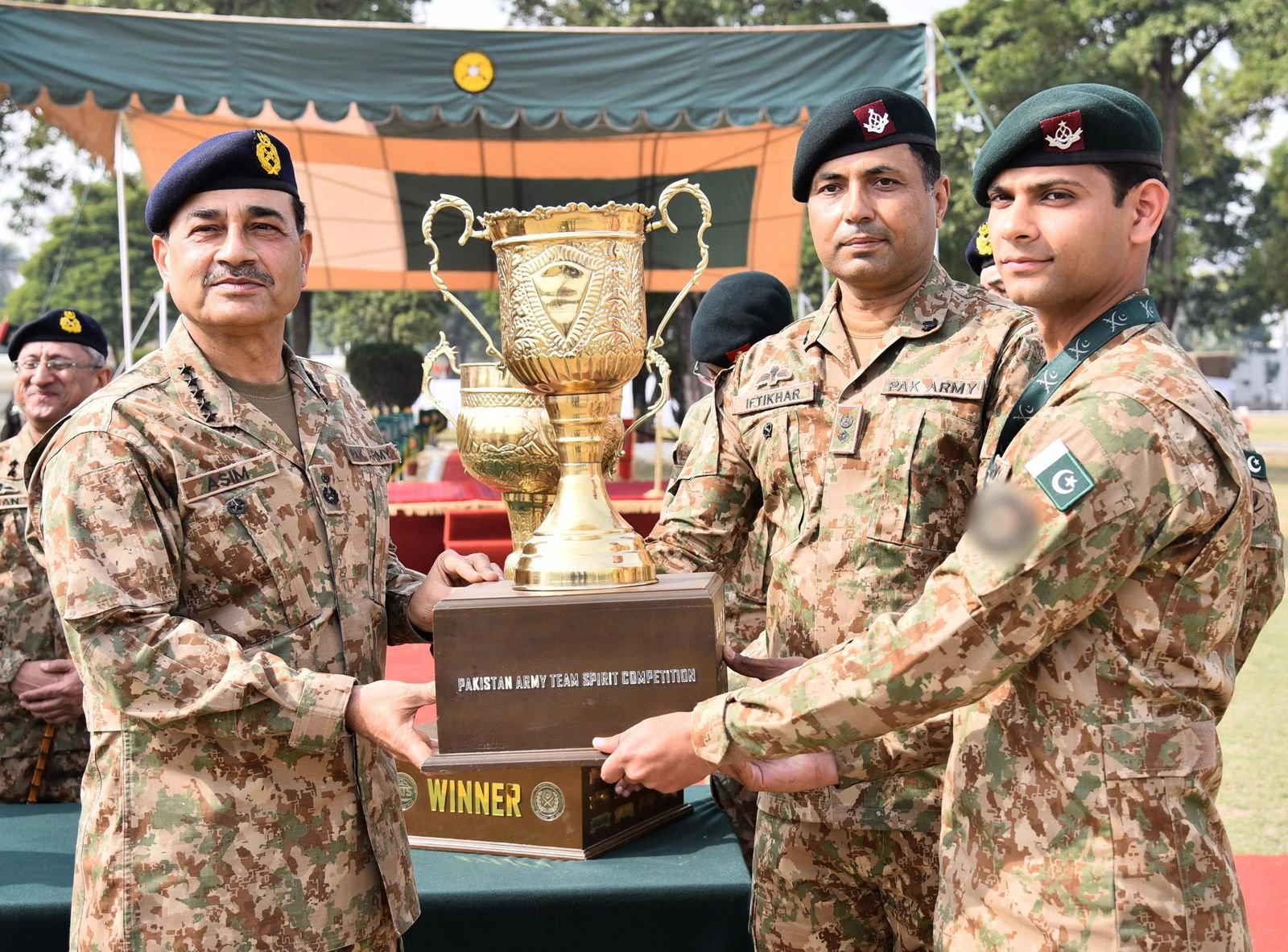
Towards the culmination of the event, the Field Marshal presented awards to outstanding participants, recognizing excellence not only in performance but in leadership and teamwork. International observers and defence attachés from participating countries expressed appreciation for the high standards of professionalism, organization, and conduct displayed throughout the exercise—praise that reinforced Pakistan’s standing as a serious military actor on the global stage.
Beyond Kharian, Asim Munir’s day did not end. He also witnessed miscellaneous training activities at the National Counter Terrorism Centre in Pabbi, including a visit to the newly established Tactical Simulator. Praising the troops and technical teams, he emphasized the growing importance of simulator-based training to complement traditional methods—another signal of a force preparing for future wars, not past ones.
From the dust of Kharian to the strategic recalibration of South Asia, Field Marshal Asim Munir’s imprint is unmistakable. In an era of uncertainty, Pakistan’s armed forces are being reshaped under a commander who believes that victory is forged not in rhetoric, but in readiness—and in the relentless pursuit of excellence on the ground.