



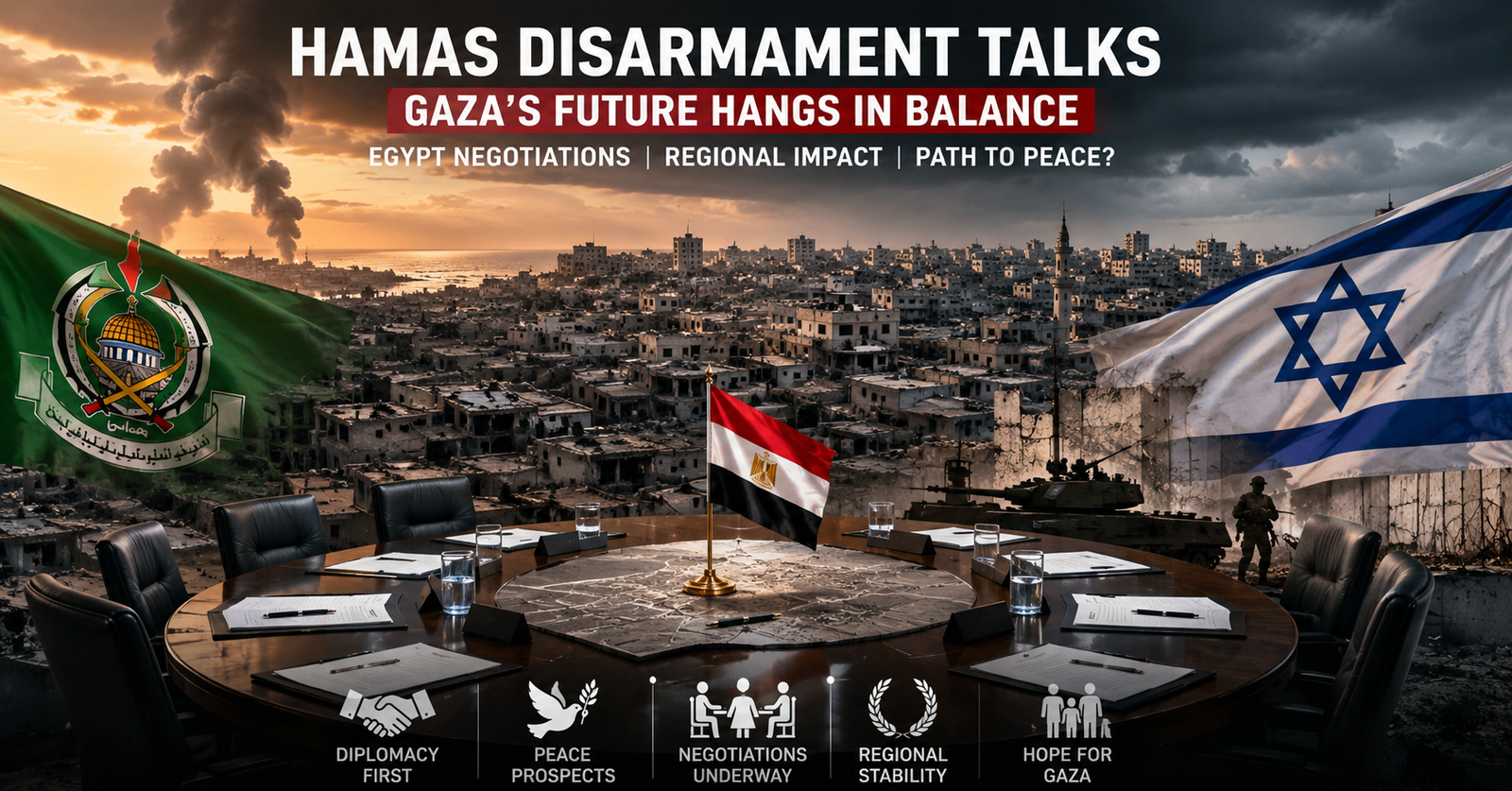
Key Takeaways
- Hamas disarmament talks enter decisive phase in Egypt amid global scrutiny
- Agreement outlines phased removal of Hamas from Gaza governance
- Israel’s approval remains uncertain, posing major risks to implementation
CAIRO/GAZA/WASHINGTON — The geopolitical landscape of Gaza, Lebanon and the wider Middle East is entering a transformative phase as Hamas disarmament talks begin in Egypt on Friday, July 31, potentially reshaping regional power dynamics after nearly two years of devastating conflict.
U.S. officials confirmed that Hamas and other Palestinian militant groups have agreed in principle to a multi-phase roadmap that could lead to disarmament and their eventual withdrawal from power in Gaza, contingent upon a full Israeli military withdrawal and unrestricted humanitarian access.
The agreement represents the culmination of months of intense diplomacy led by the United States, regional mediators, and the Board of Peace established under President Donald Trump.
“This is the start of an indefinite, multiphase process,” a senior U.S. official said, while warning that implementation and verification remain significant challenges.
Hamas Disarmament Talks and the Shadow of October 7
The significance of the Hamas disarmament talks cannot be understood without revisiting the October 7, 2023 attack, when Hamas launched a surprise offensive on Israel, killing approximately 1,200 people and taking around 250 hostages.
READ NEXT: The Fragile Promise: How Israel and Hamas Together Sabotaged Trump’s Peace Deal — and Why War May Return
Israel’s military response has since devastated Gaza, with an estimated 70,000 Palestinians martyred, according to Gaza’s health authorities.
The war triggered regional escalation, drawing in Hezbollah in Lebanon and Iran-backed militias across the Middle East, intensifying fears of a broader regional conflict. Palestinians are keenly awaiting the outcome of Hamas Disarmament Talks.
Now, Hamas’s apparent willingness to shift from armed resistance to a conditional disarmament framework signals a historic strategic recalibration.
Inside the Proposed Roadmap
The 15-point roadmap outlines a phased dismantling of Hamas’s military capabilities and governance structure. Key provisions include:
- Transfer of political authority to a technocratic National Committee for the Administration of Gaza
- Gradual decommissioning of weapons under international monitoring
- Disclosure of tunnel networks, weapons depots, and military infrastructure
- Transition of internal security responsibilities to a new authority
Hamas negotiator Ghazi Hamad, however, clarified that the group has not agreed to outright disarmament but to placing weapons in storage under Palestinian oversight, rejecting any Israeli involvement.
READ MORE: U.S. Says Hamas Has Agreed to Broad Plan to Disarm
Egypt, the host of the talks, has also refrained from explicitly confirming disarmament, referring instead to a broader “road map.”
Hamas Disarmament Talks And Iran’s Influence Over Hamas
For decades, Hamas has maintained a strategic alliance with Iran, forming part of the so-called “Axis of Resistance” against Israel and U.S. influence.
Iran has provided Hamas with financial support, weapons, and training, particularly in missile development and tunnel warfare.
The central geopolitical question now is whether Iran will permit Hamas to move toward disarmament.
Analysts suggest Tehran may tolerate a tactical shift if it preserves its broader regional strategy, while others argue Iran could resist any move that weakens its deterrence against Israel.
“Iran’s position will be decisive,” a regional analyst said. “This is not just about Gaza—it’s about the future of the resistance axis.”
Israel: Silent Yet Decisive
Israel has yet to formally endorse the agreement, despite its presence in ongoing negotiations in Egypt. It’s interesting to note as Israel is keeping mum when it comes to discuss Hamas Disarmament Talks.
Israeli leadership has consistently maintained that Hamas must be completely dismantled, both militarily and politically.
This makes Israel the most critical stakeholder in determining whether the deal proceeds.
A senior diplomat described Israel as a “silent but decisive actor,” warning that without Israeli approval, the agreement risks collapse.
Hamas’s Political Future After Disarmament
If Hamas proceeds with disarmament, its future role remains uncertain.
The group could attempt to transition into a political entity, similar to Hezbollah in Lebanon, or withdraw entirely from governance.
The proposed technocratic administration in Gaza could face challenges from internal Palestinian rivalries, particularly from the Palestinian Authority.
“Hamas stepping back does not automatically create stability,” a European diplomat noted. “It may simply open a new political contest.”
Regional Implications Beyond Gaza
The impact of the talks extends to Lebanon, where Hezbollah is closely monitoring developments, and across the Middle East, where prolonged instability has threatened economic recovery.
Arab states including Egypt, Qatar and Saudi Arabia are pushing for a sustainable resolution to prevent further escalation.
Hamas Disarmament Talks And Trump’s Strategic Push
President Donald Trump has long prioritized Hamas’s disarmament, with the creation of the Board of Peace marking a structured approach to resolving the Gaza crisis.
Trump described the agreement as “historic,” calling it a major step toward lasting peace.
However, success will depend on implementation—a phase fraught with risks.
A Defining Moment for the Middle East
As Hamas disarmament talks continue in Cairo, the outcome could redefine Gaza’s future, reshape regional alliances, and test the limits of diplomacy in one of the world’s most volatile regions.
For now, the world watches closely as negotiations unfold—aware that the difference between breakthrough and breakdown may lie in the details yet to be agreed.