



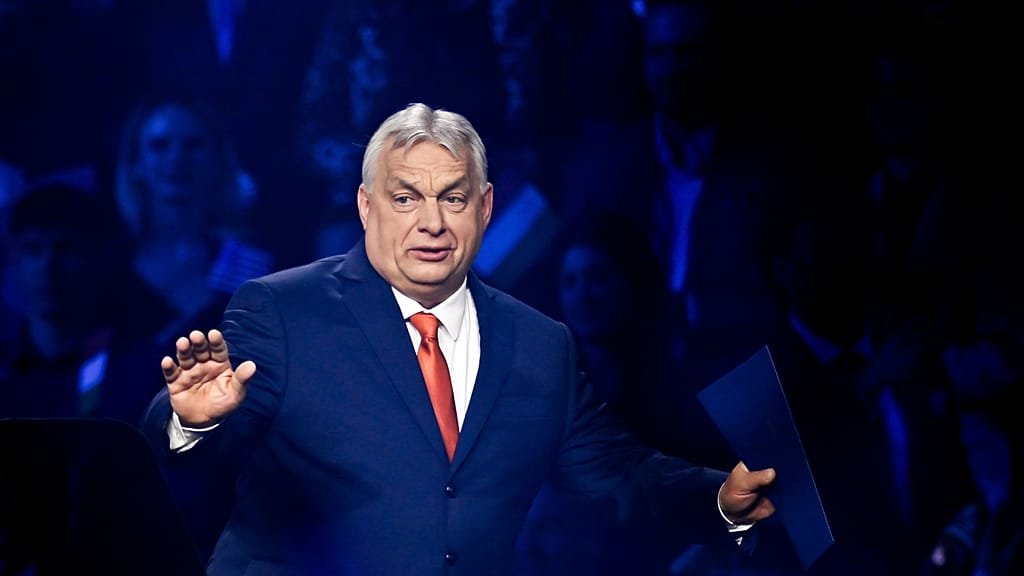
- Hungary Election 2026: Viktor Orbán faces his toughest election challenge since 2010 amid rising opposition strength
- Peter Magyar gains momentum by focusing on corruption, economy, and public services
- Hungary’s EU tensions and Russia policy dominate international attention
- Insiders predict Orbán may win, but only with a very narrow margin
BUDAPEST — After more than a decade of commanding Hungary’s political landscape with an iron grip, Prime Minister Viktor Orbán now finds himself in unfamiliar territory: a fiercely contested election that could redefine both his legacy and Hungary’s place in Europe.
For the first time since returning to power in 2010, Orbán is facing a challenger capable not only of mobilizing public discontent but of penetrating his traditionally loyal voter base. Peter Magyar, a former insider turned critic, has emerged as a formidable opponent, transforming what was once expected to be another routine victory for Orbán into the most consequential election in Hungary since the fall of communism.
Hungary Elections 2026: A Strategic Referendum on War, Sovereignty, and Europe’s Future
Despite the tightening race, insiders familiar with internal polling and campaign assessments told The Islamabad Telegraph that Orbán is still likely to secure victory—but by a razor-thin margin that reflects growing dissatisfaction across the country.
Hungary Election 2026: A Strongman Under Pressure
Orbán, 62, has built his political brand around what he calls “illiberal democracy,” combining nationalist rhetoric, strict immigration policies, and centralized control over institutions. His party, Fidesz, has dominated Hungarian politics for over a decade, reshaping the constitution, judiciary, and media landscape.
However, this election cycle has exposed cracks in that dominance.
Magyar, 45, once a loyal member of Fidesz, has capitalized on public frustration over economic stagnation, rising inflation, and allegations of corruption. His campaign has focused almost entirely on domestic issues—healthcare shortages, failing infrastructure, and what he describes as a system of “crony capitalism” benefiting Orbán’s inner circle.
MEPs warn of ‘serious’ risks to Hungary election, urge Commission to act
Traveling extensively across rural Hungary—areas traditionally loyal to Fidesz—Magyar has struck a chord with voters who feel left behind. His message is simple yet potent: reform the system from within and restore accountability.
Competing Visions
At the heart of the election lies a stark contrast in priorities.
Orbán has framed the vote as a civilizational battle, warning that a Magyar victory would align Hungary more closely with Brussels and potentially drag the country into geopolitical conflicts, particularly the war in Ukraine. He has consistently opposed European Union sanctions on Russia and resisted deeper involvement in supporting Kyiv.
Asim Munir Iran Ceasefire: Pakistan Secures Historic US-Iran Truce, War Halted at Last Minute
Magyar, on the other hand, has avoided foreign policy theatrics, instead promising to stabilize Hungary’s struggling economy, unlock frozen EU funds, and tackle systemic corruption. His platform appeals to conservative voters disillusioned with Orbán but wary of left-leaning alternatives.
International Stakes
The election has drawn unusual international attention, with both Donald Trump and Vladimir Putin seen as favoring Orbán’s continuation in power.
Orbán has long been a darling of Trump-aligned conservatives, positioning himself as a defender of traditional values and national sovereignty. Trump’s allies have actively supported his campaign, underscoring ideological ties between Hungary’s leadership and the MAGA movement.
At the same time, Orbán’s pragmatic relationship with Moscow—particularly his opposition to sanctions and reliance on Russian energy—has made him a valuable partner for Putin within the European Union.
A loss for Orbán would represent a significant geopolitical shift, weakening Moscow’s influence in Europe and removing one of Brussels’ most persistent internal critics.
A Bitter Campaign
The campaign itself has been among the most divisive in Hungary’s modern history. State-aligned media has portrayed Magyar as a puppet of Brussels and Ukraine, while independent outlets have published damaging reports about Orbán’s alleged ties to Russia, including leaked conversations that have stirred controversy.
Record early voter turnout suggests a deeply engaged electorate, reflecting both the high stakes and the intensity of the contest.
Orbán’s Strained Relationship with the EU
Central to the election narrative is Orbán’s long-standing conflict with the European Union. Over the years, he has clashed with Brussels on issues ranging from judicial independence to media freedom and migration policy.
Billions in EU funds remain frozen due to rule-of-law concerns, exacerbating Hungary’s economic challenges. While Orbán has used his veto power within the EU to extract concessions and stall collective decisions, critics argue that his confrontational approach has isolated Hungary.
Magyar has pledged to repair relations with Brussels, framing EU cooperation as essential for economic recovery.
Hungary Election 2026: A Narrow Path Forward
While some polls have shown Magyar leading, Hungary’s electoral system—reshaped under Orbán—continues to favor Fidesz. Control over key institutions, including the presidency and judiciary, further strengthens Orbán’s position.
Analysts suggest that even if Magyar performs strongly, translating votes into parliamentary power will be an uphill battle.
Still, the shifting political winds are undeniable.
“This is no longer the Hungary of 2014 or 2018,” said one Budapest-based analyst. “Orbán may win—but the era of easy victories is over.”
The Likely Outcome
As Hungarians cast their ballots, the most probable scenario remains an Orbán victory—but one that falls far short of his previous commanding mandates.
Such an outcome would mark a turning point: a weakened strongman, an emboldened المعارضة, and a country at a პოლიტიკური crossroads between its past and an uncertain future.
For Orbán, survival may no longer be enough.