



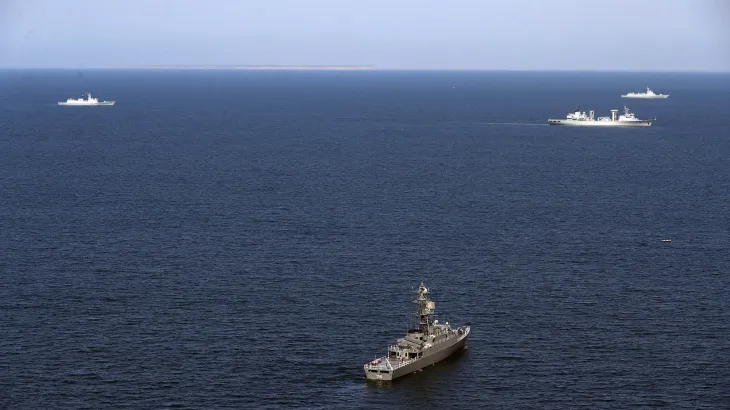
Tehran has signaled that it is no longer intimidated by U.S. military pressure, announcing naval exercises near a U.S. aircraft carrier in the Persian Gulf—a move analysts warn could spark a regional conflagration stretching from the United Arab Emirates to Israel, Yemen, and Qatar.
The announcement comes amid heightened tension following a recent U.S. deployment to the region. President Donald Trump confirmed he had communicated a private deadline to Iran for reaching an agreement, a deadline whose terms and consequences remain undisclosed. While Washington is attempting to push Tehran toward rapid concessions, Iran is projecting defiance, carefully weighing limited diplomatic openings without appearing to capitulate.
Iran’s internal situation adds complexity to the standoff. Widespread protests over economic hardship and political repression have shaken several major cities in recent months, challenging the regime’s domestic legitimacy. Despite the unrest, Tehran’s leadership is leveraging nationalist sentiment, portraying U.S. pressure as external aggression designed to weaken the country. Analysts argue that this dual focus—suppressing domestic dissent while resisting foreign threats—is shaping Iran’s foreign policy strategy today.
Speaking in Istanbul on Friday, Foreign Minister Abbas Araghchi emphasized that Iran would consider negotiations with the United States only if the military threat was removed first. His visit to Turkey was framed as exploratory, with Araghchi clarifying that Tehran would not engage in talks under coercion.
Ahmad Bakhshayesh Ardestani, a member of Iran’s parliamentary Foreign Policy Committee, described ongoing internal debates over Trump’s intentions. “Trump’s confrontation with Iran during his first term was a failure,” he told Didban Iran, noting that the U.S. president’s broader aim appears to be the long-term dismantling of the Islamic Republic. Ardestani also highlighted that regional actors—including the UAE, Qatar, and Turkey—have a vested interest in Iran’s survival, seeing its collapse as destabilizing and economically disruptive.
Meanwhile, former Iranian diplomat Kourosh Ahmadi cautioned that Trump’s military deployments are intended more as political leverage than a signal of imminent attack. “The show of force is designed to deepen Iran’s economic crisis and compel concessions,” he told Entekhab on January 29, stressing that any military action would face significant domestic and international scrutiny.
Despite the mounting tension, Tehran has not softened its rhetoric. Iran’s hardline daily Kayhan suggested that the regime itself might consider closing the strategic Strait of Hormuz, highlighting the leverage Iran holds over global energy flows. Experts such as Rahman Gharemanpour note that preparations for a major operation take time and should not automatically be interpreted as evidence of an immediate strike.
Regional calculations are shifting as well. Mashhad University academic Rouhollah Eslami observed that states in the Gulf are increasingly guided by cost-benefit considerations rather than ideological alignment. This pragmatic approach explains their reluctance to openly back military action against Tehran, even as they monitor the standoff closely.
For now, Iran appears determined to maintain strategic ambiguity. Araghchi insists the country is prepared for both negotiations and war, a posture that underscores the delicate balance of fear and defiance shaping Tehran’s decision-making. Analysts warn that any misstep—by either Washington or Tehran—could ignite a broader conflict, threatening not only Iran and the U.S. forces in the region but also the stability of neighboring states and the global energy market.
The coming weeks will test whether diplomacy can prevail amid a climate of mounting tension, or whether regional rivalries and domestic pressures will push the Middle East toward a dangerous confrontation.