



- Strategic Alliance Deepens: Pakistan’s Prime Minister and Army Chief’s joint visit to Tehran signals a unified civil-military approach to regional diplomacy.
- Iran Steps Up as Mediator: Iranian Foreign Minister’s visits to both Islamabad and New Delhi underscore Tehran’s emerging role in South Asian conflict resolution.
- Gas Pipeline Back on Table: Both sides reaffirm commitment to revive the Iran-Pakistan pipeline project despite Western sanctions and geopolitical constraints.
- Common Stand on Global Crises: Pakistan and Iran align on issues like Kashmir, Gaza, and counterterrorism, strengthening their voice in the Muslim world.
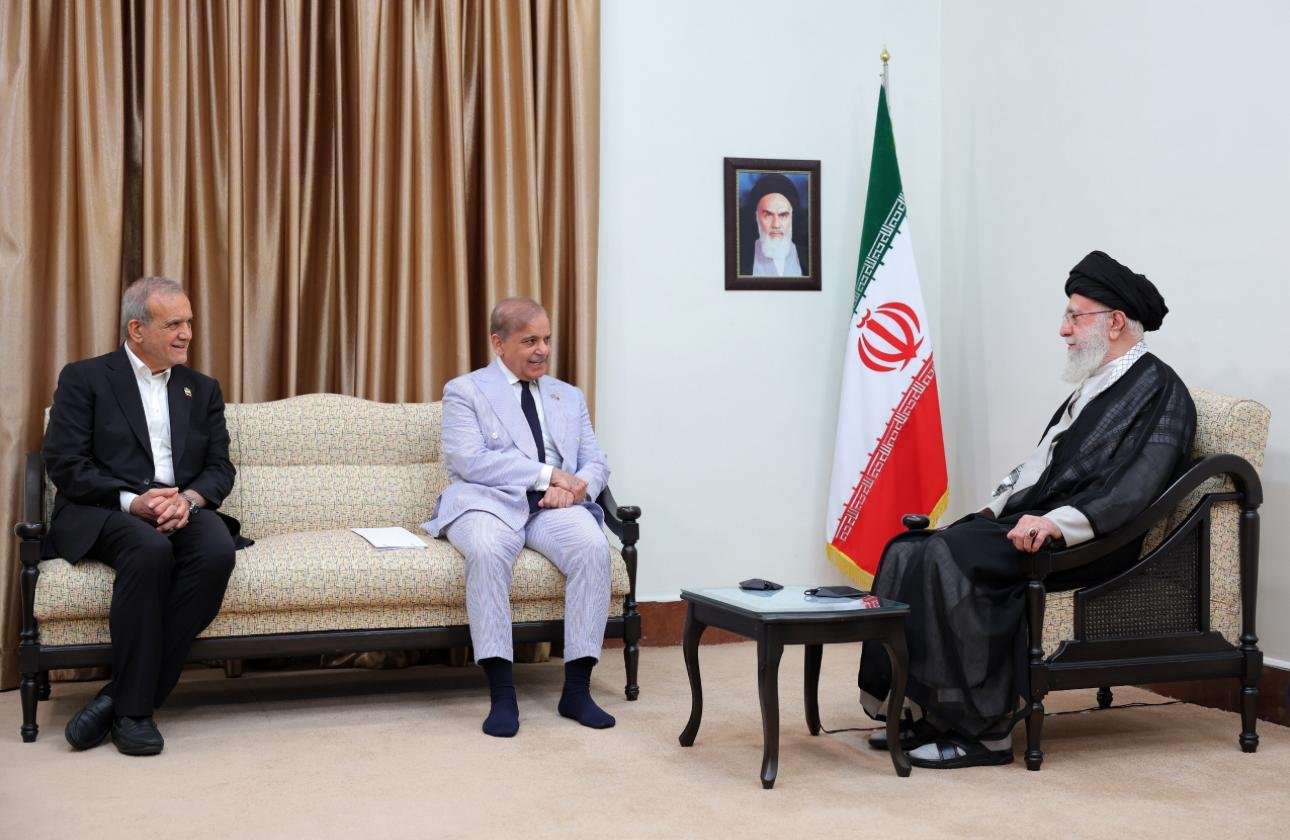
In an extraordinary show of solidarity and strategic foresight, Pakistan’s Prime Minister Muhammad Shehbaz Sharif, flanked by the country’s most powerful military chief, Field Marshal Syed Asim Munir, arrived in Tehran for a landmark meeting with Iran’s newly elected President, Dr. Masoud Pezeshkian. The visit, described by senior Pakistani officials as “both symbolic and tactical,” has set in motion a new trajectory in Pakistan-Iran bilateral ties—one that could influence the delicate balance of power across South Asia and the broader Middle East.
A Meeting of Equals
Held at the Presidential Palace with full state honours, the meeting was more than a mere diplomatic exchange. It was a recalibration of Pakistan’s regional strategy and a subtle yet potent message to adversaries and allies alike.
The presence of Deputy Prime Minister Ishaq Dar, Federal Information Minister Attaullah Tarar, and key foreign policy aide Tariq Fatemi further underscored the seriousness of the occasion. But it was the inclusion of Field Marshal Munir—Pakistan’s de facto national security czar—that elevated the meeting to historic proportions.
Trump’s Rhetoric, Military Moves Risk War With Iran, Warns Cato Fellow Doug Bandow
President Pezeshkian, a reformist with a reputation for pragmatism, welcomed the Pakistani delegation with warmth and clarity. At the heart of the discussions was regional security, particularly the recent escalation between Pakistan and India over ceasefire violations and cross-border militancy.
Prime Minister Sharif, according to sources privy to the discussions, appreciated Iran’s offer to mediate—a proposal that could mark the beginning of a regional diplomatic framework led by regional powers, not external actors.
Iran’s Quiet Shuttle Diplomacy
Crucially, this summit followed Iranian Foreign Minister Ali Bagheri Kani’s back-to-back visits to Islamabad and New Delhi earlier this month. While the details of his meetings with Indian officials remain under wraps, his statements in Islamabad were clear: Iran stands ready to defuse tensions between its two key South Asian neighbours.
Bagheri Kani’s engagement with both capitals points to Iran’s emerging role as a neutral regional arbitrator, challenging the Gulf-centric paradigm of diplomacy. Tehran’s message is simple—regional problems require regional solutions. The Iranian foreign minister’s visit laid the groundwork for the Sharif-Pezeshkian summit and helped align both capitals on core strategic concerns: border security, trade, Afghanistan, and counter-terrorism.
More Than Optics: Why This Visit Matters
The symbolism of a joint civilian-military visit from Pakistan to Iran cannot be overstated. It reflects a rare civil-military consensus in Pakistan’s foreign policy—a dynamic that often defines the country’s strategic direction. Iran, for its part, recognizes Field Marshal Munir as a decisive voice not just in Pakistan’s national security matters but in regional counterterrorism efforts as well.
READ MORE:Trump’s Greenland Obsession: A Strategic Misfire or Calculated Geopolitical Gambit?
Both countries share a long, often understated, history of cooperation. From cultural ties and shared Shia-Sunni religious heritage to anti-terror operations along the porous Balochistan-Sistan border, the partnership is layered and complex. However, recent geopolitical shifts—including Israel’s war on Gaza, the Taliban’s resurgence in Afghanistan, and India’s assertive military posturing—have brought Islamabad and Tehran closer than at any time in the past decade.
Sharif’s call for stronger counter-terror cooperation and his reference to “external actors” was a veiled criticism of those allegedly fueling instability in Balochistan—many in Islamabad suspect Indian intelligence involvement in proxy insurgencies. Iran, having faced similar threats in its Sistan-Balochistan province, understands these challenges intimately. The two sides now appear more willing than ever to synchronize their border security protocols and intelligence-sharing mechanisms.
Economic Stakes and the Pipeline Puzzle
The economic dimension of the visit also deserves close scrutiny. Both leaders reaffirmed their commitment to the long-stalled Iran-Pakistan (IP) gas pipeline project—a critical infrastructure scheme that has remained frozen due to U.S. sanctions and Western pressure. But with global energy markets in flux and Tehran showing resilience against sanctions, Islamabad is recalculating.
Iran’s vast energy reserves offer Pakistan a lifeline amid its own energy crisis. If the pipeline project is revived—and indications suggest this may now be on the cards—it could transform the energy landscape in South Asia and deepen Pakistan-Iran interdependence.
Furthermore, Sharif’s emphasis on expanding bilateral trade aligns with Iran’s eastward economic pivot, driven by its strategic relations with China and Russia. Pakistan, already a cornerstone in China’s Belt and Road Initiative, is well-placed to serve as a transit and trade hub connecting Iran with Central Asia and beyond.
Palestine, Kashmir, and the Muslim World
Prime Minister Sharif’s passionate condemnation of Israeli atrocities in Gaza and his call for a two-state solution echoed sentiments long held by Tehran. But it was his clear linkage between Kashmir and Palestine that brought emotional depth to the summit. By stressing that the resolution of Jammu and Kashmir in accordance with UN resolutions is vital for regional peace, Sharif positioned Pakistan as a moral voice in the Islamic world—one that Iran respects and increasingly supports.
READ MORE:‘Ready to talk with India,’ PM Shehbaz says during meeting with Iranian President in Tehran
President Pezeshkian’s assurances of cooperation on regional peace initiatives and his willingness to visit Pakistan in the near future further signal a maturing partnership rooted in mutual respect and shared vulnerabilities.
Conclusion: Toward a Regional Axis of Stability
This visit is more than a diplomatic event—it’s a statement of intent. At a time when global alliances are shifting, and Western influence in regional matters is waning, Pakistan and Iran are laying the groundwork for a South-Central Asian security architecture led by indigenous powers. The Sharif-Pezeshkian summit, with its civil-military balance, bold security discourse, and economic pragmatism, may well go down in history as a turning point in regional diplomacy.
And as Iran continues its shuttle diplomacy between New Delhi and Islamabad, the world must take note: regional peace will not come from afar—it will be crafted by those who live in its heart.