



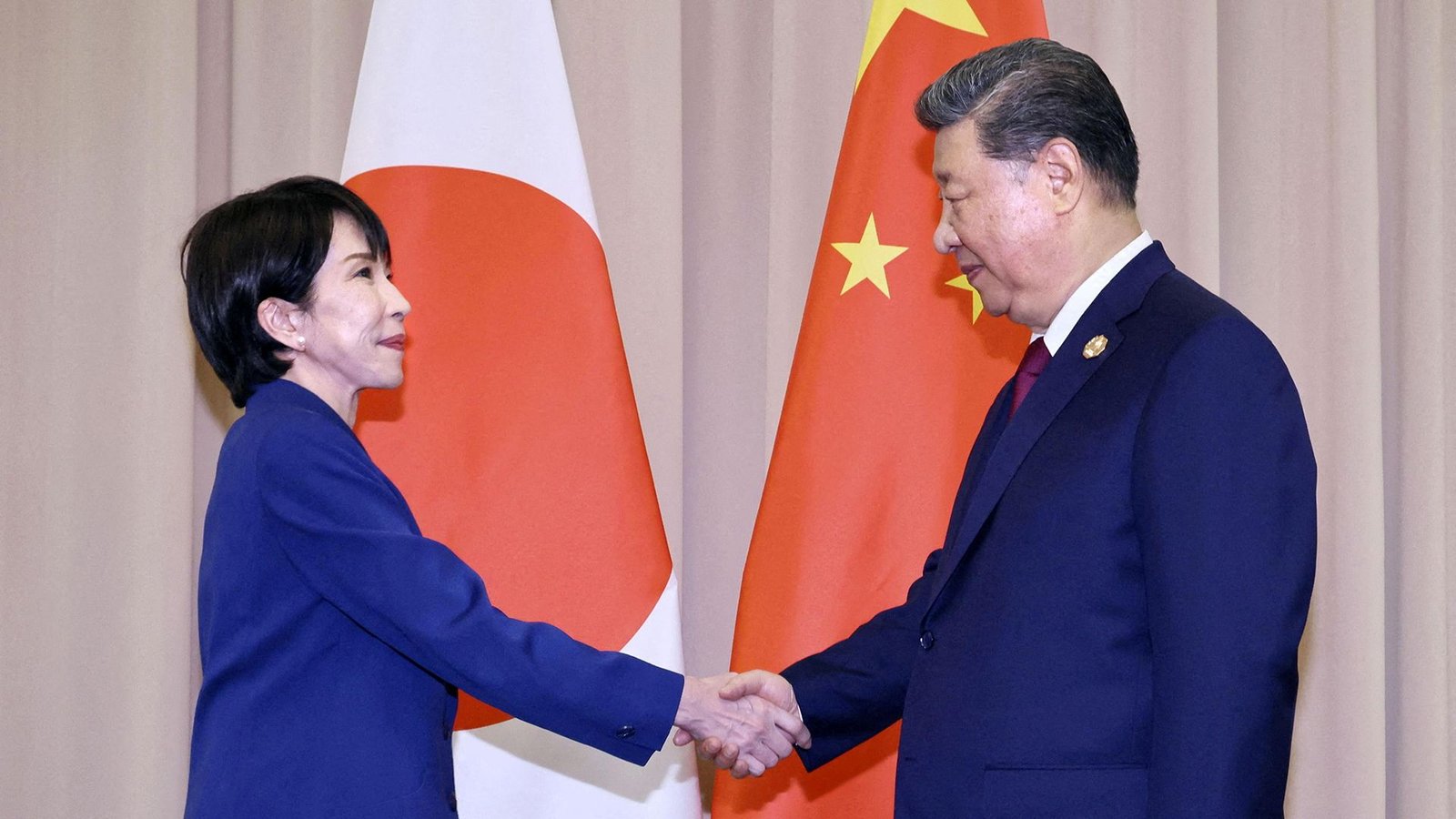
- China issues stern warnings and travel restrictions in response to Takaichi’s Taiwan remarks.
- Japanese opposition and former leaders demand immediate retraction to avoid diplomatic disaster.
- The row exposes Japan’s hawkish tilt and strategic alignment with the U.S. in East Asia.
- Missteps risk a historic low in Japan-China relations, with consequences for trade, security, and regional stability.
Japan China Taiwan relations are souring. Japan-China relations , long shaped by historical tensions and strategic calculations, have entered a perilous phase. The recent remarks of Japan’s first female prime minister, Sanae Takaichi, regarding Taiwan have provoked Beijing into an unprecedented diplomatic outcry, including threats, summons of ambassadors, and advisories warning Chinese citizens to avoid Japan.
For the first time in decades, Tokyo risks a rapid deterioration in bilateral ties, driven by rhetoric that crosses China’s red lines and signals a more aggressive Japanese posture in the region.
Takaichi, who assumed office last month as leader of Japan’s ruling Liberal Democratic Party (LDP), asserted that a Chinese attack on Taiwan could constitute an existential threat to Japan, potentially triggering a military response.
While Japan’s postwar constitution restricts military action, legislation enacted during Shinzo Abe’s tenure permits limited collective self-defense, a provision Takaichi is now invoking in the context of Taiwan. Her statements, widely interpreted as a clear departure from decades of strategic ambiguity, have been described by Chinese officials as “extremely wrong and dangerous.”
China’s response was swift and multifaceted. Vice Foreign Minister Sun Weidong warned Japan’s ambassador that any interference in China’s reunification efforts would be met with a “heavy blow.” Beijing summoned the Japanese envoy multiple times, issued stern warnings, and took the unprecedented step of advising its citizens to refrain from traveling to Japan. The economic implications are notable: nearly 7.5 million Chinese tourists visited Japan in the first nine months of 2025, comprising almost a quarter of foreign visitors. Beyond tourism, this escalation touches on trade, investment, and the broader strategic calculus in East Asia.
READ MORE: China–Japan Tensions Spike Over Taiwan: Asia Faces Potential Crisis
Within Japan, Takaichi’s hardline stance has not gone unchallenged. Opposition figures, including the Japanese Communist Party’s Shii Kazuo and Constitutional Democratic Party members Hiroshi Ogushi and Ichiro Ozawa, have called for an immediate retraction, warning that her statements risk dragging Japan into a conflict that could endanger its citizens and economy. Even late former Prime Minister Shinzo Abe, Takaichi’s mentor, had avoided making definitive commitments on Taiwan while in office, recognizing the potential for a historic crisis. Analysts note that Takaichi’s remarks represent both a personal hawkish inclination and a broader shift within Japan’s domestic politics toward aggressive posturing.
ALSO READ: Japan and China in growing row after PM Takaichi says Taiwan conflict could trigger military deployment
The tension is compounded by symbolism and historical context. Takaichi has previously visited shrines honoring Japan’s war dead and met with Taiwan representatives, moves perceived by Beijing as provocative. Her rhetoric, amplified on social media, elicited extreme responses from some Chinese commentators, including death threats, reflecting the intensity of nationalist sentiment in China regarding Taiwan, which Beijing considers its “core interest.” Experts suggest that while Beijing’s reaction is forceful, it is calculated to assert deterrence rather than provoke immediate military confrontation.
Yet the risk is real. Escalatory language, coupled with Japan’s implicit alignment with the United States, could harden Beijing’s strategic posture. Analysts warn that repeated provocations may lead to a historic low in diplomatic relations, affecting trade, regional security, and multilateral cooperation. For Tokyo, the path forward requires careful navigation: retracting inflammatory statements and emphasizing diplomatic dialogue may be the only way to prevent a protracted standoff with Beijing. Failure to do so could isolate Japan politically and economically, leaving the country vulnerable to the consequences of a miscalculated show of force.
This episode underscores the delicate balance in East Asia, where historical grievances, territorial disputes, and security alliances intersect. Japan, keen to assert its influence and reassure allies, faces the challenge of projecting strength without undermining stability. Takaichi’s remarks, however, have disrupted this balance, exposing the fragility of Japan-China relations. The coming weeks will test the resilience of diplomatic channels, the effectiveness of crisis management, and the prudence of Japan’s new leadership.
In conclusion, Sanae Takaichi’s comments on Taiwan are more than a domestic political maneuver—they are a catalyst for regional tension with far-reaching consequences. The choices Tokyo makes in response to Beijing’s warnings will determine whether Japan can recalibrate its approach or whether it plunges into an era of heightened confrontation. As China warns of serious repercussions, the onus is on Japan to exercise restraint, repair bilateral dialogue, and prevent a dangerous spiral that history may remember as a diplomatic nadir.