



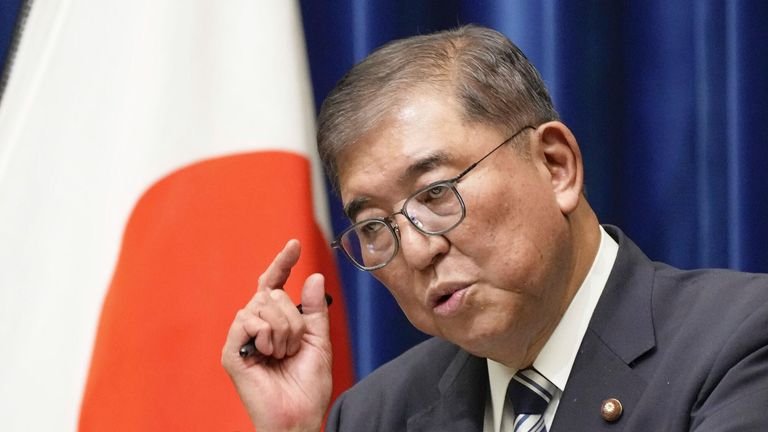
- Shigeru Ishiba resigns after humiliating election defeats, leaving Japan in political limbo at a critical economic moment.
- Trade deal with Trump fails to shield Ishiba from public anger over inflation, wages, and living costs.
- LDP succession battle looms, with Shinjiro Koizumi and Sanae Takaichi emerging as top contenders.
- Populist Sanseito party surges, threatening to reshape Japan’s political order and drag fringe nationalism into the mainstream.
Shigeru Ishiba, Japan’s embattled prime minister, finally bowed to the inevitable on Sunday. His resignation, coming less than a year after he clawed his way into office, underscores a deep political crisis in Tokyo at a time when the country faces economic strain, voter anger, and rising global pressures.
The Islamabad Telegraph had already warned of this moment in its July 21 story, “A Prime Minister Defeated: Japan’s Senate Elections Strip Ishiba of Mandate and Momentum Amid Trump Tariff Showdown.” That analysis revealed cracks in Ishiba’s fragile mandate — cracks that have now widened into a gaping void at the top of the world’s fourth-largest economy.
Ishiba’s fall was not sudden, though. It was a slow, painful unraveling of political capital. First came his humiliating losses in both parliamentary chambers, then the populist surge of Sanseito in July’s upper house election, and finally, the sobering reality that his much-touted trade deal with U.S. President Donald Trump could not mask domestic discontent over rising living costs. At 68, the veteran politician chose to step aside, admitting at a tearful press conference: “I would like to pass the baton to the next generation.”
The Trade Gamble That Failed
Ishiba’s fate was sealed by his gamble on international diplomacy. His crowning achievement — finalizing a trade pact with Washington to ease Trump’s punishing tariffs — was intended to rescue Japan’s auto sector and restore economic confidence. Instead, the deal was perceived at home as too little, too late.
Japan’s Senate Elections Reveal Rightward Shift Among Youth—A Political Turning Point?
By pledging $550 billion in investments to secure tariff relief, Ishiba sought to buy time. But inflation was already biting Japanese households, wages lagged behind expectations, and consumer frustration spilled onto the ballot box. The “Trump tariff showdown,” once framed by Ishiba as a test of national resilience, became a political coffin that buried his government’s credibility.
Markets reacted swiftly. The yen sold off, long-dated bonds hit record yields, and investors began speculating over whether Japan’s next leader would lean toward fiscal stimulus or tighter discipline.
Who Comes Next?
Attention now turns to Ishiba’s successor within the ruling Liberal Democratic Party (LDP). Two figures dominate the conversation:
-
Sanae Takaichi, a veteran politician critical of recent Bank of Japan rate hikes, is favored by LDP hawks who see her as a pro-stimulus, expansionary candidate.
-
Shinjiro Koizumi, the youthful farm minister and heir to Japan’s most famous political dynasty, appeals to a broader public yearning for fresh leadership.
Ishiba narrowly defeated Takaichi in last year’s leadership contest, but today her momentum is stronger. Still, Koizumi’s charisma and technocratic image could make him a consensus candidate in a party desperate to regain public trust.
Yet succession is not guaranteed to restore stability. The LDP has lost its parliamentary majority, meaning the new party leader may face obstacles in securing the premiership. Snap elections remain a possibility, even though a majority of voters told Kyodo News they do not want an immediate poll.
The Populist Wild Card
What unsettles Tokyo most is not simply the leadership transition but the ideological shift reshaping the political landscape. The far-right Sanseito party’s surge has dragged fringe issues into the mainstream: anti-immigration rhetoric, skepticism of globalization, and a rejection of establishment politics.
Sanseito leader Sohei Kamiya has built a movement modeled on Trumpian populism — fiery rallies, defiance of elites, and promises to defend “forgotten Japanese” from foreign influence. His success is a warning that the traditional LDP dominance may no longer hold against rising nationalist forces.
“This is no longer just about Ishiba,” said Ayumi Tanaka, a political analyst at Waseda University. “It’s about whether Japan’s postwar political order — dominated by the LDP — can withstand the populist wave.”
Economic Storm Clouds
Beyond politics, Japan’s economy teeters on the edge of deeper turmoil. Trump’s tariffs, though partially softened by Ishiba’s deal, continue to weigh on exports. Automakers face shrinking margins, inflation remains stubborn, and the yen’s volatility adds pressure on households and businesses alike.
The next leader must navigate between appeasing U.S. demands, restoring public faith in economic management, and confronting an increasingly hostile regional security environment. Last week’s military parade in Beijing — featuring Chinese, Russian, and North Korean leaders standing shoulder-to-shoulder — underscored the geopolitical challenges awaiting Ishiba’s successor.
Predictions: Japan’s Future Politics
What happens next? Three scenarios seem most plausible:
-
Koizumi Ascendancy: If Shinjiro Koizumi takes the helm, expect a focus on generational change and moderate reforms, but little ideological disruption. This would likely calm markets but may not satisfy populist anger.
-
Takaichi Populism-Lite: Should Sanae Takaichi prevail, expect aggressive fiscal stimulus, softer monetary policy, and an appeal to nationalist voters. This could risk bond market jitters but might restore some electoral confidence.
-
Populist Breakthrough: The most dramatic scenario would be Sanseito building momentum toward a major breakthrough in a future general election. That would mark the most significant transformation of Japanese politics since the 1955 system.
In any case, Ishiba’s resignation has accelerated the erosion of political stability. The LDP can no longer rely on its old formula of elite continuity and economic management. Japanese voters — weary of stagnation, wary of global pressures, and increasingly receptive to populist voices — may force a realignment.
A Closing Reflection
Shigeru Ishiba’s downfall is both personal and systemic. A party outsider who fought his way to the top, he became a symbol of resilience but also of the limits of traditional politics in a rapidly changing Japan. His resignation does not close a chapter — it opens an era of turbulence.
Japan now stands at a crossroads: will it cling to LDP dominance through managed succession, or will populist insurgency redefine its political future? Either way, the days of predictable Japanese politics are over.