



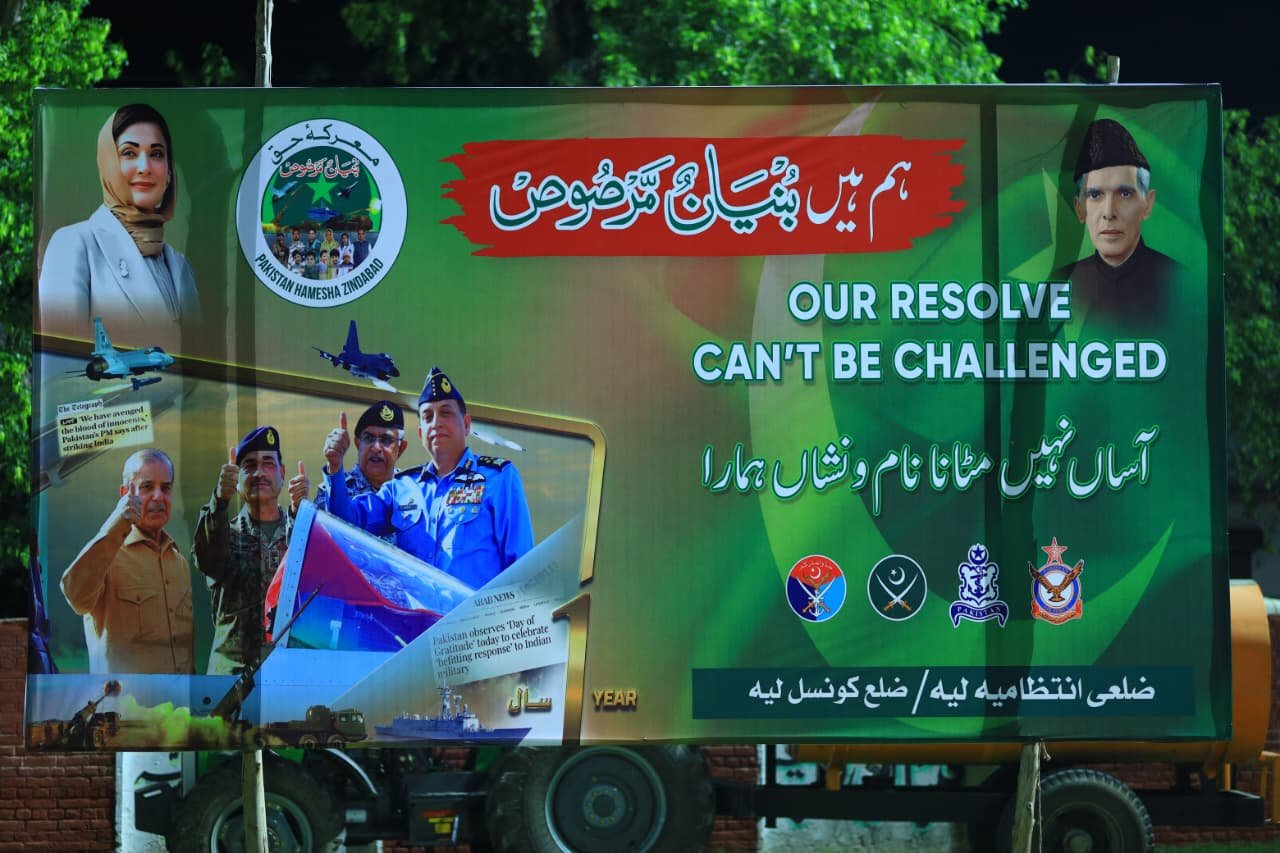
The roads leading to the city center were choked with people hours before sunset. Families arrived on motorcycles, in rickshaws, and on foot, children clutching small flags, women dressed in vibrant shades of crimson and emerald, and young men humming patriotic songs under their breath. For a district that rarely hosts events of this scale, the spectacle felt almost surreal. Yet, beneath the festivity lay a deeper, unspoken awareness: this night was not just about music—it was about resolve.
Just hours earlier, grief had gripped the nation.
In the northwestern province of Khyber Pakhtunkhwa, a suicide attack in Bannu District had claimed the lives of fifteen policemen. The attack was widely seen as an attempt to cast a shadow over the first anniversary of what many in Pakistan call “Marka-e-Haq”—a brief but intense military confrontation with India the previous May. The timing was not lost on anyone.
In most places, such news would have led to silence, cancellations, and mourning. But in Layyah, the opposite happened.
At the center of this decision stood a man described by colleagues as calm under pressure: Deputy Commissioner Asif Dogar.
“We understood the gravity of the moment,” Dogar said later, his voice measured but firm. “The tragedy in Bannu shook all of us. But we also understood the message behind it. The intention was to instill fear, to disrupt, to silence. We could not allow that.”
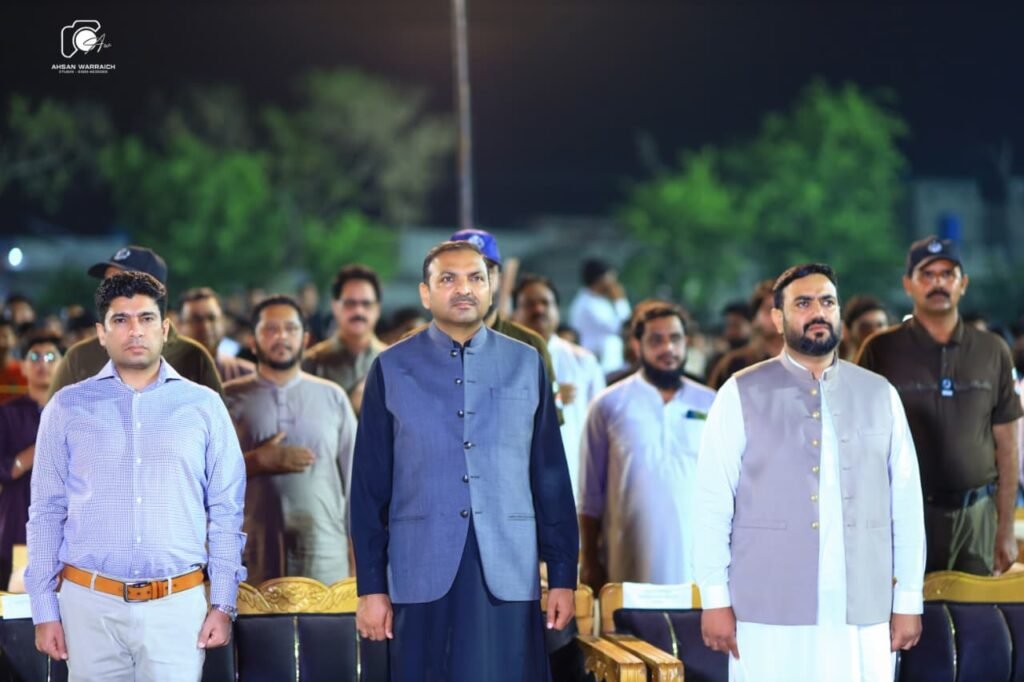
His decision—to go ahead with the planned musical night—was not taken lightly. Security concerns loomed large. Intelligence warnings circulated. The risks were real. Yet Dogar, in coordination with District Police Officer Javed Bhati, chose a path that would transform a routine administrative event into a symbol of resilience.
Orders were issued swiftly. Security was tightened across the venue. Police units were deployed in layers. Entry points were monitored, and surveillance intensified. But beyond the logistics, something intangible began to take shape—a collective determination that fear would not dictate public life.
As dusk settled, the venue came alive.
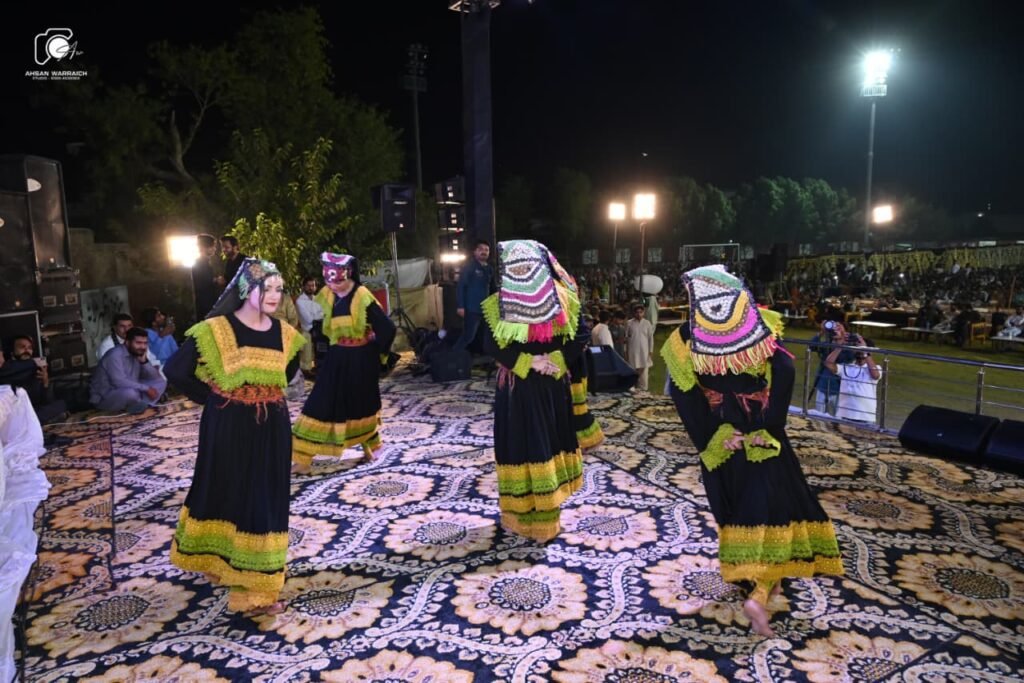
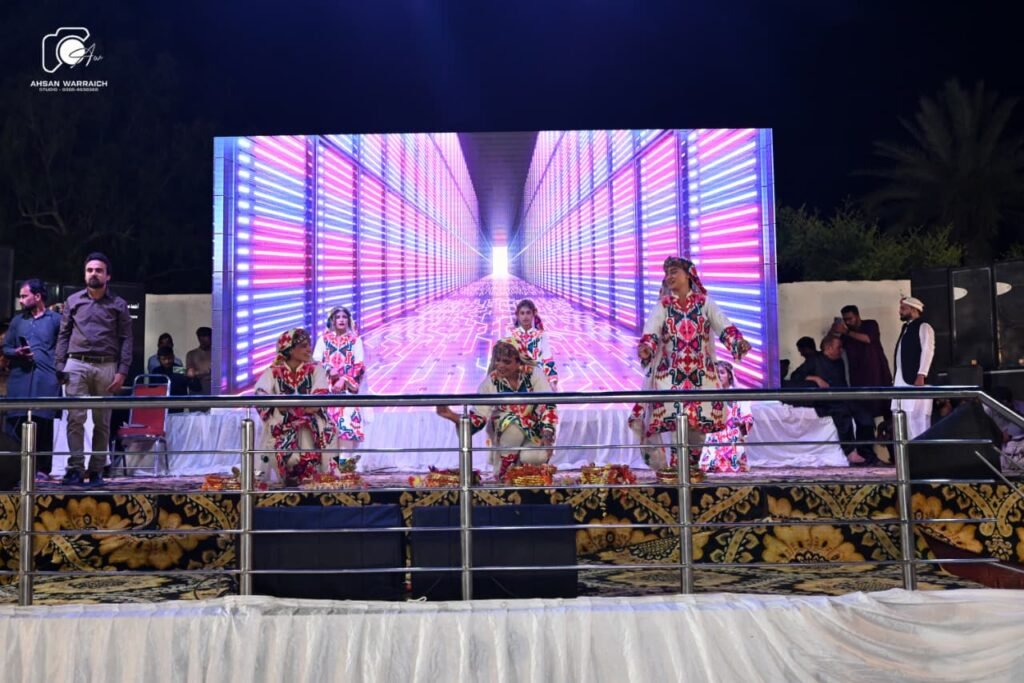
A grand stage, illuminated by cascading lights, stood at the heart of the gathering. Traditional Seraiki melodies floated through the air, blending with the rhythmic clapping of the crowd. Local singers took the stage one after another, their voices carrying stories of land, love, and identity. Each note seemed to echo louder against the backdrop of the day’s tragedy.
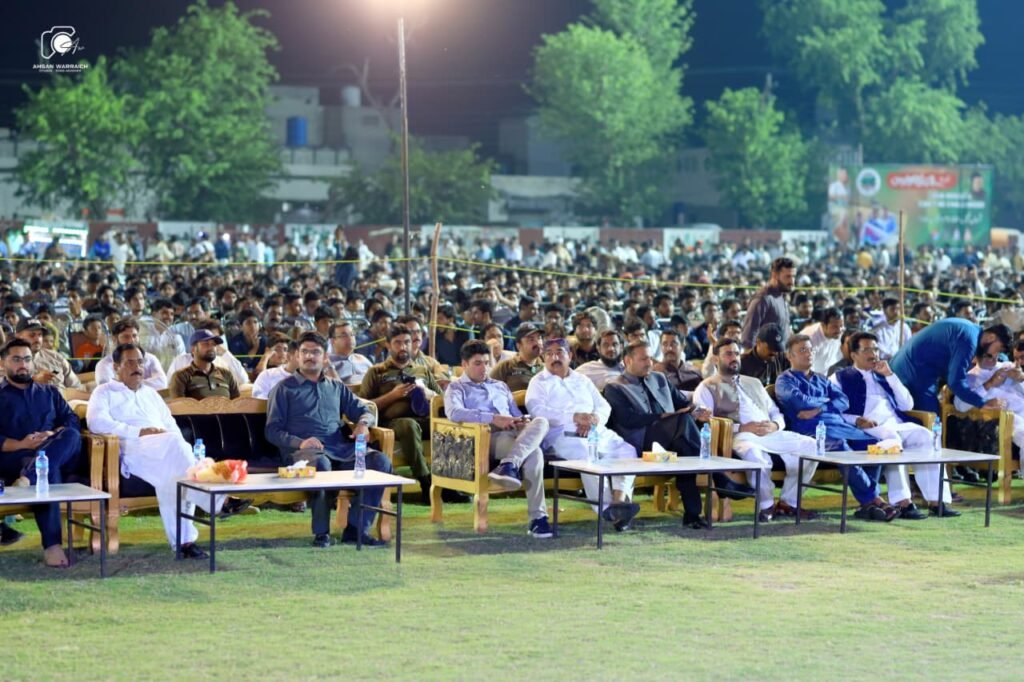
Tens of thousands filled the space—an extraordinary turnout for a district often overlooked in national narratives. There were no empty seats, no hesitant faces. Instead, there was laughter, applause, and a quiet but unmistakable pride.
Youngsters formed circles, breaking into spontaneous dances. Their movements were raw, unchoreographed, yet deeply expressive—feet stomping in rhythm, hands raised high, faces lit with unfiltered joy. It was not just performance; it was catharsis.
For many, this was the first event of its kind in years.
“People needed this,” said Mehr Ghazanfar Klasra, a local social worker watching from the sidelines. “We have seen hardship, economic struggles, and security concerns. But tonight, you see families together, you see happiness. The administration deserves credit for making this happen.”
The significance of the event extended beyond Layyah.
Across Punjab, district administrations had been directed to mark the anniversary under the leadership of Chief Minister Maryam Nawaz Sharif. In major urban centers like Lahore, Karachi, and Islamabad, such events are expected, even routine. But Layyah was different.
Here, infrastructure is modest. Resources are limited. Organizing a gathering of this magnitude requires not just planning, but courage.
And courage, on this night, was contagious.
As videos of the event began circulating, they reached the highest offices in the province. Chief Minister Maryam Nawaz Sharif reportedly watched clips of Seraiki performances and the massive turnout with admiration.
“It was indeed a wonderful event,” she said in a brief conversation. “I appreciate the effort and spirit shown by the district administration. The cultural richness of Seraiki music is something very close to my heart,” Maryam Nazwaz Sharif told this correspondent over telephone.
Her words added another layer of validation to what many in Layyah already felt—that their moment had been seen, acknowledged, and celebrated.
The anniversary itself traces back to a volatile chapter in South Asia’s recent history. Following a deadly attack in disputed territory, tensions between Pakistan and India escalated rapidly. India launched strikes under what it called “Operation Sindoor.” Pakistan responded with Operation Bunyan-un-Marsoos—a coordinated military effort that, according to Pakistani officials, demonstrated both precision and restraint.
The conflict lasted just four days, from May 7 to May 10, 2025.
But its impact was profound.
Pakistan’s armed forces, particularly the Pakistan Air Force, were widely credited within the country for delivering a decisive response. Reports circulated of multiple Indian aircraft being downed—claims that became central to the national narrative of the conflict.
It was in this context that Donald Trump entered the story.
Throughout late 2025 and into 2026, Trump repeatedly asserted that his administration had played a critical role in halting the conflict. Speaking at various forums, he claimed that escalating tensions had risked a broader, potentially catastrophic confrontation.
“We stopped a war between two nuclear nations,” he said in one address, referencing the crisis. He also spoke of leveraging economic pressure, including the threat of steep tariffs, to push both sides toward a ceasefire.
Trump went further—highlighting the scale of aerial losses during the conflict. “Seven planes were shot down,” he initially said, later revising the figure to eight, and at times suggesting even higher numbers. While these claims have been debated internationally, in Pakistan they reinforced a sense of validation—an acknowledgment, however indirect, of the effectiveness of its military response.
For the people gathered in Layyah, however, geopolitics felt distant.
What mattered was the present—the music, the unity, the shared experience of standing together in the face of uncertainty.
As the night deepened, the energy did not wane. Children sat on their parents’ shoulders, waving flags. Elderly men nodded along to familiar tunes. Vendors moved through the crowd, selling snacks and drinks, their voices blending into the ambient hum.
And on stage, the performances grew more spirited.
Each song seemed to carry a message—not of triumph over an adversary, but of endurance. Of a community refusing to be defined by fear. Of a nation choosing to celebrate even in the shadow of loss.
Deputy Commissioner Dogar watched much of it from a distance, occasionally conferring with security officials, his presence understated but constant. For him, the success of the evening was not measured in numbers alone, but in what it represented.
“We wanted to show that life goes on,” he said. “That our people are strong. That we will not be intimidated.”
In a world where headlines are often dominated by conflict and division, the story of that night in Layyah offers a different lens—one where resilience is expressed not through force, but through culture, community, and the simple act of coming together.
As the final performance concluded and the lights began to dim, the crowd dispersed slowly, reluctant to let go of the moment. There were no signs of fear, no lingering shadows from the day’s tragedy—only a quiet satisfaction.
For one evening, in a modest district far from global attention, defiance had taken the form of music.
And it had been heard.