


-
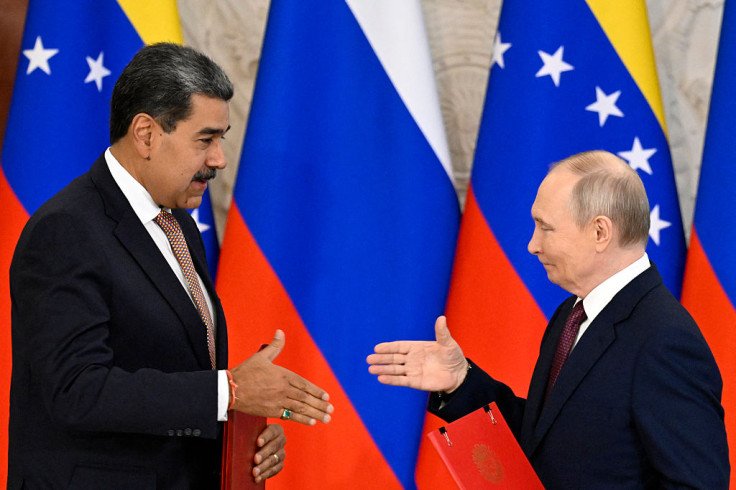
Maduro Seeks Missiles From Russia: Venezuela’s president has sent a personal letter to Vladimir Putin requesting aircraft repairs, missile systems, and radar upgrades amid rising U.S. military pressure.
-
American Buildup in the Caribbean: The U.S. has deployed the aircraft carrier USS Gerald Ford and naval assets near Venezuela, citing counternarcotics operations that Caracas calls “acts of aggression.”
-
Russia’s Strategic Dilemma: With troops stretched thin in Ukraine, Moscow faces a difficult decision — whether to defend its ally or prioritize the European front.
-
High-Stakes Geopolitics: China and Iran have also stepped in, supplying drones and radar systems, signaling a new era of multi-polar competition as Venezuela falls into darkness.
Caracas — In a dramatic escalation of Latin America’s latest geopolitical crisis, Venezuelan President Nicolás Maduro has turned to Moscow, Beijing, and Tehran for urgent military aid as the United States deploys warships, drones, and special forces near the Caribbean coast.
Internal U.S. government documents, obtained by The Washington Post, reveal that Maduro has sent personal letters to Russian President Vladimir Putin and Chinese President Xi Jinping, appealing for radar systems, missile batteries, aircraft repairs, and what he described as “logistical support” to defend against what he calls “U.S. aggression.”
The correspondence underscores how far Venezuela is willing to go to survive mounting American pressure — and how much is at stake for Moscow, which faces a “testing time” as it juggles its war in Ukraine and seeks to maintain a foothold in Latin America.
Trump’s Patience Runs Thin: Venezuela Faces the Shadow of U.S. Bombers
Maduro Seeks Missiles from Russia: A Desperate Plea for Help
Maduro’s outreach, dated earlier this month, requested the restoration of several Russian-built Sukhoi Su-30MK2 fighter jets, overhaul of aircraft engines, radar systems, and possibly missile units through Russia’s defense conglomerate Rostec. The letter, according to U.S. officials, asked for a three-year financing plan to pay for the upgrades.
The Venezuelan leader also appealed to Beijing to accelerate production of radar systems by Chinese defense contractors and to expand military cooperation “to counter the escalation between the U.S. and Venezuela.”
READ MORE: As U.S. ramps up the pressure, Venezuela pleads with Moscow, Beijing for help
Meanwhile, Venezuelan Transport Minister Ramón Celestino Velásquez coordinated with Iran for shipments of drones and “passive detection equipment.” According to U.S. intelligence, Venezuela is seeking drones capable of ranges up to 1,000 kilometers (about 600 miles), as well as GPS jammers that could potentially disrupt U.S. operations in the region.
“In the missive, Maduro emphasized the seriousness of perceived U.S. aggression, framing any U.S. military action against Venezuela as action against China and Russia due to their shared ideological and economic ties,” one classified U.S. assessment reads.
The U.S. Moves In
The Biden administration — and now the Trump campaign’s foreign policy team — has repeatedly accused the Maduro government of allowing drug cartels and paramilitary groups to use Venezuelan territory as a hub. The U.S. Navy’s USS Gerald R. Ford, its most advanced aircraft carrier, is already stationed near Venezuelan waters, accompanied by destroyers, reconnaissance drones, and anti-smuggling patrol units.
ALSO READ: Trump’s Shadow War: How the CIA’s New Covert Operation in Venezuela Defies International Law
Washington insists the buildup is part of a counternarcotics mission, but Caracas views it as preparation for regime change. More than a dozen U.S. strikes since September have killed at least 61 people, according to local reports — most of them in waters claimed by Venezuela.
“The Americans are sending a message that Maduro’s days are numbered,” said a Latin American diplomat familiar with U.S.-Venezuelan negotiations. “Maduro is responding by playing the Russia-China-Iran card, but it’s unclear if any of them can deliver.”
Moscow’s Dilemma
For Vladimir Putin, the Venezuelan crisis presents both a strategic opportunity and a logistical nightmare. A Russian Ilyushin Il-76 military transport — one of several under U.S. sanctions — landed in Caracas on Sunday, taking a circuitous route over Africa to avoid European airspace. A day later, Russia ratified a new “strategic cooperation treaty” with Venezuela.
The pact includes vague language on defense cooperation and energy projects, but experts caution against overstating Moscow’s capacity.
“Would Russia do anything if the U.S. launches an operation? Probably not,” said Victor Jeifets, editor of Latin America, a Russian foreign policy journal. “Russia’s forces are tied up in Ukraine, and its economy is strained under sanctions. Moscow might offer symbolic support — intelligence, technicians, or equipment — but not boots on the ground.”
Nonetheless, Russia’s stakes remain high. State firms like Rosneft and Gazprom have billions invested in Venezuelan oil and gas ventures, producing roughly 107,000 barrels a day — around 11 percent of Venezuela’s output — and generating an estimated $67 million per month. Russia also holds exploration rights in lucrative offshore gas fields at Patao and Mejillones, valued at over $5 billion.
“A regime change in Caracas would be disastrous for Moscow,” said Francisco Monaldi, director of the Latin American Energy Program at Rice University. “It would mean losing a foothold in the Western Hemisphere and exposing Cuba to renewed isolation.”
Military Realities
Despite Maduro’s defiance, Venezuela’s military is a shell of its former self. The once-formidable arsenal of Russian-made tanks, helicopters, and Sukhoi fighters has largely fallen into disrepair. By 2018, fewer than five operational Sukhois remained, and most missile systems were obsolete.
“Chávez bought pure junk from the Russians,” said a retired Venezuelan officer, referring to former president Hugo Chávez’s lavish weapons deals in the early 2000s. “Today, Maduro’s army cannot match even a fraction of the U.S. firepower in the Caribbean.”
Still, Maduro claims to have deployed 5,000 Russian-made Igla-S portable air-defense systems nationwide — a sign of how seriously he takes the threat of an American strike.
China and Iran Enter the Frame
While Russia’s capacity to help is constrained, China and Iran may play auxiliary roles. Beijing has economic leverage through loans and technology transfers, while Iran has supplied drones and radar components in recent months. Tehran has also reportedly facilitated training of Venezuelan technicians and cyber specialists.
Both nations see Caracas as a useful irritant for Washington — a Latin American counterpart to Syria or Yemen. “It’s a low-cost, high-impact way to stretch American attention,” said Douglas Farah of IBI Consultants, a U.S. security firm.
A Hemisphere on Edge
The crisis has revived Cold War anxieties across Latin America, with Colombia, Brazil, and the Caribbean states quietly aligning with Washington’s position. For now, Putin is weighing his options — to test America’s resolve or conserve his dwindling resources for Ukraine.
“The fact that we’ve moved over 10 percent of our naval assets to the Caribbean is already a win for Putin,” said former U.S. ambassador James Story. “It divides Washington’s focus — and that’s a strategic victory in itself.”
Whether Moscow ultimately sends missiles or merely words, the message is clear: the Caribbean is once again a flashpoint in global power politics. And as Venezuela falls into darkness, the world watches whether Putin dares to extend his reach beyond Ukraine — or lets one of his last Latin American allies fall alone.