



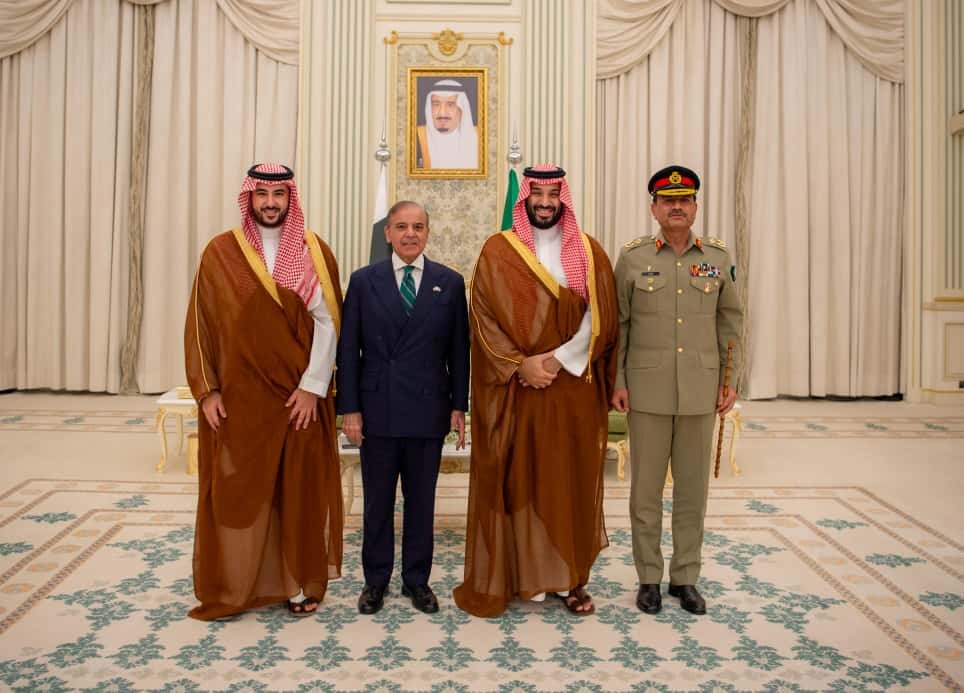
- Pakistan and Saudi Arabia sign a historic mutual defence pact in Riyadh.
- Agreement declares “an attack on one is an attack on both.”
- Pakistan Army hailed as the Islamic world’s shield, led by Field Marshal Asim Munir.
- Crown Prince Mohammed bin Salman reshapes Gulf security architecture.
In a moment charged with symbolism and strategy, Pakistan and Saudi Arabia signed a landmark mutual defence agreement in Riyadh on Wednesday, binding the two nations in an unbreakable pact that transcends mere geopolitics. The agreement, inked by Prime Minister Shehbaz Sharif and Saudi Crown Prince Mohammed bin Salman, is nothing short of historic—a shield of solidarity that reverberates across the Islamic world.
At the ornate Yamama Palace, Pakistan’s Prime Minister stood shoulder-to-shoulder with Crown Prince Mohammed bin Salman, embraced not only in ceremony but in vision. At their side was Pakistan’s Field Marshal Asim Munir, the man who embodies the might and resilience of the Pakistan Army. Together, the three leaders projected the message that Pakistan and Saudi Arabia will never stand alone in the face of aggression.
The agreement is clear: an attack on one is an attack on both. It is the language of deterrence, the promise of joint defence, and the formalization of decades of military brotherhood. For Pakistan, the only nuclear-armed Muslim state, and for Saudi Arabia, the custodian of Islam’s holiest sites, this pact represents the fusion of faith and firepower—an alliance that carries both moral legitimacy and strategic weight.
The Strategic Significance
The timing is not accidental. Just a week after Israel’s reckless airstrikes on Qatar jolted the Gulf, this deal has redrawn the security map of the Middle East. Gulf monarchies, long dependent on the shifting commitments of Washington, now recognize the value of building regional self-reliance. Who better to partner with than Pakistan—an Islamic powerhouse whose Army stands battle-tested, disciplined, and resolute?
A senior Saudi official underscored that this is not a pact forged in reaction, but in continuity. For years, both nations have quietly built a framework of joint training, deployment, and consultation. Today, that understanding is codified into a doctrine of collective defence. It sends a crystal-clear message: the Ummah has its own shield.
And when speculation arose whether Pakistan might extend a “nuclear umbrella” to Riyadh, the Saudi response was both pragmatic and powerful—this agreement encompasses all military means. While Pakistan’s nuclear doctrine remains India-focused, the very fact that a nuclear-armed Pakistan stands so closely aligned with Saudi Arabia enhances the deterrence factor across the wider region.
Pakistan Army: A Pillar of Trust
Central to this alliance is the role of Pakistan’s military establishment. For decades, Pakistani soldiers—currently estimated at up to 2,000—have served inside the Kingdom, providing training, operational expertise, and technical support. This is not a transactional arrangement; it is a bond of trust built in the sands of shared history.
Field Marshal Asim Munir’s presence at the signing ceremony was symbolic but also strategic. It reminded the world that Pakistan’s Army is not just a national institution—it is an Islamic force of stability, unity, and deterrence. In an age where armies crumble under politics, Pakistan’s military has stood the test of time, guaranteeing the state’s survival against internal sabotage and external aggression. In Riyadh, that credibility was recognized and celebrated.
Mohammed bin Salman: Architect of a New Security Order
At the heart of this new order is Crown Prince Mohammed bin Salman, the visionary who has redefined Saudi Arabia’s role in global affairs. His leadership has modernized the Kingdom, diversified its economy, and sharpened its foreign policy. By signing this pact, MBS has ensured that Saudi Arabia’s future security is not outsourced to uncertain Western promises but entrusted to a reliable, brotherly ally.
For Pakistan, too, the deal cements a lifeline. Riyadh has been a consistent partner, from loans that stabilize Pakistan’s economy to the supply of oil that keeps the wheels of industry turning. The Kingdom has never abandoned Islamabad in moments of crisis, and Islamabad has never hesitated to deploy its best men for the defence of Saudi soil. Now, this mutuality is sealed in writing.
Implications for India and Beyond
It is no surprise that New Delhi reacted nervously. India’s ministry of external affairs announced it would “study the implications” of the deal. For a country still reeling from its failed military adventure in May, the sight of Pakistan embracing Saudi Arabia in a defence pact sends a sobering reminder: Pakistan’s deterrence is not isolated—it is amplified by powerful friends.
India has fought three wars with Pakistan and knows well the steel of its adversary. Now, with Saudi Arabia standing shoulder-to-shoulder with Pakistan, India faces not one but two formidable forces of stability.
Brotherhood in Faith and Fire
Ultimately, this pact is more than a treaty—it is a covenant rooted in faith, brotherhood, and shared destiny. The agreement stands as a living testament that Pakistan and Saudi Arabia are not merely allies but extensions of each other’s strength. In times when the Muslim world faces unprecedented challenges, the Riyadh agreement is a clarion call of unity: we defend together, we endure together, and we prevail together.
As the ink dried on the document in Riyadh, one could not help but feel the weight of history. Pakistan and Saudi Arabia, bonded by Islam and strengthened by arms, have shown the world that when two brothers stand united, no aggression—be it from Israel, India, or any other—can ever break their shield.
This is not just diplomacy. It is destiny.