



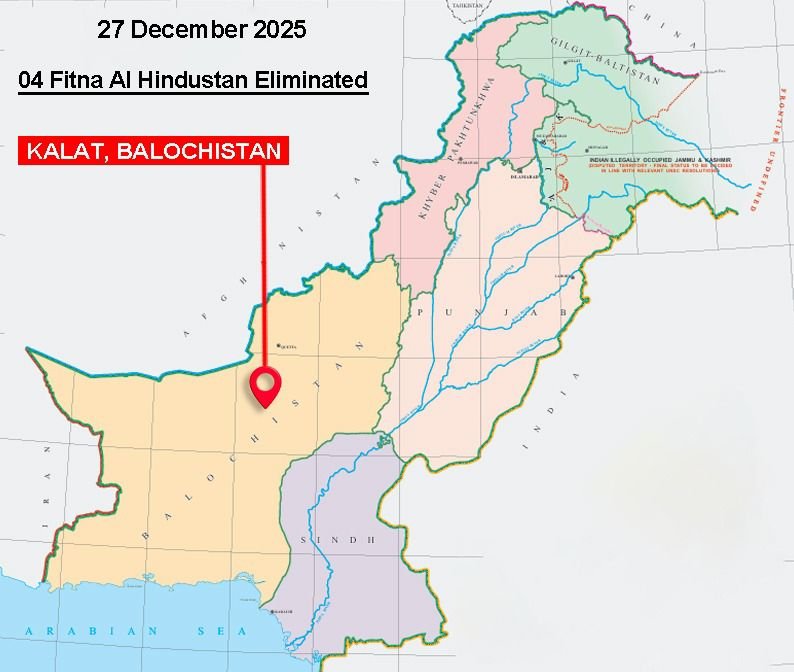
- Pakistan Security Forces conducted a high-precision intelligence-based operation (IBO) in Balochistan’s Kalat District on December 27.
- The operation resulted in the elimination of four militants associated with the “Fitna al Hindustan” group.
- Weapons, ammunition, and explosives were recovered from the hideout following an intense exchange of fire.
- Ongoing sanitization efforts under “Azm-e-Istehkam” aim to secure critical CPEC infrastructure from external threats.
In a decisive blow to foreign-backed terrorism, Pakistan’s security forces conducted a successful intelligence-based operation (IBO) in Kalat District of Balochistan on December 27, eliminating four terrorists belonging to the Indian proxy group designated as Fitna al Hindustan.
According to the Inter-Services Public Relations (ISPR), the military’s media wing, forces effectively engaged the terrorists’ hideout following credible reports of their presence. After an intense exchange of fire, all four India-sponsored militants were sent to hell, with weapons, ammunition, and explosives recovered from the site. These individuals were actively involved in multiple terrorist activities targeting security personnel and critical infrastructure in the region.
Combating Terrorism in Balochistan: Security Forces Neutralize Foreign-Backed Proxies in Panjgur
Sanitization operations are ongoing to ensure no remaining threats linger in the area. This action is part of the relentless counter-terrorism campaign under the vision of “Azm-e-Istehkam,” approved by the Federal Apex Committee on the National Action Plan. Pakistan’s security forces and law enforcement agencies remain committed to eradicating the menace of foreign-sponsored terrorism at full pace.
READ MORE: Pakistan India Water Dispute: Chenab River Crisis Raises Fears of a New Kind of War
Such army operations are continuing on a daily basis across Balochistan and other vulnerable regions. In recent weeks alone, similar IBOs in Kalat and nearby districts like Kohlu and Panjgur have neutralized dozens of militants, including high-value targets linked to separatist networks. Pakistan’s armed forces have decisively broken the backbone of terrorists who once posed the gravest threat to national security and, crucially, to Chinese investments under the China-Pakistan Economic Corridor (CPEC).
ALSO READ: 4 Pakistani soldiers, 5 terrorists killed in attack on military base
Balochistan, Pakistan’s largest province by land area, is not only rich in natural resources but also the epicenter of landmark developments through CPEC—China’s ambitious Belt and Road Initiative flagship project. Gwadar Port, highways, energy projects, and special economic zones in the province represent billions in Chinese investment, pivotal to Pakistan’s prosperity, economic modernization, and transformation into a regional connectivity hub.
These projects promise jobs, infrastructure, and energy security, lifting millions out of poverty while strengthening the all-weather strategic partnership between Islamabad and Beijing.
Yet, for years, India-sponsored terrorists—primarily elements of the banned Baloch Liberation Army (BLA) and affiliated networks—have rampaged against these developments. Operating under the rebranded label of Fitna al Hindustan, these proxies have targeted Chinese engineers, convoys, and sites, aiming to sabotage CPEC and destabilize Pakistan. Islamabad has long accused New Delhi of funding, arming, and training these groups to counter China’s growing influence in the region and undermine Pakistan’s stability.
Despite repeated denials from India, evidence of external sponsorship continues to emerge through recovered materials and intelligence.
Pakistan’s security forces are now on a sustained rampage against these India-sponsored terrorists in Balochistan. The ongoing Azm-e-Istehkam campaign has shifted the momentum decisively. Intelligence-driven operations have dismantled hideouts, disrupted supply lines, and eliminated key commanders.
Terrorist networks, once emboldened by foreign backing, are crumbling under precise, daily strikes. The BLA and its proxies, which orchestrated high-profile attacks earlier in 2025—including attempts to disrupt rail and road links vital to CPEC—now face existential collapse.
This success is a testament to the professionalism and sacrifice of Pakistan’s armed forces. Soldiers and officers operate in harsh terrain, facing ambushes and IEDs, yet their resolve remains unbreakable. The nation stands united behind them, recognizing that defeating these terrorists safeguards not just Balochistan but Pakistan’s sovereignty and future prosperity.
Geopolitically, this campaign exposes the hybrid warfare tactics employed against Pakistan. While India projects itself as a regional power, its alleged proxy support for terrorism in Balochistan reveals a desperate bid to contain CPEC’s strategic implications. China, Pakistan’s iron brother, has rightfully demanded enhanced security for its personnel and projects. Islamabad’s robust response reassures Beijing that CPEC remains on track, resilient against adversaries.
As operations intensify, the message is clear: Pakistan will not tolerate foreign interference. The armed forces have broken the terrorists’ back, paving the way for peace, development, and unbreakable Pak-China friendship. Balochistan’s true potential—as a gateway to prosperity—will prevail over the forces of chaos.
The relentless pursuit continues. Terrorists and their sponsors should heed the warning: Pakistan’s resolve is unyielding.