



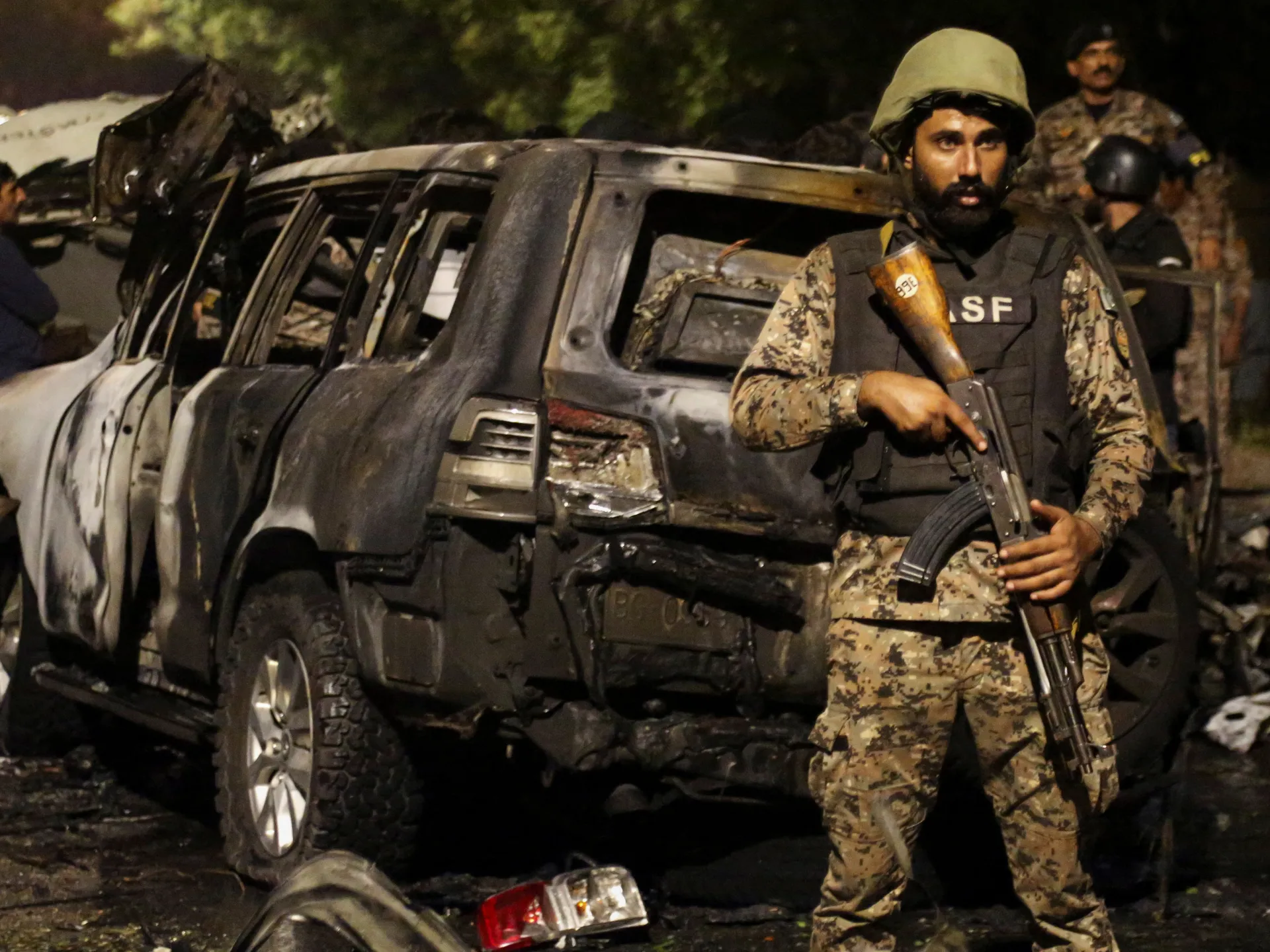
KOHAT, Pakistan — Pakistan is confronting what officials describe as a renewed wave of terrorism only days after conducting targeted air strikes against terrorists hideouts across the Afghan border, as a deadly ambush in Khyber Pakhtunkhwa (KP) killed seven people, including six police personnel and a senior officer, underscoring rapidly escalating security challenges in the region.
The latest attack, carried out Tuesday in Kohat district, targeted a police convoy near Shakardara Road. Authorities confirmed that the Deputy Superintendent of Police (DSP) of Lachi was martyred on the spot along with two guards after heavily armed assailants opened sustained fire on the vehicle.
Police officials later confirmed that multiple officers lost their lives in the assault, marking one of the deadliest recent attacks against law enforcement in Pakistan’s northwestern province.
Security forces immediately deployed additional contingents to the area, sealed surrounding routes, and launched a large-scale search operation to track down the attackers.
Escalation After Cross-Border Counterterrorism Strikes
The attack comes amid heightened tensions following Pakistan’s recent air strikes targeting terrorist sanctuaries across the Afghanistan border — operations Islamabad described as necessary to neutralize militants responsible for cross-border violence.
Security analysts believe the recent spike in attacks may represent retaliatory action by militant networks attempting to demonstrate operational capability following those strikes.
Officials say the pattern reflects a broader resurgence of coordinated militant activity across KP’s southern districts, historically vulnerable due to their proximity to mountainous border regions.
Gunmen kill five police in northwest Pakistan near Afghan border, police say
“This is not an isolated incident,” a senior security official said. “Pakistan is facing an adaptive enemy attempting to reassert itself after sustained counterterrorism pressure.”
A Week of Bloodshed
Tuesday’s attack follows a series of deadly incidents that have shaken Pakistan’s security establishment:
- Monday: Three Frontier Constabulary personnel were martyred in Karak district after terrorists launched an attack and ambushed rescue ambulances near Ghole Banda Dam, injuring rescue officials and destroying emergency vehicles.
- Last week: Eleven security personnel and a young girl were killed when an explosive-laden vehicle struck a checkpost in Bajaur district, leaving several civilians injured.
- Recent months: Repeated attacks on checkpoints and patrol units have targeted police and paramilitary forces across KP.
The growing frequency and coordination of attacks have prompted authorities to warn of a shifting militant strategy aimed at overstretching security resources.
Khyber Pakhtoonkhaw: Epicenter of Rising Violence
According to the Centre for Research and Security Studies (CRSS) Annual Security Report 2025, Khyber Pakhtunkhwa experienced a sharp rise in violence last year. Fatalities increased from 1,620 in 2024 to 2,331 in 2025 — an absolute rise of 711 deaths, accounting for more than 82 percent of the nationwide increase in militant-related fatalities.
Escalation, Fatigue, and Uncertainty: The Ukraine War Enters a Dangerous New Phase
Security experts note that terrorists are increasingly targeting police forces rather than military installations, aiming to weaken local governance and create psychological pressure in vulnerable districts.
KP Governor Faisal Karim Kundi strongly condemned the Kohat attack, paying tribute to the martyred DSP and accompanying officers.
“The police are fighting on the front lines in the war against terrorism and rendering immense sacrifices,” he said, calling their service a source of national pride while extending condolences to bereaved families and prayers for injured personnel.
Pakistan’s Frontline Role and Global Attention
For international observers, the renewed violence highlights Pakistan’s continuing role as a frontline state in the global war against terrorism, a position that has shaped regional security dynamics for more than two decades.
Diplomatic sources say reports of escalating terrorist attacks in Pakistan have echoed across major world capitals — including Washington, Paris, Brussels, Moscow, and Beijing — where policymakers closely monitor stability in South Asia due to its implications for regional security, migration, and counterterrorism cooperation.
Western and Asian security analysts warn that instability along the Afghanistan-Pakistan frontier carries consequences far beyond the region, affecting NATO security assessments, intelligence coordination, and global counterterrorism planning.
Pakistan has long argued that its security forces have paid one of the heaviest costs in combating extremism, with thousands of soldiers, police officers, and civilians killed since the early years of the U.S.-led war on terror.
Changing Nature of the Threat
Officials say militants are increasingly adopting hybrid tactics combining ambush warfare, improvised explosives, and emerging technologies such as drone-based reconnaissance and remote attacks — developments that complicate traditional counterterrorism responses.
The targeting of senior police leadership, analysts say, reflects an attempt to undermine morale and disrupt local security command structures.
“Attacks against policing leadership signal strategic intent,” said a regional security analyst. “Militant groups are attempting to project strength and regain relevance.”
Government Response So Far
Authorities have intensified intelligence-based operations across KP following the recent attacks. Security checkpoints have been reinforced, patrol patterns altered, and surveillance operations expanded.
Interior ministry officials indicated that coordination between federal and provincial agencies has been enhanced to prevent further escalation.
Government officials have also emphasized diplomatic engagement with neighboring Afghanistan, urging stronger action against militant sanctuaries believed to operate near the border.
A Security Challenge with Global Implications
For international audiences, the unfolding situation illustrates the evolving complexity of counterterrorism in South Asia. Pakistan’s security forces now confront a multi-layered threat shaped by geography, regional instability, and technologically adaptive militant groups.
As investigations continue in Kohat, the loss of senior police leadership underscores the human cost behind strategic headlines — officers operating on volatile frontlines where local policing merges with global counterterrorism efforts.
The latest attacks serve as a stark reminder that despite years of military operations and international cooperation, the fight against terrorism in the region remains far from over.